


Project No. 226580-CP-1-2005-1-LT-COMENIUS-C21
Project duration: 1 October 2005–30 September 2008
Project co-funder: EU Socrates Comenius program
Project coordinator: Jaunimo karjeros centras, LT
Project partners:
Šiuolaikinių didaktikų centras, LT
Miks ja Millepärast, EE
Euroform RFS, IT
A. Θ. ΚΟΛΥΒΑ & ΣΙΑ O.E., GR
Andragoški Zavod Maribor – Ljudska Univerza, SI
Universitetet I Stavanger, NO

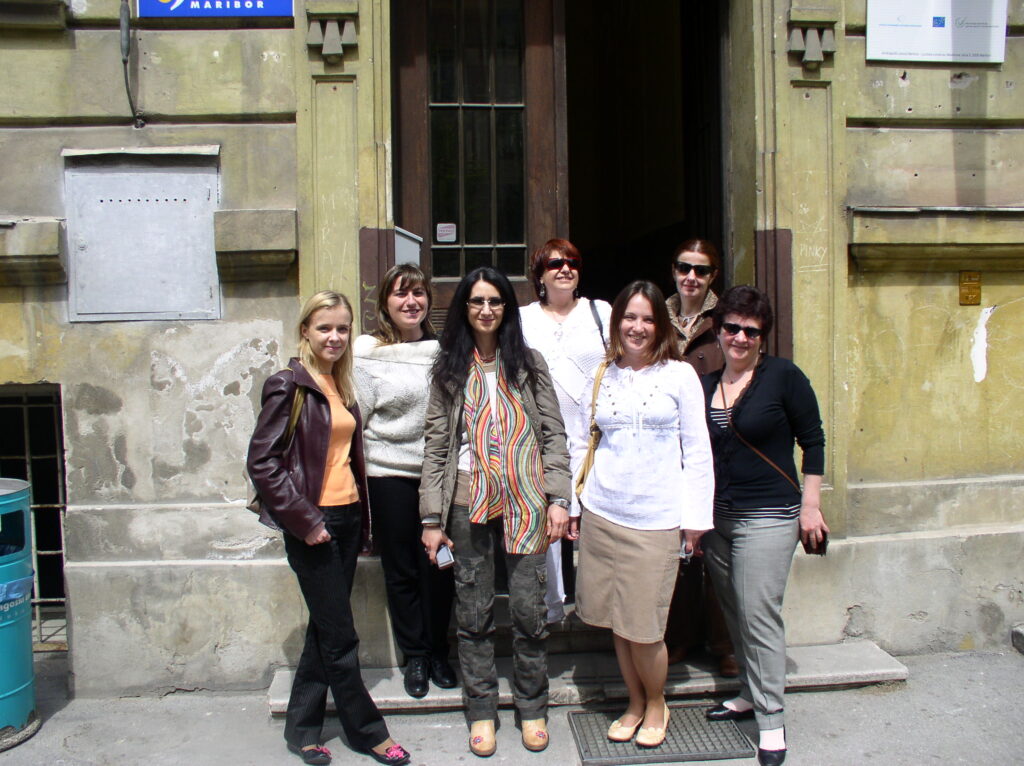
Project team
PROJECT RELEVANCE
The challenges faced by teachers who work with students with behavioral and emotional disturbances are enormous. Teachers need a partnership with parents, other students, and community agencies in order to succeed with these students. This project focuses on the interdependent relations among these groups. The education principle is to help every student adjust normally to the school environment and to succeed in life. This can only be accomplished if the school, community and parents work together.
Does the school carry this mission today? Does it address the increasing societal expectations of education in a complex and modernizing society? We think not. The students in the schools in countries that joined in the partnership have a similar range of problems. They can be grouped into 3 main problematic areas – attentional or academic, behavioural and emotional disturbances. These problems occur as a result of child abuse and neglect, crime, health (HIV/AIDS/ drugs/ sexual problems/teenage pregnancy), violence in school, in street and at home, homelessness and socio-economic disadvantages, unemployment and an increasing immigrant population.
Students with these problems often become a burden to society. They cause truancy, show poor achievement levels, have absence of motivation and vocational/ professional orientation, have anxiety and dependence, and demonstrate school and family disruption and interpersonal conflicts. The school alone is incapable of addressing this broader spectrum of students’ needs. Co-operation among different players inside the school is insufficient. At present, the community is not involved. The communication between different sectors of the community is weak. Parents must also be involved. They need to reinforce the concepts that the school and community are developing. In addition, the peers in the school are not being trained so that they can help the other students. This is a loss of manpower. Students can relate to their peers in different ways than teachers or community leaders can. It is important to utilize all institutions.
PROJECT AIMS
- To encourage teachers to offer students at risk the opportunities to learn how to manage their own actions and become more self-reliant.
- To help students become healthy citizens, both in the classroom and in society.
- To encourage student peer participation in behaviour change, self-management, correctional counselling and school governance.
- To develop school and community partnerships.
PROJECT OBJECTIVES
- To develop in-service training courses that strengthens the role of the teacher as the facilitator and train teachers, community agency personnel, parents and students to assist in the social and emotional well-being of students at risk.
- To create a strategy for a safe and secure school environment.
- To assist community agencies in the cooperative role of sharing responsibility with schools.
- To train parents in skills so that they can work with their own children more effectively.
- To provide tailored attractive programmes that meet young people’s individual needs and their aspirations.
PROJECT TARGET GROUPS
- Teachers and other school professionals.
- Peers of students.
- Parents.
- Community service agencies.
PROJECT ACTIVITIES
Situation analyses and needs assessment. 2005 November–2006 March.
Partners collect information and best samples from their countries on school academic and social behavior management strategies. During the first partner meeting project coordinator and content developers share gathered information, exchange their ideas, compare needs and state general findings on joined project strategy.
Building up social partnerships and development of in-service teacher training course framework. 2006 March–July.
Project managers and consultants paid study visits to partner schools. Together with social partner teams and school communities they discussed training course methodologies. Course developers analyzed examples of various training courses and developed the draft of the framework, that will be reviewed by partners and evaluate by external experts.
Development of multidisciplinary training course, reference materials and ICT tools. 2006 July–2007 January.
Partners select in-country course developers from various institutions and of various backgrounds. Multidisciplinary teams developed mini training courses and course materials for every specific target group. Prepared materials were translated into the project language (EN). ICT specialists opened e-communication forum – Project Management System and e-learning Management System.
Workshops in schools. 2007 February–May.
Course development teams presented prepared mini course modules to partner schools and prepared detailed plans for testing of the course module in schools. School teachers tested and evaluated mini courses. Teams revised and improved the courses according to the evaluation results. Coordinator collected and analysed all tested and evaluated course materials from partner countries. Project developers compiled one training course module putting together mini courses on different specific issues for all target groups.
Evaluation and preparation of final version of the course and training materials. 2007 May–December.
Internal experts in partner countries and external experts from USA and Lithuania evaluated the course and present recommendations for improvement. Project developers analyzed evaluators’ recommendations, amended the course and prepared its final version.
International trainings of trainers (ToT). Creation of joint training programme. 2007 December–2008 January.
Each country selected 2 trainers for the pilot in-service training. Selected trainers prepared for a training on a specific issue. Each country trainer delivered a mini training to all partners. All partners worked as trainers and facilitators during the ToT. Trainers exchanged their knowledge on the content of the course and training skills. Partners and project developers selected best trainers and form international training teams. Project developers and trainers drawed final content outline for the unique training course module. Coordinators and experts put all specific topics together into one course.
Publishing of training materials. 2008 January–May.
All project materials – Course Guide, Module Handbook with handouts for students, Peer Counseling Guidebook, Reference Guides were published in EN national languages (LT, IT, GR, SI, EE).
Training of Teachers-Multipliers. 2008 May–August.
Partners selected trainees – future trainers-multipliers from local schools and other institutions all over the country. Pilot trainers delivered 4 days training courses in national languages to local trainees – future trainers. After the training the trainees have to use training methods and materials in school practical work. They prepared written assignments for the assessments. Local trainers, coordinators and experts provided consultations and assistance during their practical work.
Dissemination of project products and results. 2008 August–October.
During the final partners meeting in Lithuania partners and experts evaluated project and it’s results, discussed dissemination and further project continuation issues. Coordinators prepared dissemination plans. Project coordinator organized the final conference in Lithuania. Developers presented all project products to conference participants. All pilot schools, experts and trainers from each participating country took interactive part in the conference via Internet.
PROJECT INTELLECTUAL OUTPUTS
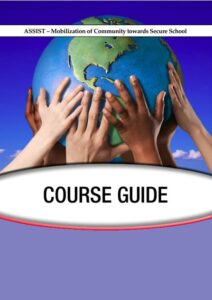
Mobilization of Community towards Secure School: Corse Guide, 2008
The aim of the training course (24 hours) is to provide new skills for teachers, so they could help students to become equipped with skills so that they know how to resist negative peer pressure, to learn how to change their own behavior, adjusting to new settings, becoming more self-assured, and resolving conflicts in a healthy manner, to learn how to relate to their teachers, their parents, and their fellow classmates., to become less dependent on others and have direction and purpose in life. The training course is dedicated for teachers, wishing to introduce new working methods in their schools, psychologists, social pedagogues, and other school who are directly responsible for development of a safe school environment.
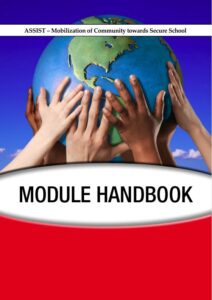
Mobilization of Community towards Secure School: Module Handbook, 2008
The Module Handbook contains the methodological material and tasks used in the training. The handbook consists of separate sections devoted to specific issues: the concept of conflict, conflict prevention, methods to help students resolve conflicts, game therapy methods, counseling or peer support methods, skills needed for counseling and mutual support, group work, leadership development, problem-solving strategies and methods, and training using video material. The handbook concludes with several examples of training evaluation forms that can be used to analyze specific parts or the entire training.
Mobilization of Community towards Secure School: Play therapy in Schools. Tips for Getting Started, 2008
This publication is intended for teachers, educational support specialists, parents, and anyone who helps or wants to help children, adolescents, and young people solve various problems they encounter at school or in other close environments. It describes the principles and methods of play therapy and how they can be used in schools and social services. Play therapy is an effective counseling method that helps children correct their behavior, improve their self-awareness, find acceptable ways of communicating, establish meaningful relationships, regain spiritual balance, and develop emotional literacy. Children are often unable to describe their thoughts, feelings, and perceptions of the inner and outer world, but during play they establish an active connection with the therapist, which allows them to express and understand complex and painful experiences, and to comprehend confusing feelings and sad events that they have not had the opportunity to properly understand.
Mobilization of Community towards Secure School: Peer Counseling Manual, 2008
This publication is intended for teachers and educational support specialists who wish to implement a peer counseling program at school. The manual provides a concise overview of the essential principles and theoretical foundations of counseling, illustrated with practical examples. The book consists of seven interrelated parts. It begins with the most general concepts—the theoretical foundations, the definition of terms for planning a counseling program at school, and the assessment of needs. It then goes on to present various types of conflicts and ways of resolving them, strategies, and methods illustrated with specific case examples.

Mobilization of Community towards Secure School: Set for Students, 2008
This is additional methodological and handout material, a set of interactive games for student assistants, to use for practical activities. The student workbook contains tasks for getting acquainted, promoting cooperation, conflict resolution, self-awareness, leadership skills development, and other tasks carried out as part of the program “Mobilization of Community towards Secure School”.
Mobilization of Community towards Secure School: The Family School Calendar, 2008
The Family School Calendar is a methodological tool for parents, designed to draw their attention to their children’s behavior, desires, hobbies, and the environment in which they learn and interact with their peers. It contains advice and short tasks that can help prevent emotional, behavioral, and communication problems faced by today’s students.
PROJECT RESULTS
The project encouraged teachers (and any other school professionals), student peers within the school, community agencies (child protection institutions, local authorities, social services and legal institutions) and parents to work together so that every student succeeds both in the school environment and in life outside the classroom. Together all four groups designed activities that develop links among them. Through the collective effort, students at risk will improve their academic and social behaviour. Ultimately the achievement level of the students will increase. Such partnership will help teachers to overcome their narrow focus on student’s problems. It will provide support teams that will better formulate strategies and plan actions to implement changes. Finally it will add an innovative aspect to many community agencies, strengthening their position in their community.
- Teachers and other school professionals (psychologists, social educators, special needs educators)in 18 partner countries schools were trained how to deal with the problems, occurred in schools: how to identify, asses who needs the help, how to look for help, how to cooperate with other community members, how to develop effective school programmes and etc.
- Peers of students (about 42–46) were trained to work effectively with other peers that need help. They have been taught peer counselling and negotiation skills, conflict management and other social skills.
- Parents (about 200) were taught to identify and recognise their child’s problems, to be able to find appropriate help and consultancies, legal advices, to be able to talk openly about the issues. They have learn negotiation skills so that they can work more effectively with their children, to get basic knowledge about Play Therapy.
- Community service agencies from governmental, voluntary and business sector (about 16) have work in cooperation with other groups in order to collaborate for solving occurred problems. They delegated practically applicable counselling skills and knowledge to teachers, students and parents. They have direct access to students at risk through their peer counselling programmes. They will be in charge of developing and promoting sharing of resources, offering effective negotiation and communication skills to volunteers in the field and services of their agencies personnel to help teachers and parents to overcome resistance and barriers related to drug and sex education and other relevant problems.

Funded by the European Union. Views and opinions expressed are however those of the author(s) only and do not necessarily reflect those of the European Union or the National Agency. Neither the European Union nor National Agency can be held responsible for them