



Project No. 2023-1-LT01-KA220-SCH-000156521
Project duration: 4th September 2023–3rd November 2025
Project co-funder: EU program Erasmus+
Project coordinator: Šiuolaikinių didaktikų centras (Lithuania)
Project partners:
Mokyklų tobulinimo centras (Lithuania)
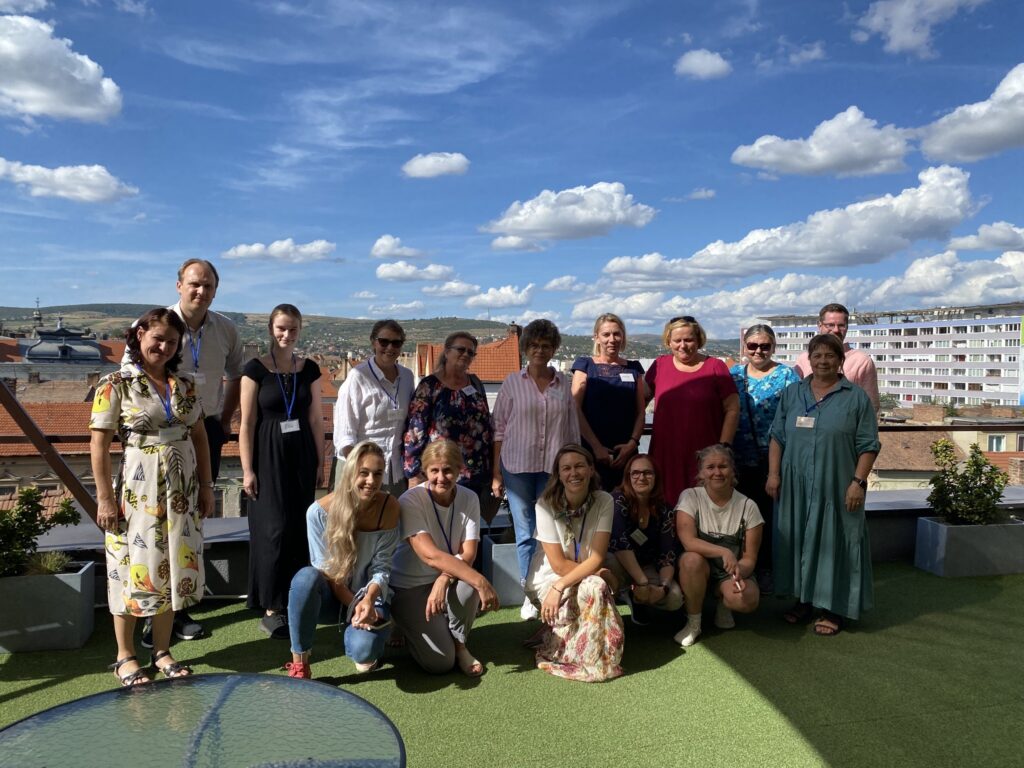
Project team
RELEVANCE OF THE PROJECT
Reinforcing the development of a range of key competences is in line with the EU Council Recommendation on Key Competences for Lifelong Learning, 2018:
“The development of key competences, their validation and the provision of competence-oriented education, training and learning should be supported by establishing good practices for better support of educational staff in their tasks and improving their education, for updating assessment and validation methods and tools, and for introducing new and innovative forms of teaching and learning”.
Therefore, basing itself on the experiences of the last decade, this Recommendation should address the challenges in implementing competence-oriented education, training and learning.
Research shows that student achievements in Lithuania and Romania are not good enough and lack systematic growth (PIRLS, OECD PISA). The OECD’s “Education 2030” project’s analyses (Education 2030. OECD, 2018) show that certain personal qualities, skills and values are insufficiently included in the Lithuanian and Romanian Framework Programs, or are included of only one subject, or are not included at all. Although competences are very often referred to in the general frameworks of different subjects the above-mentioned data on students’ achievements show insufficient effective development of these competences.
Lithuania developed new school curriculum aimed to promote inclusive, high-quality education for all students. New descriptions of general competences have been created, but there is no evaluation system presented. Teachers (at pre-service and in-service) lack knowledge and skills how to plan, deliver competence-based curriculum at school and at class level. New curricula and a description of general competences entering into force from new academic year in 2023. School communities face a huge challenge not only to develop competences, but also to assess them.
While the competence-based national curriculum has been introduced to the Romanian education system over a decade ago, teachers in secondary education still focus on knowledge and content mastery, and are disoriented when it comes to competence assessment. They complain of too much content `to be covered`, and therefore claim that they do not have time to develop competences, although, in recent years, the national evaluations also are starting to focus on assessing competences. However, the overall education system – including pre-service teacher education – is still not systematic and coherent in preparing and assisting teachers to assess competences and support the development of students’ competences.
Finland is a model for many countries on how to focus on overall development of student and his/her competences. In Finnish education, transversal skills (competencies) are integrated into the national core curricula along the subject objectives. The competencies are taught and assessed within the subject assessment, but assessment is still a challenge.
PROJECT AIM
The project aims to support teachers, school leaders and other pedagogical staff in development and assessment of students’ competences, for the progress and success of all and each single student, and promote an inclusive approach to education.
This is to be achieved by developing and testing a universal competency assessment model at classroom/subject and all school levels.
PROJECT OBJECTIVES
- Strengthening the knowledge of teachers and the pedagogical communities on competency development and assessment in the EU and other countries around the world, based on scientific knowledge and good practice, through the development of a Compendium of summarized and tailored scientific literature and Report on in-country documents and existing practices.
- Providing a universal tool for assessing competences by development of a methodological Model and Guidelines for its piloting in partner countries.
- Supporting and sustaining a culture of professional sharing, mutual learning among teachers and pedagogical communities by teaching and learning together (nationally and internationally) and by putting competency assessment practices in a Set of best Practices.
- Providing Recommendations for teachers, educators, schools and education policy makers on competence assessment.
PROJECT TARGET
Primary target audience: teachers, school leaders and other pedagogical staff.
Secondary target audience: educational policy makers.
Beneficiaries: students of all schooling levels.
PROJECT INTELLECTUAL OUTPUTS
Compendium of scientific literature on competence development and assessment (2024)
This Compendium of scientific literature is prepared for general education teachers to help them better understand the importance of developing and assessing competences in daily school life. Since the term “competence” is itself a confusing one, with several similar meanings, we first attempt to give a clear answer to what is meant by “competence”, “competence development” and what are its components. We also provide evidence and arguments for the need for competence development. Finally, we discuss possible ways of assessing competences and the evidence of their effectiveness.
Brief review of competence development and assessment policies and practices in general education. Cases of Finland, Lithuania and Romania (2024)
Competence education is at the core of the general education content in Finland, Lithuania and Romania, but each country have taken different approaches to developing and implementing a competence-enriched curriculum. In this paper it is explore the origins and development of the competence-enriched curriculum in each country, as well as the representation of competences in their national curricula. There it is also examined the challenges associated with competence development and assessment, and identify successful practices that can be shared and learned from. This review will contribute to a better understanding of national policy orientations and experiences of their implementation in schools and classrooms.

COMPASS Model and Guidelines for the development and assessment of generic competences (2025)
In this document, it is introduced a model for the development and assessment of competences, which is symbolically named COMPASS. The intention is to provide guidance for planning the development and assessment of competences, rather than a rigid framework that overlooks contextual differences.
The COMPASS Model aims to be universal and adaptable to any national curriculum. Different countries’ curricula and legislation use different names for competences, provide different configurations and lists, and emphasise different competences, because of the different approaches to competence development. The COMPASS Model is versatile so it can be used to design, implement and assess learning experiences aimed at developing competencies. The assessment practices and examples presented in this document focus on the development and assessment of the most common generic competences, which encompass a larger number of individual competences specified in national curricula.
The COMPASS Model Implementation Guidelines are designed to explain in more detail how to plan, how to provide opportunities for learning and acquiring competence, how to evaluate competences. The Guidelines also provide a concrete example of how the COMPASS Model can be implemented in a specific educational activity.

Set of best practices using the COMPASS Model of competence development and assessment (2025)
The present volume is a selection of 13 good practice examples shared by teachers actively engaged in the COMPASS project. Under the guidance of mentor teachers trained within the project, these teachers used the COMPASS Model and Guidelines for the development and assessment of generic competences. They were guided by the Model to plan and teach lessons, and assess learning in a variety of school contexts – in curricular, cross-curricular and extracurricular activities, with students of different age groups – from primary school to upper secondary, including vocational education, within various school disciplines – from language and literature to science and social studies, as well as technical disciplines. The teachers and mentor teachers who described the practices presented in this collection come from the three countries where the COMPASS project has been implemented: Lithuania, Finland and Romania.
We hope that teachers will find the good practice examples inspiring to plan lessons, teaching materials and assessment instruments, striving to create the best conditions for students to develop their generic competences.
We also hope that head teachers, teacher trainers or a mentors will find our publication useful as a guide their school staff or fellow teachers through professional development in the specific domain of students’ competence development and assessment.

National collections using the COMPASS Model of competence development and assessment: Lithuania, Romania, Finland (2025)
The purpose of these publications is to present national collections of best practice – examples of using the COMPASS Model of competence development and assessment prepared by schools participating in the project in Lithuania, Finland, and Romania. Competence development and assessment activities in schools were coordinated by school representatives – COMPASS project mentors, who, together with other teachers, planned and implemented educational cycles aimed at developing students’ competences. The authors of the practical examples presented in the publication are practicing teachers who have described real educational episodes implemented with specific students. The examples reveal that we can develop and assess competences at all levels of education, in all subjects, and in various areas of school life, but this requires purposeful long-term planning. The examples also reflect the fact that the development and assessment of competences is not only a matter for individual teachers, but also for the educational policy of the entire school, where teachers collaborate with each other, involving students and parents. We hope that by reading the examples described in this publication, teachers will gain more professional confidence and find useful ideas that will inspire change in their schools and classrooms.

Recommendations on generic competences development and assessment (2025)
Although it is often claimed that contemporary education is competence based, in many cases it is merely competence enriched. The analysis of scientific literature and in-countries documents, as well as existing practices, conducted by the COMPASS project team, revealed that competence development, and especially assessment, is still complicated.
The experience gained by all participants during the project made it possible to identify and highlight several key aspects which might help to implement competence-based learning and assessment more smoothly and effectively. These aspects include both educational policy and educational practice – in fact, the creation of a certain culture that enables the consistent development of competences, provides opportunities to demonstrate them, and ensures that they are properly assessed and nurtured throughout the rest of the life.
PROJECT RESULTS
It is expected to strengthen the provision of inclusive and quality education; to support national education reforms in partner countries; to improve the professional competences of project staff and participants; and to increase the knowledge and skills of teachers in competency development and assessment.
PROJECT DISSEMINATION
D. Penkauskienė. COMPASS In support of students’ competence assessment
N. Ouakrim-Soivio & P. Nilivaara. Continuous assesment and competences
M. Kovacs. COMPASS – a model of competence development and assessment
T. Clucerescu. The challenge – living with technology
A. Petriuc. Integrating the competence of interaction and relationship in technical teaching
G. Čapkauskas, G. Šliumpienė. Grade 3/4 example – lesson cycle topic “Family budget planning”
A. Rafanavičius, N. Barauskaitė-Šarkinienė. Developing cognitive competence in physics classes
A. Huopainen. Observations and insights from the practical implementation of the Compass model
M. Ryhänen. Managing and taking care of oneself: Healthy eating habits in school
A. Huopainen. Designing and creating winter-themed postcards with 4th graders
Discussion „Development and Assemment of Generic Competences: How Do We Do it in Lithuanian General Education”, 2025
Discussion “How should the culture of assessment in schools change?”, 2025 (Automatic EN subtitles available)

Funded by the European Union. Views and opinions expressed are however those of the author(s) only and do not necessarily reflect those of the European Union or the National Agency. Neither the European Union nor National Agency can be held responsible for them.