




Project No. BPD2004-ESF-2.4.0-01-04/0070
Project duration: March 2005–February 2008
The project was funded by the European Social Fund and the Republic of Lithuania co-financing funds
Project aplicant: Association „Naujos jungtys”
Project coordinator: Modern Didactics Centre (member of Association “Naujos jungtys”)
Project partners:
Vytautas Magnus University
Trakai District Police Commissariat
Elektrėnai Municipality Education Services Centre
Kaunas Union of Youth Organizations, association “Apskritasis stalas”
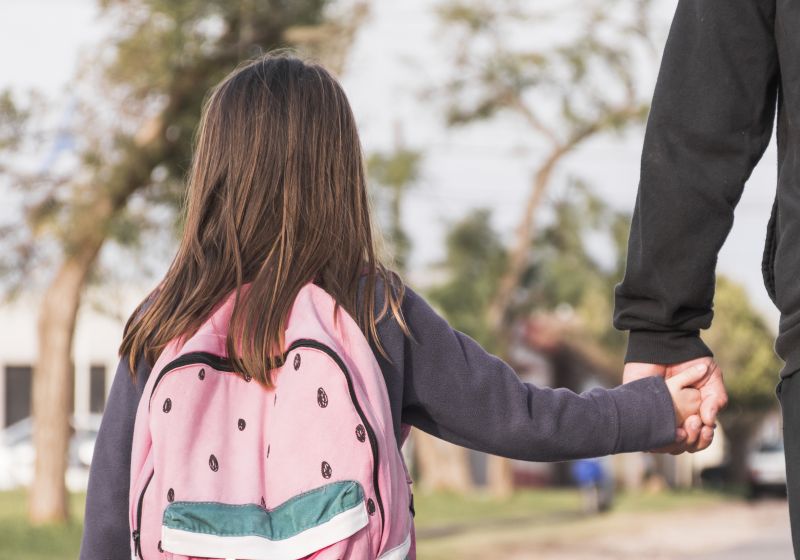
Freepik.com photo
PROJECT RELEVANCE
Student dropout is a loss not only for the education system but for the entire State of Lithuania. Due to rapidly changing economic and, especially, social conditions, the country is seeing an increase in the number of children who struggle to adapt to school, lack motivation to learn, or avoid attending school altogether for various reasons.
This project aims to develop and test preventive mechanisms and alternative programs in the regions that encourage young people to remain in the education system until they acquire a professional qualification. This includes creating an attractive learning environment to increase the motivation and academic responsibility of students who tend to avoid school, improving the quality of education in the regions, and mobilizing educational staff, specialists from various fields, governmental and non-governmental organizations, business partners, and local communities for collective action.
The results of the project will directly affect the regions of the participating organizations: Vilnius, Kaunas district, Panevėžys, Skuodas, Elektrėnai, Trakai, Šalčininkai, and Radviliškis. These regions differ in their geographical location, population size (including the number of students), and infrastructure. Such diversity will allow for a comprehensive testing of the model developed by the project, as well as the comparison, summarization, and dissemination of the results. By working with local communities, municipal institutions, and non-governmental organizations, and by mobilizing the efforts of all local stakeholders, the widest possible accessibility of the final project results will be ensured.
PROJECT AIM
Development and piloting of preventive mechanisms and alternative programs designed to encourage young people to remain within the education system until they acquire a professional qualification in the regions, incorporating the creation of attractive learning environments based on the principle of family-school-community collaboration.
PROJECT OBJECTIVES
- Summarize best practices from Lithuania and other countries in working with children who avoid attending school.
- Identify the causes of school dropout and non-attendance in the participating municipalities and conduct comparative and needs analyses.
- Develop long-term strategies for participating municipalities to integrate school-avoiding children and youth into the education system using alternative educational models.
- Establish prerequisites for participating municipalities to develop social support models, mobilizing local community resources for strategic partnerships aimed at active problem-solving, increasing student motivation and personal responsibility, and creating attractive learning environments.
- Create qualification programs and study modules for working with school-avoiding children and present them to university lecturers and practicing educators.
- Enhance the qualifications of teachers and other specialists by providing them with the necessary knowledge and skills required to work with students who avoid school.
- Develop and disseminate peer-to-peer participation models for addressing learning motivation challenges.
PROJECT TARGET GROUPS
Representatives of Vilnius, Kaunas district, Panevėžys, Skuodas, Elektrėnai, Trakai, Šalčininkai, and Radviliškis municipalities; formal and non-formal education institutions; school teachers and students; and higher education lecturers and students.
PROJECT INTELLECTUAL OUTPUTS
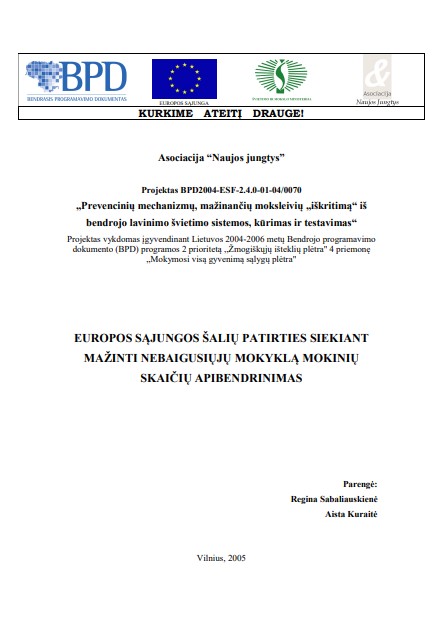
Analysis of European Union Countries’ Experience in Reducing Dropout Rates from Educational Institutions (2005)
This document provides a comprehensive overview of best practices from various foreign countries (Estonia, Finland, Germany, the United Kingdom, and the Netherlands) to identify effective social prevention mechanisms for addressing early school leaving and other social risks. The analysis focuses on inter-institutional cooperation, early diagnostic tools, and the integration of preventive services at the local level. The aim of the publication is to provide recommendations for Lithuanian social policy-makers on how to improve existing support systems based on proven models from other countries. The document emphasizes the importance of a systemic approach, integrating the education, social protection, and employment sectors to ensure sustainable youth well-being and the reduction of social exclusion.
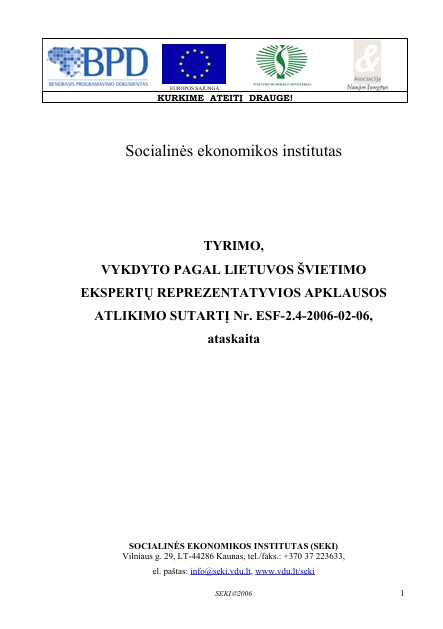
Representative Survey of Education Experts in Lithuania (2006)
This document presents the results of a qualitative study based on an extensive expert survey regarding the state of social prevention mechanisms and their potential for improvement in Lithuania. Education, social protection, and healthcare specialists who participated in the study evaluated the existing legal framework, inter-institutional interaction, and the primary obstacles hindering effective social risk prevention. The experts emphasize that the country still lacks a systemic approach to prevention, with support often being fragmented and focused on addressing consequences rather than early intervention. The analysis highlights the need to strengthen professional competencies, ensure sustainable funding sources, and develop a unified data monitoring system. The conclusions of this publication serve as a valuable set of recommendations for policy-makers seeking to create a more effective, person-centered network of preventive services.

Problems and Needs of School-Avoiding Children (2006)
This monograph seeks to understand why children avoid attending school, searching for answers at both theoretical and empirical levels. A particularly significant and novel aspect of this work is that the analysis of school avoidance is constructed based on the problems and needs expressed by the children themselves. As the discourse of the sociology of childhood is not yet well-developed in Lithuania, we have no doubt that the content of this monograph will spark discussions. In the authors’ view, these are truly necessary. The children’s experiences encountered during the empirical research revealed the depth of the issue and a conflict between adults and children that remains essentially unresolved – or is addressed in ways that ignore the children’s needs for safety and the challenges they face. We can choose not to see problems if we do not look for them. We can claim they do not exist, but that will remain part of a painful social reality. Therefore, the authors of this monograph invite us to abandon the preconceived notion that children are unreliable, ignorant, weak, or unworthy of attention. For some, this will be truly difficult, but it is essential; otherwise, no progress will be made in solving the problem.

Prevention of School Attendance Problems (2008)
This publication presents qualification and professional development programs for subject teachers, class tutors, teacher assistants, non-formal education specialists, special educators, social educators, and psychologists who develop and implement programs related to school non-attendance and dropout issues within the general education system. These programs can serve as a benchmark for teachers and other school specialists in creating individualized teaching, learning, and non-formal education programs. The publication features five programs:
- A five-module program for educators and class tutors.
- A program for school specialists (special educators, social educators, psychologists, and teacher assistants).
- A program for non-formal education specialists working in schools as well as other educational institutions.
- A program for students (those acting as peer consultants, assistants, group leaders, or providing peer support to their friends, etc.).
TV Program “The Missed Lesson” (2007)
This playlist features a series of 5 TV episodes titled “The Missed Lesson,” where experts, educators, and students discuss the causes of school absenteeism and potential preventive measures. The shows delve into the issue of students dropping out of the education system, analyzing psychological factors, family influence, and the importance of the school’s microclimate.
Municipal Strategies, Preventive Models, and Mechanisms for Reducing the Number of School-avoiding Students
Municipal strategies emphasize the necessity of creating a safe school environment and strengthening student motivation, taking into account their individual psychological and social needs. The developed models offer concrete tools to help identify at-risk children in a timely manner and provide them with targeted pedagogical and psychological support. The primary focus of the preventive mechanisms is early diagnostics and close inter-institutional cooperation between educational institutions, families, and social partners. These initiatives aim not only to reduce the number of non-attending students but also to ensure long-term student engagement in the educational process.
PROJECT RESULTS
- The research conducted and the analysis of experiences from Lithuania and other countries have helped educators and municipal communities identify the causes of school avoidance and potential solutions to this problem.
- The preventive strategies developed by the municipalities have mobilized the local communities, outlined common operational principles, and established partnerships between various organizations.
- Municipal education departments, schools, and other institutions will now be capable of identifying and addressing issues related to school avoidance and non-attendance.
- Within the participating schools, a more attractive psychological and pedagogical learning environment has been created; students are provided with psychological counseling and necessary material support (learning tools, clothing, meal subsidies, etc.).
- In the participating towns and villages, students have been offered new learning spaces beyond school walls, including youth clubs, community cultural and sports centers, as well as institutions for extracurricular and non-formal education.
- A teacher training study program focusing on the education of children with special needs has been implemented in two higher education institutions specializing in teacher training.
- A professional development program for educators and specialists working with children has been created, specifically designed for working with school-avoiding students. 280 educators and specialists have improved their qualifications, enabling them to work more effectively with children facing these challenges.