



Project No. 510477-LLP-1-2010-1-PL-COMENIUS-CMP
Project duration: 1 November 2010–31 October 2012
Project co-funder: EU Comenius programme
Project coordinator: PCG Polska Public Consulting Group (Poland)
Project partners:
Šiuolaikinių didaktikų centras (Lithuania)
Institut für Informationsmanagement Bremen GmbH (Germany)

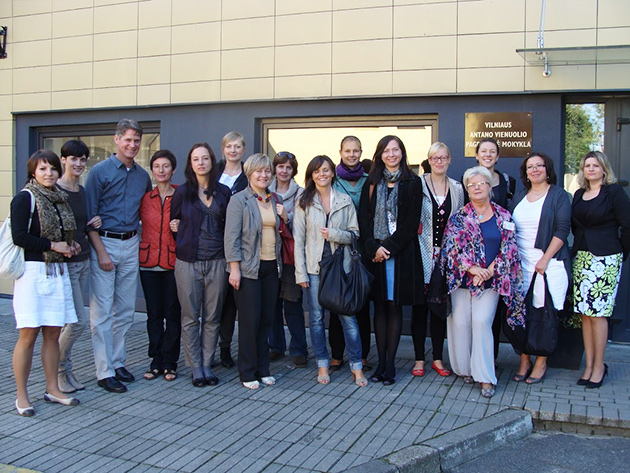
Project team
PROJECT RELEVANCE
Data has become increasingly important in an age of increased accountability and significant school autonomy. As schools are being held more accountable for the education they provide the data-driven decision making is becoming increasingly important. Data can be used to formulate appropriate and effective education policy and to measure the effectiveness of programmes and instructional interventions. Data can also be used to measure individual student progress, guide the development of curriculum, determine appropriate allocation of resources and to report progress to the community. But despite the leverage that can be gained by using data effectively, many schools still struggle with data-driven decision-making. Despite the importance of using data, very little training exists throughout Europe to help school leaders and their staff use data effectively. The DATAUSE project was created to build the capacity of school leaders and staff to establish learning communities where data is used to improve educational outcomes.
The Data Use theory of action recognizes that education policy has the greatest influence on data use in schools. School policy affects all other components by creating conditions, incentives, and/or barriers. The Data Use Activity Theory distinguishes between three types of data-based decisions: school improvement (e.g., policy improvement, teacher professional development, flexible allocation, etc.), accountability (e.g., compliance with official requirements, communication with stakeholders), and organizational improvement (e.g., progress monitoring, adaptation of instructions). If data is used for these three different purposes, it is possible to achieve all learning outcomes. The learning of school teachers, in turn, affects the learning of students (e.g., their interest in their own learning and improvement of learning outcomes
PROJECT AIM
The DATAUSE project was created to build the capacity of school leaders and staff to establish learning communities where data are used to improve educational outcomes.
The aims of the project included:
- helping school leaders establish a vision for using data to improve educational outcomes;
- increasing the understanding of how to maximize use of available data;
- building key data use skills among school leaders;
- helping leaders use data to inform decisions.
PROJECT OBJECTIVES
- research and documentation of best practices for using data to improve instructional outcomes;
- building and administering a data use survey instrument that measures the extent of data use in schools both at the beginning and the end of the project;
- designing and piloting a data use professional development curriculum for school-based professional learning communities;
- delivering a training and materials on data use to the professional learning communities;
- collecting feedback from schools and refining the Data Use Course content and structure.
PROJECT TARGET GROUPS
The project’s short term target groups included school-based professional learning communities that were established for the purpose of the project in 10 participating schools, based in 5 partners’ countries – Poland, United Kingdom, Germany, Lithuania and the Netherlands.
Long-term target groups identified for this project included educational leadership training institutions and organizations, district and regional administrators and leaders, research institutions, school leaders and teachers, and ultimately, students.
The benefits for the long term target groups included developing their awareness about the available suite of tools, materials and methodologies to support schools in reaching better outcomes. The envisioned impact upon this group was to nurture a new approach to school improvement. Long-term target groups were reached by numerous dissemination activities performed by project consortium both nationally and internationally.
PROJECT INTELLECTUAL OUTPUTS
SURVEYS OF USE OF DATA FOR SCHOOL IMPROVEMENT
Comparative Analysis Data Use in Germany, the Netherlands, Lithuania, Poland and England (2011)
All partners conducted case study reports which were subject to a cross case analyses. All the results were compared and contrasted and compiled into a comparative report which provided a basis for developing a Data Use Theory of Action constituting the framework for the Data Use Survey and development of the Data Use Course materials. Important outcomes of the case study indicated that in all 5 countries school staff believe data use to be important, and that it can lead to school improvement in terms of increased student achievement. Moreover, we found that schools declare the need for support in the use of data, and that several factors need to be taken into account in order for schools to use data effectively, i.e.: school leader support, the need for training, and the importance of teacher collaboration.
Download EN
Data Use Survey (2011–2012)
From the state-of-the-art research, a set of 78 indicators on data use were developed and later categorized according to the Data Use Theory of Action. Two surveys were conducted among schools: one before and the other after the Data Use Course implementation.
In case of the first survey, conducted in 2011, it was administered to 398 recipients, in 5 countries, in 13 schools. The results of the survey for each of the schools allowed for school’s self assessment and identifying the areas of strength and areas of weaknesses in each of the categories according to the Data Use Theory of Action. In 2012, the survey was re-administered through the online tool to the schools taking part in the project. In total, there were 229 recipients in 5 countries. The results allowed for the schools to determine their progress level in terms of data use during the Course.
Observations from the first survey administration in 2011:
The results of the first survey proved the rationale for the project. Cross-country factor analysis has shown that “User Skills”, “User Attitudes” and “Using Data for Instructional Development” are not pivotal categories in the data use practices in the schools proving the rationale for the project.
Observations from the survey re-administration in 2012:
Second administration of the survey provided results on the cross-country level and showed an improvement in all of the survey categories. Integration of school leadership into the course helped improving qualitative and infrastructural bases for data use.
All these results provided a great basis for the analysis of the change and progress in data use in the participating schools. The analyses provided also a statistically valid measure for project success as they proved achieving the project goals as measured against the success indicators.
Download EN
DATAUSE COURSE AND METHODICAL MATERIALS
Using Data Professional Development Course: Program and Methodical Materials (2011)
The professional development course is a convenient tool for European educators to use in improving their professional skills in order to achieve better teaching and learning outcomes. The course includes both activities and specific tools that can be used in schools to develop a culture of data use. The course aims to develop the skills of leaders and their teams, who can then develop the data skills of everyone else – teachers and community members. The course curriculum included tools and activities that help build capacity within professional learning communities to establish a culture of udong data to inform decisions about policy, programs, and instructional practice.
The professional development course is based on an inquiry model consisting of the stages of discovery, diagnosis, action, and evaluation. The stages of the course accompany school teams throughout the inquiry process and provide opportunities for active learning during this process. The course not only provides guidance for inquiry and action, but also helps teams develop the technical, analytical, and collaborative skills necessary to implement the data use action theory framework and use data to improve teaching and learning.
The course curriculum was built up from 11 obligatory modules, with each module being delivered in an approximately 3 hour session (depending on pace, knowledge and experience of a given PLC). Modules 1 and 2 are Preparation modules that build the capacity of the PLC to engage in data work. Modules 3 to 11 take the PLC through each stage of the data use inquiry model: Discovery, Diagnosis, Doing, and Evaluation.
The benefits for each school taking the Data Use Course included:
- practicing the process of data collection and analysis to solve school problems through problem identification, root cause analysis, action planning, initiative implementation and monitoring as well as evaluation;
- developing a professional school-based team proficient in data use to support and spread the methodology implementation;
- hands on application of data use principles to address an urgent issue identified by the school;
- learning a universal data-informed process of problem solving.
The envisioned impact upon the schools was to observe improvement as a result of a structured, data-informed process that included identifying and solving a student centred problem.
Data Coach Facilitator Guide (2011)
The role of the data coach is crucial to the success of the course as a whole. Coach need to set the tone by bringing together a range of data experience and confidence from among team members, reassuring both those who might feel a lack of confidence and those who have done it all before. All team members will need to perceive that their contributions are valued. Essential to the success of the course will be developing a team whose different strengths can be drawn upon to help each other and to move the programme along.
The Data Coach Facilitator Guide is an instruction manual on how to consistently guide teachers through all the modules of the training course and develop a qualified and professional data management school team. The guide provides a description of each module of the course on data use in schools, the main objectives, a list of necessary resources and materials, the time required to present each part of the module, and instructions for presenting the slides.
PROJECT RESULTS
- The DATAUSE project contributed to EU education policy, such as the Lisbon, Bologna, and the Bergen Conventions, by implementing an innovative program that aims to focus educators’ attention on the results of their work, seek new methods to improve them, and thus better prepare students for a dynamic world and job opportunities.
- The DATAUSE project partners brought their individual experience and expertise to collaboratively produce high quality courseware and tools that address the needs of schools assuring at the same time exchange of experiences.
- The project involved numerous research methodologies, strategies, and approaches to develop the project deliverables effectively. Some of them included: methodology for the exploratory research of data use, Data Use Theory of Action, Data Inquiry Model as well as the analysis and interpretation of data use survey results. The project employed also strategies in the areas of quality management, dissemination and exploitation as well as project management.
- Project produced project deliverables which included: comparative report on data use across 5 partner countries, data use survey, data use survey results report and analysis, data use professional development course, data coaches guide.
- Professional learning communities were established in 10 participating schools (approx. 400 teachers), based in 5 partners’ countries – Poland, United Kingdom, Germany, Lithuania and the Netherlands.
- Final evaluation of the project was performed by measuring against the established set of success indicators, proving that the attitude of teachers to using data has become more positive, data use knowledge and skills of teachers have improved, teachers use data for instructional as well as school improvement more often and systematically and collaboration in school has improved. This has been confirmed based on individual case studies analyses of schools participating in the project.
PROJECT DISSEMINATION

The European Commission’s support for the production of this publication does not constitute an endorsement of the contents, which reflect the views only of the authors, and the Commission cannot be held responsible for any use which may be made of the information contained therein.