




Project No. 2018-1-IT02-KA201-048481
Projec dration: 1 October 2018–3 September 2021
Project co-funder: EU program Erasmus+
Project cordinator: ILMIOFUTURO (Italy)
Project partners:
Istituto d’istruzione Superiore “V. Crocetti – V. Cerulli” (Italy)
Agrupamento de Escolas de Águeda Sul (Portugal)
Universitatea Valahia Targoviste (Romania)
Theoretical High School ”Ion Ghica” Răcari (Romania)
Šalčininkai Janos Sniadeckis Gymnasium (Lithuania)
Modern Didactics Centre (Lithuania)
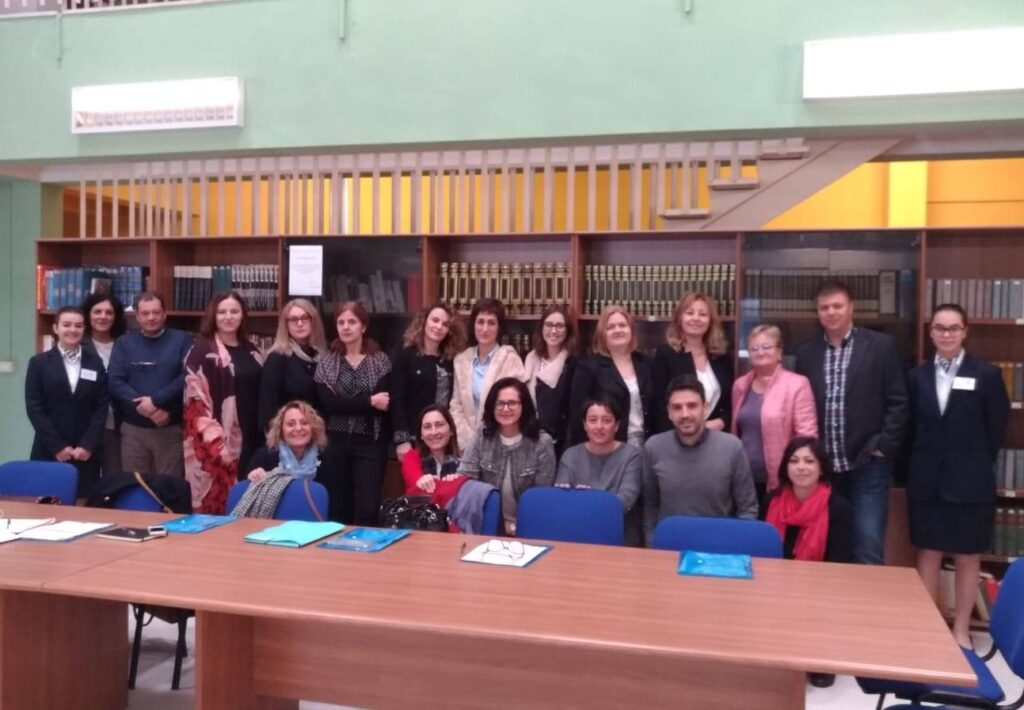
Project team
PROJECT RELEVANCE
Štai teksto vertimas į anglų kalbą:
One of the goals of the Europe 2020 strategy is to reduce the number of early school leavers from 14.4% in 2009 to less than 10% by 2020. The latest research report (NESET II, Publications Office of the European Union, 2017), which reviews documents from the Thematic Working Group on Early School Leaving (2011–2013) and the ET2020 Working Group on Schools Policy (2015), establishes 10 principles for reducing early school leaving. These include: the application of appropriate preventive measures, a holistic approach, the development of strengths, interdisciplinarity, and collaboration among various specialists to meet the complex needs of students.
Significant attention is given to preventive measures intended for everyone, i.e., not just for students in risk groups. There are several school-related factors that influence early school leaving: the school climate, which includes, for example, conflicts with teachers; poor academic performance; lack of motivation; and students’ perception that methods and curricula are uninspiring and unnecessary.
Research indicates that secondary education does not sufficiently meet students’ needs. However, educational curricula play a vital role in engaging young people in learning. Therefore, a challenge arises: to offer young people stimulating and interesting ways of learning so that they are motivated to study and obtain a secondary education.
It is also important to consider the specifics of the younger generation, which lead to:
- A changed attitude toward learning, where learning occurs through challenges and a “trial and error” approach, which is considered an effective form of personal growth and expansion of existing skills.
- A shift in the younger generation’s culture due to the digital age, where it is no longer enough to simply adapt conventional teaching—it must be fundamentally transformed.
- The changing needs of new-generation students: the increased importance of teacher competencies, the need for more diverse teaching methods, greater individualization of learning, and more flexible learning tasks.
PROJECT AIM
To address the problem of early school leaving caused by school-related factors. The issue is tackled through preventive and early intervention measures, enhancing the quality and innovation of pedagogical activities, improving teacher competencies, and creating a positive learning environment.
PROJECT OBJECTIVES
1.To increase knowledge and understanding of the causes leading to early school leaving.
2. To structure a periodic monitoring process designed to identify and provide preventive support in a timely manner to students at risk of early school leaving.
3. To improve teachers’ skills in 3 areas:
- Monitoring and Support: Providing timely assistance and identifying risks.
- Communication and Relationships: Facilitating emotional and social learning by creating a suitable classroom microclimate; establishing a motivating learning environment that encourages participation and collaboration; practicing empathy and conflict management.
- Management and Teaching: Utilizing instructional methods to foster critical thinking and creativity; learning and integrating non-formal education methods during lessons; acquiring tools for systematic reflection and evaluation of one’s own teaching practice and its impact on students.
4. To strengthen cross-sectoral territorial cooperation between schools and external institutions, taking into account the specific situation of each country.
5. To create an international learning community across various fields of education.
PROJECT TARGET GROUPS
The project is intended for teachers and school support specialists (social educators, psychologists, career counselors, etc.). The indirect target group of the project is students.
PROJECT INTELLECTUAL OUTPUTS
Theoretical and Typological Model Regarding the Target Groups at Risk of Early School Leaving (2020)
This publication presents a comprehensive theoretical and typological model designed to identify and support students at risk of early school leaving (ESL) across Italy, Portugal, Romania, and Lithuania. It integrates comparative quantitative and qualitative research findings to categorize specific risk factors and student profiles, providing teachers with a structured framework for early detection. By offering evidence-based insights into the socio-psychological and institutional drivers of school dropout, the document serves as a practical guide for developing targeted intervention strategies and fostering a more inclusive educational environment.
A.C.C.E.S.S. System of Monitoring and Preventive Support Against Early School Leaving (2020)
The Early School Leaving Monitoring and Preventive Support System is a tool that allows schools to detect at-risk students at the earliest stage and prevent dropout. The system facilitates continuous monitoring of students using a clear set of indicators, enables timely assessment of risky behavior, and helps implement targeted support programs for the student.
A specialized application has been developed for the monitoring process, which allows for data collection and, based on defined indicators and risk thresholds, provides information regarding a specific student’s risk of early school leaving. Within the app, each student is assigned early school leaving risk indicators, which are linked to various behavioral descriptions. The teacher monitors student behavior and enters the data into the application. When a student’s behavior reaches a risk threshold, it serves as a signal to initiate the intervention program and support steps.
A.C.C.E.S.S. Toolkit: Supportive Teaching and Assessment Strategies (2020)
The toolkit presents teaching strategies that facilitate the creation of a supportive and positive learning environment aimed at preventing early school leaving. The proposed strategies integrate different teaching methods that are closely related at a conceptual level but are not yet common in schools. These strategies include: educational methods focused on developing teachers’ communication skills to ensure students’ social-emotional and relational well-being; educational methods focused on fostering critical thinking to increase the value and appeal of the curriculum; and non-formal education methods.
PROJECT RESULTS
The project brought together 8 partner institutions (NGOs, general education schools, and higher education institutions) from 4 countries (Italy, Portugal, Romania, and Lithuania).
Three intellectual outputs were developed:
- A quantitative and qualitative study of the factors contributing to early school leaving from the general education system was conducted (surveying teachers and students, with a total of 1,371 participants).
- 273 students from 13 classes participated in the pilot testing of the early school leaving monitoring and preventive support system, assisted by 18 mentors.
- Over 372 participants attended the final information events.
The project contributed to addressing the issue of early school leaving by applying an integrated approach to the problem. It improved teachers’ skills in creating a positive classroom microclimate and a motivating, participation-oriented, and collaborative learning environment. Furthermore, it proposed a practically implementable early school leaving monitoring and preventive support system.
PROJEKTO SKLAIDA
Participants feedback
 As a mentor, I hoped to identify at-risk students at an early stage, learn to understand the root causes of their problems, and reduce the risk factors for early school leaving. Being a mentor was quite challenging, as it required presenting the student with several possible solutions to their problems. Furthermore, some students found it difficult to articulate their issues and choose the best course of action. To me, a mentor is someone who opens doors to new opportunities for a student. What was very important is that the teachers participating in the project established a close collaboration. Being a mentor gave me a sense of self-confidence.
When the mentor invited me to participate in the project, I was quite skeptical. Throughout ten years of school, I got used to teachers teaching, making demands, and giving grades, and suddenly – a mentor offered me help. At first, I didn’t understand why I was having difficulties and why I no longer wanted to study. Furthermore, it was hard for me to talk to the mentor about my personal life. Later, I got used to our meetings, and they helped me realize that I actually want to learn, I was just afraid of failing. We tried several ways to deal with my problems. The mentor helped me improve my relationships with the teachers. I realized that it is better to stay in school and obtain a secondary education than to leave and go to work. Thank you for changing my life.
As a mentor, I hoped to learn how to address the issue of early school leaving. Additionally, I was interested in the tools and measures needed to work with students facing difficulties. During the pilot testing, I experienced a wide range of emotions – from inspiration and happiness at the beginning, to fatigue and helplessness during remote learning, and finally, gratitude and joy at the end of the school year when my students successfully completed their studies.

Funded by the European Union. Views and opinions expressed are however those of the author(s) only and do not necessarily reflect those of the European Union or the National Agency. Neither the European Union nor National Agency can be held responsible for them.