


Project duration: 2002
Project funder: Embassy of the United States
Project coordinator: Modern Didactis centre
Project partner: Informal Education Debate Center
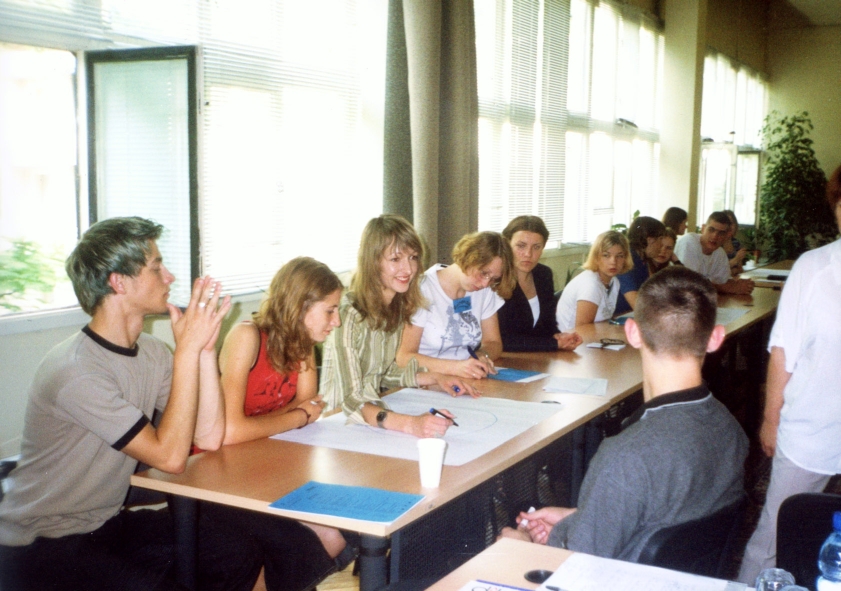
Project participants
PROJECT RELEVANCE
Young generation have important part in the social and political life of the country. In Lithuania youth have an opportunity to participate in consolidating democracy, developing civil society. Through their participation in new democratic institutions and socio-cultural activities young people can also help shape society and so make it into one with which they identify.
Maximizing young people’s contribution to the building of society became the most asserted goal of youth policy in contemporary Europe. Government of Lithuania in its 1996 resolution of State Youth Policy Conception declare, that it is important to raise intellectual, civil, democratic young generation actively participating in political, economical, social and cultural life of society.
Young people participate in civil society through a wide range of activities, including social organizations, sports and recreation clubs, and non-governmental organizations. Youth organizations, in particular, provide a space where young people can develop and represent their interests. In Lithuania much of this type of participation is still evolving as a new relationship forms between the state and civil society. During the transition the share of youth formally joining in social organizations has been low. Although there are now a great variety of associations, there is a tendency among young people to reject organized activities.
One of the reason this situation occurred in Lithuania – there are no active leaders of youth organizations. The other reason, that youth is lack the appropriate skills for implementing democracy: in order to participate in the cultivation of a free democratic environment, one must be skilful in democratic practices such as tolerance and the abilities to develop understandings and reach conclusions.
The development of civic values is not a task only for the school and its teachers. Lithuanian NGOs by joining their experience also can assist in the process of development skills and values to make democracy work by offering the effective teaching programs and organizing workshops for the youth organizations.
PROJECT AIMS
- To encourage the activity of youth organizations and they involvement in social-political life of Lithuania.
- To provide the opportunity for young people to participate and develop as individuals and citizens.
- To encourage youth participation in all aspects of society.
- To create and apply the effective learning model in order to promote the competence of youth organizations leaders, members and participants.
- To present for the participants of youth organizations the set of modern interactive teaching methods which will be useful in personal, social and professional activities.
- To foster the cooperation between youth organizations.
PROJECT PARTICIPANTS
Target groups of the project – social and political youth organizations, unions of students and pupils.
36 members of these youth organizations participated in the project:
Students Association of Lithuanian Law University Public Administration speciality
Liberal Youth
Pupil Parliament of Taurage “Versme” gymnasium
Students Association of Vilnius University
Youth Centrists
Association of Siauliai youth organizations “Apskritas stalas” (Round table)
PROJECT ACTIVITIES
The main goal of the project – to develop program, which can help acquire skills basic to the functions of a democracy and organize set of seminars to show how to apply these skills practically.
The activities of the project was build on two programs – Critical Thinking Development and Debate. They are run successfully in Lithuania for many years already. The core of Critical Thinking Development program – critical pedagogy and democracy building, based on the best achievements of the educators, such as Piaget, Dewey, Nodding, Vygotsky, Anderson et etc. The methodology of this program is devoted to acquire and strength the intellectual skills, that enable young people to perceive, describe, explain, analyze, and evaluate information. They empowered them to argue positions and make decisions.
Debate as a rational discussion is an essential activity in democratic societies. Debate program helps to maintain participation skills, that render the young people capable of effecting public and civic life. They assist them to work with the others in order to arrive at common interests and resolution of conflicts through compromise. Debate is a effective tool to maintain communication abilities, logical argumentation, rhetoric, tolerance to other opinion.
Joined program of Debate and Critical thinking development designed according needs of youth and series of workshops based on this program, would help the younger generation of Lithuania to become active citizens of their country, to foster positive attitudes in finding solutions for the better future of our society.
Workshop for teams of youth organizations. 7–8 May 2002, Vilnius
Topics of workshop:
– Team building and motivating
– Coordination of individual and group interests
– Creating favorable environment for communication and cooperation
– Formulating and defending the opinion
– Discussions and argumentation
Summer school. 2–5 July 2002, Druskininkai
Topics of workshop:
– Problems identification and ways of their solving
– Search and selection of the information
– Preparation of the public speeches
– Reading and analysing of official documents
– Replying to official documents
– Styles of debates. Parliamentary debates
– Development and implementation of projects
PROJECT INTELLECTUAL OUTPUTS
Qualitative research “Needs of the youth leaders for training” (2002)
The development of the NGO sector (the majority of which consists of non-governmental youth organizations) as the foundation of civil society, along with its increasing social importance, encourages a re-examination of its challenges and a focus on the most pressing needs of non-governmental organizations. This qualitative situational study aimed to determine the leadership training needs of six different types of non-governmental youth organizations and to identify the profile of a youth leader.
The most important quality of a youth leader was identified as the ability to assemble and motivate a team, while in practical activities, it is the ability to form and defend one’s opinion. For representatives of political organizations, the most crucial leadership trait is team building, whereas non-political organizations place a higher value on the ability to plan, organize, and take responsibility. In non-political organizations, leadership is closely linked to the duration of membership (positions are usually held by members who have been part of the organization for more than 2 years), while vertical mobility is faster in political organizations. It was found that members of political organizations participate more actively in training; however, both types of organizations lack specific, practice-oriented training and professional lecturers.
Download LT
Youth Leadership Development Program (2002)
The program is designed to strengthen youth leadership skills through active practical activities. The publication covers four main topics: team motivation, public speaking, project management, and debates. Each section details specific educational goals, teaching methods, and expected results, aiming to develop young people’s critical thinking, argumentation, and teamwork skills. The program focuses on practical applicability, providing participants with knowledge on project development, public speaking structure, and effective debate strategies.
Download LT
PROJECT RESULTS
Upon completion of this project, members of youth organizations have acquired practical skills in teamwork, public speaking, and project management, which will enable them to engage more effectively in community activities. Participants have learned to defend their opinions with arguments, critically evaluate information, and independently prepare and complete project applications to solve problems. It is expected that increased self-confidence among the youth has been achieved, strengthening their leadership potential and ability to motivate others toward a common goal.