



Project No. 2024-1-IT01-KA210-VET-000243700
Project duration: 1 December 2024 –31 May 2026
Project co-funder: EU program Erasmus+
Project coordinator: La Chiave di Sofia (Italy)
Project partners:
Šiuolaikinių didaktikų centras (Lithuania)
Health Growth (Bulgaria)
Arte M Associacao Cultural e Artistica na Madeira (Portugal)


Project team
PROJECT RELEVANCE
In today’s professional field, a creative methodology that integrates artistic and philosophical concepts to enhance problem-solving and communication is highly relevant:
- The job market demands professionals with innovative problem-solving skills.
- Trainers in the arts, philosophy and communication need structured Visual Thinking resources.
- The project provides new methodologies for effective and engaging education.
PROJECT AIM
The project aims to promote the acquisition of Visual Thinking skills for trainers in artistic, philosophical, and communication sectors.
PROJECT OBJECTIVES
- Developing digital educational resources to enhance trainers’ Visual Thinking skills.
- Establishing a network of expert Visual Thinking trainers to act as mentors and agents of change.
- Fostering the practical application of visual thinking skills through sessions for trainers and interested learners.
PROJECT TARGET GROUPS
Direct target groups:
- Trainers in arts, philosophy, and communication that are going to acquire Visual Thinking skills to improve their training methodologies.
- Learners (20–34 years) in arts, philosophy, and communication that are going to improve employability through innovative skills.
Indirect target groups:
- Training organizations (profit & non-profit) that are going to enhance attractiveness and adaptation of training courses to market demands.
- Humanities professionals in business that are going to gain Visual Thinking competencies for business strategy and development.
- Businesses & Enterprises that are going to access to professionals with innovative problem-solving skills.
PROJECT ACTIVITIES
1. Online training course on Visual Thinking “Philosophy in Art as a Learning Tool – Visual Thinking Strategies”
Development of 4-Module training course. Key topics covered include:
- The role of philosophy in everyday life and art.
- Art as a tool to understand Visual Thinking.
- Methods and strategies for Visual Thinking.
- Visual Thinking in skills development and problem-solving.
2. Local workshops for practical Visual Thinking application
- Workshop 1: Introduction to Visual Thinking: theory, museum visits, creative labs.
- Workshop 2: Visual Thinking in Art and Philosophy: art creation, philosophical analysis.
- Workshop 3: Visual Thinking in Business: case studies, problem-solving exercises.
PROJECT RESULTS
- Implementation of a 40-hour training course for the development of Visual Thinking strategies based in the artistic-philosophical areas, for IFP trainers.
- Establishment of a Virtual Community for Visual Thinking trainers within the European space.
- Creation of instructional videos and testimonials produced through the practical phase of local activities.
- Enhancement of participants’ skills in project activities.
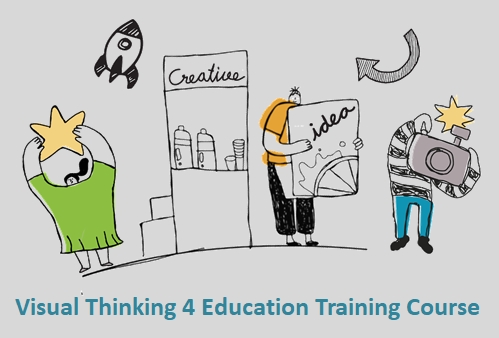
Online training course “Philosophy in Art as a Learning Tool – Visual Thinking Strategies” (40-hours)
The course is designed for adult learners who wish to acquire or improve their visual thinking skills, as well as adult educators who wish to improve their professional practice.
Course objectives:
- Understand visual thinking as a cognitive and communicative process, exploring its historical roots and contemporary relevance.
- Develop the ability to read, interpret, and use art as a tool to enhance understanding of visual thought.
- Learn practical methods and strategies to apply visual thinking in educational, professional, and training contexts.
- Promote the use of visual thinking for active learning, problem solving, creativity, and collaboration.
- Experiment with visual and artistic tools through guided simulations and online activities.
- Foster the development of transversal (soft) skills required in the modern labor market, especially those related to communication and cooperation.

Funded by the European Union. Views and opinions expressed are however those of the author(s) only and do not necessarily reflect those of the European Union or the National Agency. Neither the European Union nor National Agency can be held responsible for them