


Project No. 2020-1-EE01-KA227-SCH-093376
Project duration: 1 March 2021–28 February 2023
Project co-funder: EU program Erasmus+
Project coordinator: Tallinna Kunstigümnaasium (Estonia)
Project partners:
Šiuolaikinių didaktikų centras (Lithuania)
PROJECT RELEVANCE
The COVID-19 pandemic had and continues to have a too great impact on the education system and on young learning requiring a re-thinking and re-design of educational approaches. Together with the partners we came to the conclusion that offering them the possibility to learn design thinking, to use and practice Visual Thinking methods using their creativity and the digital instruments, they will acquire new, necessary skills and knowledge to help them stay mentally and emotionally well and continue the learning regardless of the situation and location: in a classroom, or in isolation.
“Creative Digital Visualization for the Development of Design Thinking Strategies among students and youth” project was designed to encourage young learners to stay creative regardless of where they are.
The project aim was to integrate arts and creativity to develop digital skills among target groups by the means of innovative practices in a digital era when distance learning becomes the “new normal” in education and youth work. It aimed at enabling learning opportunities for students, pupils, youth, teachers about innovative digital tools making use of and boosting their creativity.
PROJECT AIM
To encourage young learners – pupils, students, young people, but also teachers, coaches, youth workers to stay creative regardless of their location during working/studying process by integrating arts and creativity to develop digital skills due to innovative practices such as design thinking strategies and visual thinking techniques in education and youth work; by enabling learning opportunities for students, pupils, youth, teachers to develop a new culture of independent studying assuring the mental wellbeing of the stakeholders.
PROJECT OBJECTIVES
- To enable young learners and teachers to use creativity and arts to stay balanced despite the situation they are facing.
- To develop new skills and knowledge among young learners and teachers to help them to cope with various issues affecting their possibility of movement.
- To train students and teachers to use Visual Thinking Techniques for the creative visualization of their situation and condition.
- To train students and teachers to use Design Thinking Strategies for the solution processes of various problems in life, in studies, in work.
- To support teachers and youth workers to employ Design Thinking Strategies for planning lessons, delivering activities and content.
- To elaborate a methodological framework for a course to be delivered in schools, youth centers, organizations on Visual Thinking techniques and Design Thinking Strategies.
- To shift the approach to planning and delivering lessons to a new one, more creative, engaging and animated with the use of Design Thinking Strategies.
- To establish a network of partners who will continue the coperation after the project is ended.
PROJECT TARGET GROUPS
- teachers of formal and in-formal education;
- youth workers;
- students and other learners.
INTELLECTUAL OUTPUT
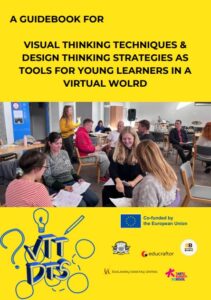
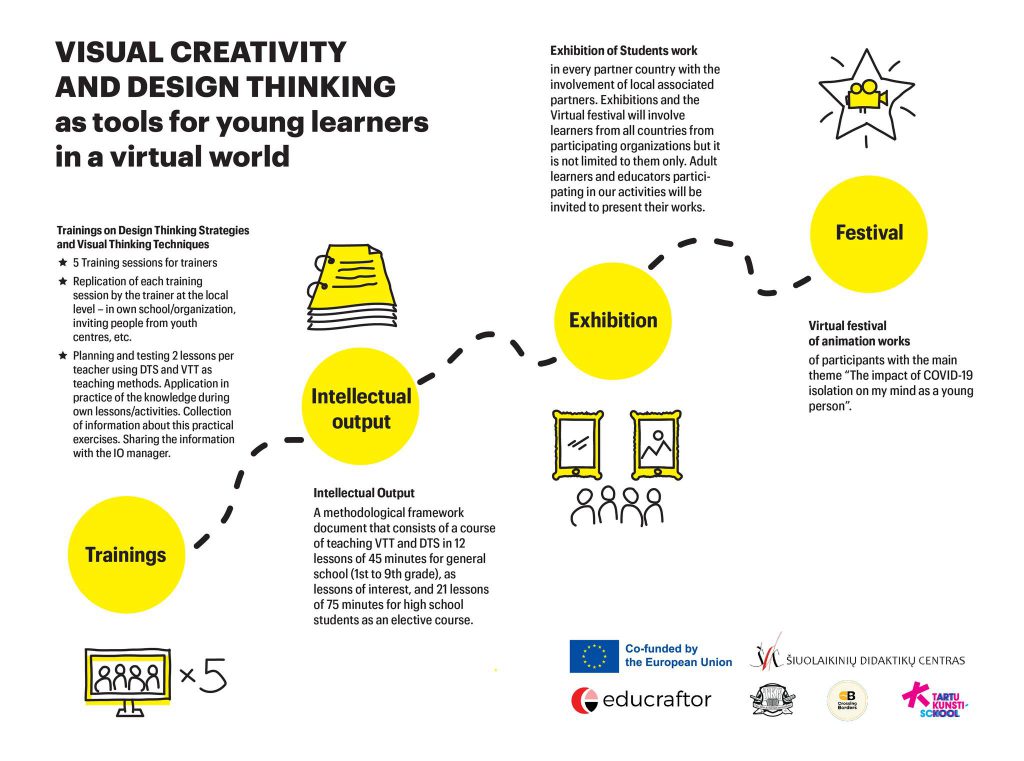
A Guidebook For Visual Thinking Techniques & Design Thinking Strategies as Tools for Young Learners in a Virtual Wolrd (2023).
This material presents Design Thinking and Visual Thinking as methods for teaching problem solving both when learning and at the learning community. The material guides through the different stages of the methodology and provides with ideas and examples on how to bring more visual elements into your lessons.
The project behind the material introduced to explaining the why’s and how’s. Then the material guides through the theory behind the Design Thinking and Visual Thinking methodologies and explains how the process works.
The material also includes 12 case studies with different target audiences: basic, secondary and adult education, and teacher training. The cases for teachers and educators have been explained in more detail in order to open up the process of teaching and applying
the methodology.
PROJECT RESULTS
- 5-sessions coaching activities “train the trainers” organized for future trainers on VTT and DTS .
- Replication of the 5-sessions training activities for learners from the partner countries (formal partners and organizations).
- Teachers and workers of the partners organizations started to deliver lessons and activities by the mean of DTS and VTT.
- Collected works and photos from the process of learning DTS and VTT exhibited in the organizations’ premises and on Youtube.
- Trained teachers plan their lessons using DTS to be taught in the classroom.
Our long-term aimed results is to have a new framework for educators to apply in order to animate their lessons, to deliver them in an attractive way, to involve more actively the learner in the process of learning. The main result is an enjoyable learning period for young people under any conditions, enabling tools for them to stay creative in the classroom or at home during distance days. We offer the framework that helps to open up the borders for our target groups the same way the COVID-19 pandemic closed them.

The European Commission’s support for the production of this publication does not constitute an endorsement of the contents, which reflect the views only of the authors, and the Commission cannot be held responsible for any use which may be made of the information contained therein.