
Project No. 2023-1-LT01-KA220-ADU-000153426
Project duration: 31 December 2023–30 December 2025
Project co-funder: EU program Erasmus+
Project coordinator: Lietuvos suaugusiųjų švietimo asociacija (Lithuania)
Project partners:
Izglītības attīstības centrs (Latvia)
Latvijas Pieaugušo izglītības apvienība (LPIA) (Latvia)
Ustanova za obrazovanje odraslih DANTE (Croatia)
Pucko otvoreno uciliste LIBAR (Croatia)
Academia de Studii Economice din Bucuresti (Romania)
Asociatia EGOMUNDI (Romania)
Šiuolaikinių didaktikų centras (Lithuania)


Project team
PROJECT RELEVANCE
The professional experience of the partner organizations proves that Critical Thinking (further – CT) education has already become a part of formal school education and higher education studies. At least in research, official documents, strategic guidelines, programs goals and some practical experiences. In non-formal adult education, CT presented in a very fragmented way, either as part of media literacy, or as a tool to fight against propaganda. However, neither the concept of CT itself, nor its attributes as a CT competence, have been widely studied or analysed in terms of how it is manifested in non-formal adult education, how it is applied. A preliminary analysis of the literature on the subject has revealed an apparent lack of not only the development but also the presentation of this competency in adult education of Lithuania.
The situation is very similar in the partner countries – Latvia, Croatia and Romania. Therefore, all partners agreed on the need to increase the awareness and application of CT in non-formal education by bringing together science and best practice to suggest a universal model that can be applied and adapted in different adult education contexts, while at the same time providing guidance for adult education policy.
PROJECT AIM
The project aims to improve the competences of adult educators by fostering CT among adult learners so that they can apply it in their daily professional and community life and make a meaningful contribution to their own well-being, that of others and that of all.
PROJECT OBJECTIVES
- Provide evidence of CT presence (and non-presence) and importance for adult education by developing: Compendium of most relevant scientific literature, tailored to adult educators; Executive Summary of adult education documents/programs in partner countries; Recommendations for Adult education policy.
- Provide clear guidance on how CT can be developed and practiced by elaborating: science and practice informed Methodical Model to be used in various adult education settings and contexts; Program for adult educators and Toolkit to be used for work with adult learners.
- Provide opportunity to practice CT and improve digital skills in adult education organizations and communities by: developing training program and materials; delivering training/workshops.
- Skatinti kritinio mąstymo mokymą(si), sukuriant patrauklias skaitmenines priemones mokymąsi, pvz. internetines užduotis / testus (WebQuests).
- Share project results and lessons learned among partnership, local communities, respective audience at national and international contexts via: mutual learning and direct communication, hands-on activities, websites, newsletters, FB, EPALE, and other relevant means.
PROJECT TARGET GROUPS
Primary target audience: adult educators working with different groups of adult learners.
Secondary target audience: adult learners and adult education policy makers.
Beneficiaries: families, communities, society.
PROJECT INTELLECTUAL OUTPUTS

Compendium of scientific ideas. Critical thinking in non-formal adult education (2024)
The present study is a systematic review of the landscape of adult education, performed through non-formal teaching strategies, with the objective of enhancing critical thinking (CT) skills and dispositions. Our findings indicated that the definition of CT in adult education is aligned with the prevailing definitions and schools, yet there is a paucity of research in this field. Consequently, our paper can assist in illuminating an emerging field, namely CT in adult education.
Overall, the recommendation points to the need for innovative, integrated approaches to fostering CT in adult education. There is also need for further research into effective assessment methods, the integration of arts and non-formal learning spaces, and the development of educational frameworks that emphasize responsibility, control, and intrinsic values. The focus is on creating holistic and adaptable educational environments that address the diverse needs of adult learners.

Executive report. Critical thinking in non-formal adult education programs and documents (2024)
An analysis of adult education documents and existing programs and practices with the focus on critical thinking (CT) in each country provides a concentrated picture of the situation and give an indication of what to focus on when developing practical tools.
Executive report on adult education programs and documents consists of 4 chapters: I. International documents, II. National legislation, III. Training programs and projects.
Analysis of international documents provides a general overview of the current political thinking on European and global political level on the issue of CT and importance of its development in the society and on the role of adult education in this respect.
Analysis of the National legislation provides a picture of how politicians at National level reflect the issue of CT and how they transform the ideas into actions.
Analysis of programs and projects provides concrete information and ideas for designing a universal model for CT development among adults in non-formal education.

The MIND Model. Model framework for the development of critical thinking in non-formal adult education (2024)
The Model Framework for the Development of Critical Thinking (MIND model) is intended for non-formal adult education staff, teachers, trainers, and adult education programme developers who wish to develop and enhance the critical thinking skills of diverse groups of adult learners. Diverse means a variety of age groups, social backgrounds, ethnic origins and other diversities that transcend geographical and cultural boundaries. This is the universality of our MIND model. It can be easily applied to formal education because of its philosophical-methodological approach, based on a wealth of research into how adults learn best.

The MIND programme. Critical thinking development programme and materials for non-formal adult education (2025)
This programme is aimed at leaders and developers, lecturers, trainers, and all those working with adult learners in non-formal adult education programmes in different non-formal education contexts. The programme aims to provide clear methodological guidelines for the development of critical thinking among various adult groups and to model its process by providing concrete steps for the implementation.
The programme is built on the best knowledge informed by science, how adults learn best, and on development of critical thinking methodologies, namely social constructivism, pragmatism, and critical pedagogy.

The MIND toolkit. Tools for development of critical thinking in non-formal adult education (2025)
The methodical tool set supplements MIND Programme and will be useful for adult educators, adult education program managers, non-formal educators, lecturers and adult educators for including critical thinking approach in their own programs.
The Toolkit is structured according to the topics and tasks of the five modules of the MIND Program. In each chapter, there is one or more tools offered, providing their general characteristics, practical action steps, feedback, materials needed for the work and the recommended literature. The description of the tools includes recommendations on the forms of work organization, the number of group members and the time required for activities.
The set of methodological tools was created with the intention to provide for inspiration and examples for the development of adult critical thinking. The tools included in it can be easily adapted for the learning of different topics to make the learning process more meaningful, reducing the stereotypes of the participants, deepening their understanding and strengthening critical views.

The MIND recommendations. An advocacy paper for policymakers to promote critical thinking in non-formal adult education (2025)
The MIND project set out to address a growing gap in adult education across Europe: the lack of systematic, evidence-based approaches to fostering critical thinking (CT) among adult learners. Through research, model development, and piloting, MIND demonstrated that CT is not an abstract academic goal, but a practical competence that empowers adults to make informed decisions, engage in democratic life, and respond constructively to social and digital challenges.
These Policy Recommendations aim to translate MIND’s findings into action for adult education policymakers, municipalities, and AE providers. They advocate for embedding CT in adult learning strategies, funding schemes, educator training, and community-based programmes.
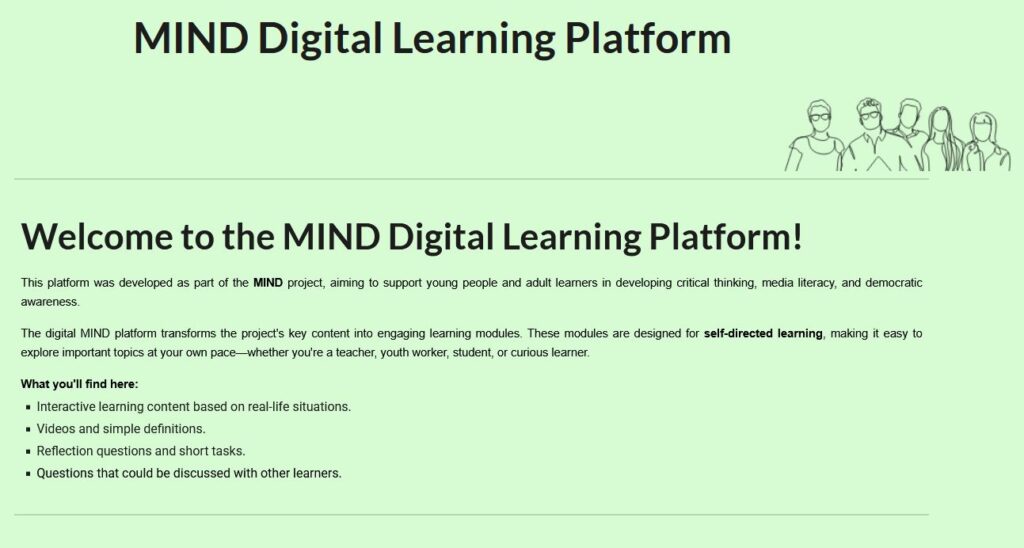
MIND digital learning platform (2025)
This platform was developed as part of the MIND project, aiming to support young people and adult learners in developing critical thinking, media literacy, and democratic awareness.
The digital MIND platform transforms the project’s key content into engaging learning modules. These modules are designed for self-directed learning, making it easy to explore important topics at your own pace—whether you’re a teacher, youth worker, student, or curious learner.
Digital learning consists of the 5 Modules. Each module provides an opportunity to explore the essence of critical thinking and the importance of its development, and to understand its implications as well as value for adult education at the individual, community, and societal levels: Module 1: What is critical thinking?, Module 2: Portrait of a critical thinker, Module 3: The value of critical thinking for the individual, Module 4: The value of critical thinking for the community, Module 5: The value of critical thinking for society.
The platform provides: interactive learning content based on real-life situations, videos and simple definitions, reflection questions and short tasks, questions that could be discussed with other learners.
PROJECT RESULTS
Improved knowledge of CT in adult education; improved adult educators’ skills in teaching adult learners to use CT; improved adult learners’ skills in applying CT in their lives; improved partners’ skills and competences in strategy, analysis, modelling, cooperation and communication, in English.
DISSEMINATION

Funded by the European Union. Views and opinions expressed are however those of the author(s) only and do not necessarily reflect those of the European Union or the National Agency. Neither the European Union nor National Agency can be held responsible for them.