
Project duration: 19 May 2003–31 December 2004
Project co-funders:
United Nations Development Programme
Government of the Republic of Lithuania
Project coordinator: Modern Didactics Centre
Project partners:
Ministry of Education and Science of the Republic of Lithuania
Lithuanian universities

Freepik.com nuotr.
PROJECT RELEVANCE
The fight against corruption may be effective when preventive, punitive and educational measures are combined. Therefore in the Lithuania National Anti-Corruption Programme (adopted by the Seimas on 17 January 2002, No. IX-711) and the Lithuania Law on Corruption Prevention (adopted by the Seimas on 28 May 2002, No. IX-904) major emphasis is placed on the prevention of corruption and public education.
The National Anti-Corruption Programme prospects: 8.2.4. developing and applying anti-corruption curricula in comprehensive schools and higher education colleges. Special anti-corruption curricula should be carried out at universities and colleges that offer specialities most prone to corruption. The anti-corruption education should become an inseparable part of the public education system.
The Law on Corruption Prevention states: 10.2. Anti-corruption education of the public shall be carried out at the educational institutions of all types and levels in accordance with the corresponding educational programmes, through the media and other means.
To implement the said measures Special Investigation Service carried out the PHARE project “Building Integrity and Raising Anti-Corruption Awareness” (No. LI9913.02.06) in 2002 and in close co-operation with the Ministry of Education and Science has drafted methodological recommendations for the preparation of the anti-corruption education course for secondary schools. Projects of Modern Didactics Center “Education against Corruption” (2002–2003) and “Development and Dissemination of Educational Anticorruption Programmes” (2004) was also orientated towards secondary education curriculum. These initiatives did not cover higher education establishments. Therefore, an important target group in public education was missed, namely university students who after all will be the next generation of Lithuania civil servants.
The development of anti-corruption study programs for higher education institutions is part of the 2002–2004 project “Corruption Prevention through Public Education, Information, and Awareness”, carried out by the Special Investigation Service of the Republic of Lithuania. The objectives of this project are:
- To contribute to the formation of a civil society by fostering anti-corruption attitudes.
- To carry out anti-corruption education for youth by developing and implementing anti-corruption programs in higher education institutions.
- To disseminate information regarding corruption and its prevention.
Project consisted of four independent but thematically-linked components:
Component I – Development of anti-corruption study programs for higher education institutions
Component II – Presentation of a television program on anti-corruption educational themes
Component III – Conducting public opinion surveys to improve anti-corruption measures
Component IV – Round table discussion on the issues of political party and political campaign financing
PROJECT AIMS
- To contribute to the formation of a civil society by fostering anti-corruption attitudes.
- To provide anti-corruption education for youth by developing and implementing anti-corruption programmes in higher education institutions.
- To disseminate information about corruption and its prevention.
PROJECT OBJECTIVES
- To develop and test modules of anti-corruption education for higher schools study programmes.
- To integrate modules of anti-corruption education to higher schools curriculum.
AUTHORS OF ANTI-CORRUPTION PROGRAMMES AND COURSES
doc.dr. Arunas POVILIUNAS (Vilnius University, Sociology)
Corruption as Sociology of Deviation Approach. Integrated module into the course “Sociology of Deviation”
Vitalija SKERUVIENE (Kaunas College, Law)
Corruption as an Object of the Law. Integrated module into the course “Business Law”
Gintare SATIENE (Siauliai University, Public Administration)
Corruption and Anti-Corruption Policy. Optional course
Integrated module into the course “Business Law”
Corruption and the Law. Integrated module into the course “Fundamentals of the Law”
dr. Tadas TAMOSIUNAS (Vilnius Pedagogical University, Sociology)
Corruption as Form of Deviation. Integrated programme into the course “Social Organization”
Corruption and it’s Prevention. Optional course
Vaiva ZUZAVICIUTE (Vytautas Magnus University, Educology)
Personal Interests and Advocacy. Integrated programme into the course “Life Long Learning Strategies”
dr. Romas PRAKAPAS (Vilnius Pedagogical University, Educology)
Corruption as a Moral Problem in Codes of Ethics. Lecture for the course “Professional Ethics”
PROJECT INTELLECTUAL OUTPUTS
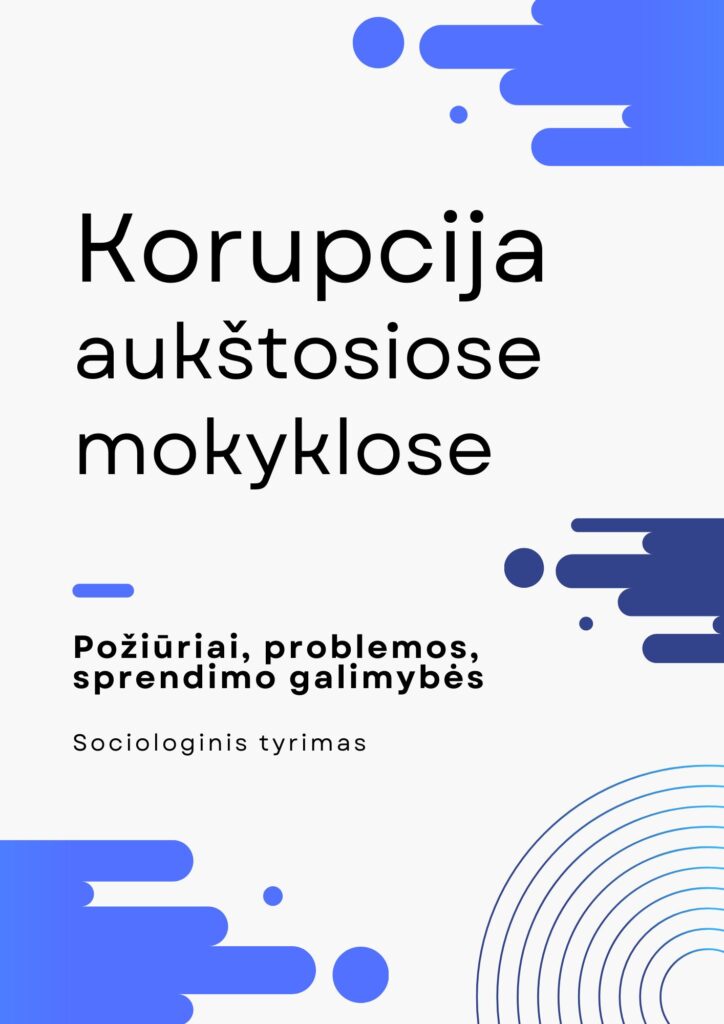
Sociological study „Corruption at Higher Schools: Views, Problems, Ways of Solution“ (2004)
This document presents a study on the corruption experiences and attitudes of students in Lithuanian higher education institutions, aiming to assess the level of academic integrity in the country. The research primarily focused on a qualitative analysis of corruption within higher education. The survey included 90 lecturers from ten higher education institutions, while interviews were conducted with 20 lecturers and 25 students across twenty-five higher education institutions.
The results reveal that although students theoretically condemn corruption, a significant portion still justifies dishonest behavior—such as cheating or plagiarism—viewing it as a survival mechanism in high-workload environments. The study highlights that perceptions of corruption vary across different institutions, with the lack of transparency in assessment processes and insufficient focus on strengthening ethics from faculty and administration identified as the main issues. The findings emphasize the necessity of implementing systemic anti-corruption measures and fostering students’ civic responsibility from the very beginning of their studies.
Download LT

Corruption at Higher Schools: Views, Problems, Ways of Solution (2005)
This is a methodical publication for higher education lecturers and students. It presents programmes of integrated and optional courses, extended plans of lectures. It demonstrates possibilities of anti-corruption education at social sciences curriculum. Presented materials are prepared by project participants according their higher school requirements and particularity of teaching subject.
Readers of this publication could use prepared programmes, they also will find additional information about the phenomena of corruption, it’s outspread in Lithuania and other countries, corruption appearance in the system of higher education, Lithuania universities lecturers’ and students’ viewpoints to corruption. At the end of the publication vocabulary of main terms and concepts is presented.
Download LT
PROJECT RESULTS
- A long-term basis for anti-corruption consciousness-raising through education of the youth established.
- Integrated and optional anti-corruption education courses for higher schools curriculum developed.
- Set of methodical materials for lecturers and students “Anti-Corruption Education at Higher Schools” prepared and published.
- Sociological survey “Corruption at Lithuania Higher Schools: Views, Problems and Ways of Solution” performed.