


Project duration: 2002–2003
Project supported by:
Open Society Institute-New York
International Reading Association
Project coordinator: Šiuolaikinių didaktikų centras
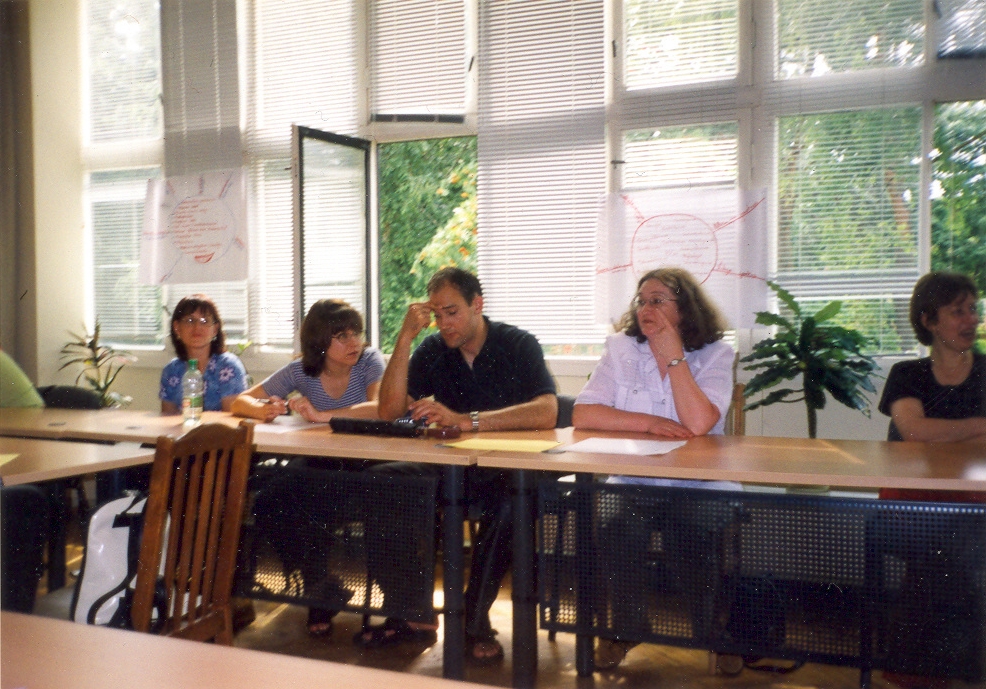
Summer school
PROJECT RELEVANCE
The project Reading and Writing for Critical Thinking (RWCT) which had been carried out in Lithuania in 1997 – 2000 was directed to all educators – elementary and secondary school teachers and college and university lecturers. The project was mostly oriented for general education and was successfully carried out in elementary and secondary schools. After the careful situation analysis, Modern Didactics Center decided to elaborate long term project for higher schools.
Contemporary universities face the challenge not only to develop the system of knowledge but also the system of different skills. Educators claim that didactic goals of the curricula of the universities must be oriented not only towards providing fundamental and applied knowledge but also towards teaching methods for different activities and problem resolution. Though traditionally universities require the students to learn, memorize, draw conclusions, analyze the arguments and solve the problems, students are seldom taught how to do it. So progressive education must rest on two foundations: learning how to get quickly oriented in the rapidly growing flow of the information and finding what is needed, and knowing how to think over and apply the information. This program can help the educators to meet the challenges of contemporary science, restructure teaching process, present consistent and theoretically grounded teaching methods, encouraging the students to learn actively and think critically.
Critical thinking program enables the lecturers:
– To create the atmosphere based on open and responsible cooperation.
– To use teaching framework and methods encouraging critical thinking and independent studies.
The lecturers working according critical thinking program develop students’ abilities to:
– Think critically.
– Accept responsibility for their learning.
– Work in cooperation with the others.
– Acquire skills of permanent learning.
Critical thinking program does not demand preliminary preparation; the lecturers can rely on their own experience, available programs and teaching materials. The theory is closely related to practice: after the workshops the lecturers can immediately apply new teaching methods in their classes. The program is based on the unanimous system of thinking and learning, which is based on the latest research in education and ideas of the eminent scholars: J. Piaget, J. Dewey, N. Noddings, L. Vygotsky, C. B. Smith, P. D. Pearson, L. Fielding, L. Rosenblatt, J. L. Vaughan, T. Estes, and others.
PROJECT AIM
Project was aimed to integrate critical thinking training into universities’ curriculum.
PROJECT TARGET GROUP
The project was directed to the lecturers of the colleges and universities.
49 educators, representing the following institutions, take part in the project:
Kaunas College
Klaipeda University
Lithuanian Christian Fund College
Siauliai University
Utena College
Vilnius Gediminas Technical University
Vilnius College
Vilnius Pedagogical University
Vilnius Pedagogical College
PROJECT ACTIVITIES
I STAGE – Formation of critical thinking development teams in higher education institutions
To participate in the project there where invited not individual teachers, but teams of higher education institutions. Taking into account teaching peculiarities, two groups of lecturers were formed: form pedagogical and non-pedagogical higher education institutions.
Participants of the project passed the full 48 hrs course of Critical Thinking. During the participation in the project, the lecturers were encouraged to apply new strategies in their schools, observe the lectures led by their team members, have meetings with them and discuss their achievements and what might be changed in order to get adjusted to specific situations.
19–20 March, 2002 Workshop “Framework and Environment for Teaching Critical Thinking”
29–30 April, 16–17 May, 2002 Workshop „Methods of Teaching Critical Thinking”
2–5 July, 2002 Summer school, workshop “Planning and assessment of critical thinking lecture. Development of student orientates study programmes”
24–25 September, 2002 Seminar for administrators of higher education institutions “Content of Contemporary Studies at University”
Guest lecturers: dr. Jeannie STEELE, dr. Kurt MEREDITH (University of Northern Iowa, USA)
Seeking of project sustainability, it was decided to involve universities administration into the project and to deliver to them an introductory seminar. Vice-rectors and directors of study departments got acquainted with the project and had understanding about benefits of the modern critical thinking course in higher education curriculum.
24–25 October, 18–19 November, 2002 Workshop “Writing as a tool for critical thinking development. Attitudes towards scientific texts reading. Text analysis”
7–9 January, 2003 Winter School, workshop “Adult education”
II STAGE – Development of integrated and individual programmes for critical thinking teaching
The second year of the project was devoted for analyzing of study programmes and teaching subjects from the point of view of critical thinking teaching possibility.
Lecturers chose one of those ways for individual or group activity:
– to integrate a programme of critical thinking into their subject teaching;
– to develop an optional critical thinking teaching course;
– to develop a new critical thinking course.
17 February, 2004 Final conference of the project.
During the conference project coordinators implemented an idea to link together experience of critical thinking development in secondary and higher education. Therefore teachers from Modern Didactics Center methodical schools – Critical Thinking centres: Vilnius “Vyturys” primary school, Vilnius Simonas Daukantas secondary school, 1st gymnasium of Silute, Moletai gymnasium – were invited to participate in conference. Project participants presented developed programmes for their colleagues as well as secondary school teachers share their long-lived experience in critical thinking education.
PROJECT INTELECTUAL OUTPUT
Critical Thinking Development in Higher Education: Study Programmes (2004)
This publication presents curriculum programmes and detailed course outlines that highlight opportunities for fostering critical thinking across a wide range of study programmes—including law, accounting, foreign languages, social pedagogy, communication, and others. in the respective courses. A similar model was followed in preparing the syllabi: first, the purpose of the course, its place in the study program, goals and objectives, connections with other subjects, course structure, teaching principles and methods are presented, followed by the expanded content and a lecture or seminar illustrating it.
All extended lectures are based on a three-stage model for fostering critical thinking. The first stage – stimulation – aims to spark students’ interest in a new topic and encourages them to recall previously acquired knowledge and experience related to the lecture. In the second stage—comprehension—new material is taught. In the third stage—reflection—conclusions and evaluations are drawn by connecting prior knowledge with newly acquired knowledge. All three of these stages form the foundation of a lecture or lecture series, upon which the content and teaching methods are built.
The material presented consists of original works by the project participants. We hope that the lecture plans and descriptions provided will encourage interest in various theories of teaching and learning in higher education, inspire the search for one’s own teaching methods, and foster critical thinking among students.
Download LT
PROJECT RESULTS
- Project is characterized by the unity of theory and practice, comprehensive analysis and reflection of the higher education activity.
United critical thinking teams were organized at the Universities. - Participants got acquainted with the methods and strategies encouraging critical thinking and were encouraged to use strategies of critical thinking while teaching their subjects.
- Project materials were issued in the publication „Critical Thinking Development in Higher Education: Study Programmes”.