This document reports the experience of conceiving and delivering a European training course on Critical Thinking (CT) education targeted for Higher Education (HE) faculty. It draws on the preliminary quality guidelines for CT education and gives a comprehensive description of methods and activities to be potentially adopted in HE teachers’ training contexts.



Project No. 2016-1-PT01-KA203-022808
Project duration: 1 September 2016–31 August 2019
Project co-funder: EU program Erasmus+
Project coordinator: Tras-Os-Montes e Alto Douro universitetas (Portugal)
Project partners:
The University of Santiago de Compostela (Spain)
The University of Roma Tre (Italy)
The University of Western Macedonia (Greece)
University of Thessaly (Greece)
University College Dublin (Ireland)
Catholic University Leuven (Belgium)
University Colledge Leuven-Limburg (Belgium)
Modern Didactics Centre (Lithuania)The University of Economics, Prague (Czech Republic)
The Bucharest University of Economic Studies (Romania)
Project experts:
prof. Diane F. Halpern (Claremont McKenna College, USA)
prof. Harvey Siegel (University of Miami, USA)
Ronald Barnett (University College London, JK)

Project team
PROJECT RELEVANCE
Critical thinking is essential in today’s higher education when preparing future employees and active citizens. Employers frequently point to a noticeable gap between the competencies of young professionals and the actual needs of the labor market. Current societal shifts indicate that specific professional knowledge and skills are no longer sufficient to solve emerging, complex problems and tasks. Attention must be shifted toward the development of social skills, which include complex thinking abilities, interpersonal communication, collaboration skills, personal motivation, lifelong learning, and situational management—all of which help individuals function successfully in a dynamic and unpredictable professional world.
Across European countries, growing concern regarding these issues is linked to the inclusion of critical thinking as a subject in higher education curricula. This involves efforts to change teaching methods, collaborate more closely with experts and companies on curriculum reform, and redefine learning outcomes. Despite being emphasized by educational policymakers, critical thinking development is often not effectively integrated into higher education programs, which fundamentally prioritize rote memorization, information retrieval, and the transmission of data. Consequently, the discipline of teaching critical thinking remains difficult to define, and educators often struggle with how to teach it or how to measure the effectiveness of their methods.
Recent research highlights the need to seek new methods for fostering critical thinking by strengthening teacher training and professional development. This includes focusing on course content and implementation, ensuring a supportive environment, and defining quality assurance criteria for critical thinking education.
This project perfectly aligns with and contributes to the “Future of Jobs” identified by the World Economic Forum (2016). The top three essential skills—complex problem solving, critical thinking, and creativity—are regarded as priorities by the partners of this project.
PROJECT AIM
Fostering critical thinking in European higher education to ensure academic quality and relevance to labor market demands and challenges.
PROJECT OBJECTIVES
- To develop guidelines for integrating critical thinking development into the curricula of diverse European higher education institutions, focusing on defined critical thinking learning outcomes.
- To contribute to the modernization of teaching in European higher education institutions; to prepare recommendations and strategies for critical thinking teaching and learning in the training of specialists across various fields, and to promote the professional development of educators.
- To establish quality criteria for critical thinking development in higher education, contributing to the reform of curricula within European higher education institutions.
- To create a network of European higher education institutions, businesses, and non-governmental organizations, and to disseminate best practices, recommendations, quality criteria, and research data on critical thinking development.
PROJECT TARGET GROUPS
Higher education institutions, educators, students, non-governmental organizations, business organizations.
PROJECT INTELLECTUAL OUTPUTS
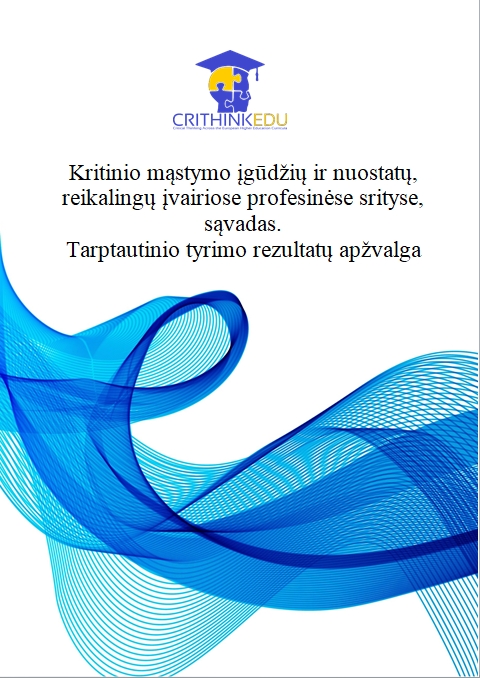
A European Collection of the Critical Thinking Skills and Dispositions Needed in Different Professional Fields for the 21st Century (2018)
This document provides an overall analysis of the understanding of Critical Thinking (CT) by 189 employers of different professional fields (Biomedicine, STEM, Social Sciences and Humanities), and establishes similarities and differences in its expression, need and practical application at the workplace. Rather than guiding teachers and higher education institutions on how to teach or promote CT, this collection aims to provide a consistent basis of skills and dispositions needed in main professions that can be useful to define new learning objectives, goals and outcomes, leading to adaptations that can be incorporated into the existing European university curricula. It is expectable that this study may support organizations and human resources in the design of internal training programs to attend existing needs, as well as to identify future graduates for recruitment purposes.
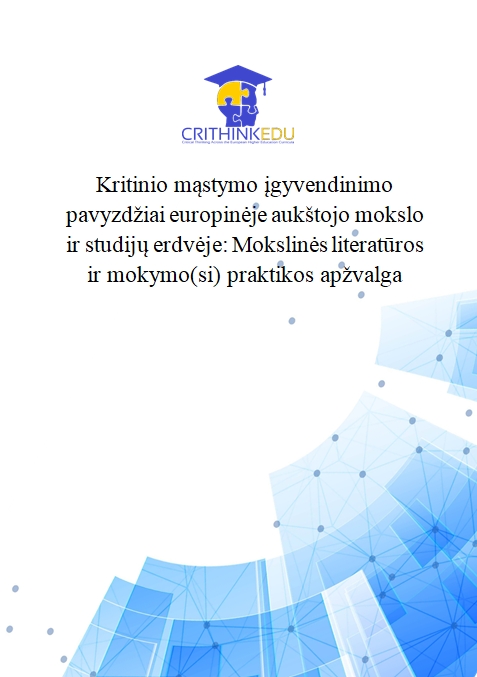
A European Review on Critical Thinking Educational Practices in Higher Education Institutions (2018)
This document derives from the screening of current Critical Thinking (CT) Higher Education education practices from all the partner institutions of the project and from an international literature review, involving the analysis of 46 scientific papers and 53 teachers’ interviews. It presents and discusses current teaching and assessment methods, pedagogical materials and tools, research instruments, and other elements, including mechanisms of support at the institutional level, to favour the acquisition of CT skills. It identifies the gaps between the CT needs in different professional fields and the current pedagogical practives, proposing a preliminary proposal of guidelines/recommendations for quality in CT education in European Higher Education Institutions.
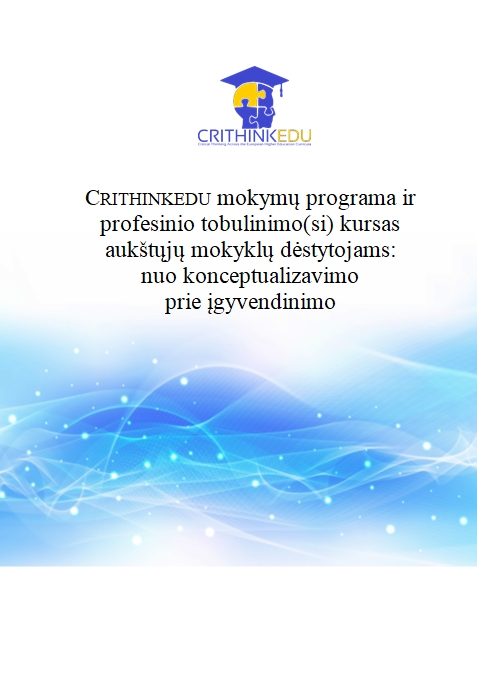
The CRITHINKEDU European Course on Critical Thinking Education for University Teachers: From Conception to Delivery (2018)
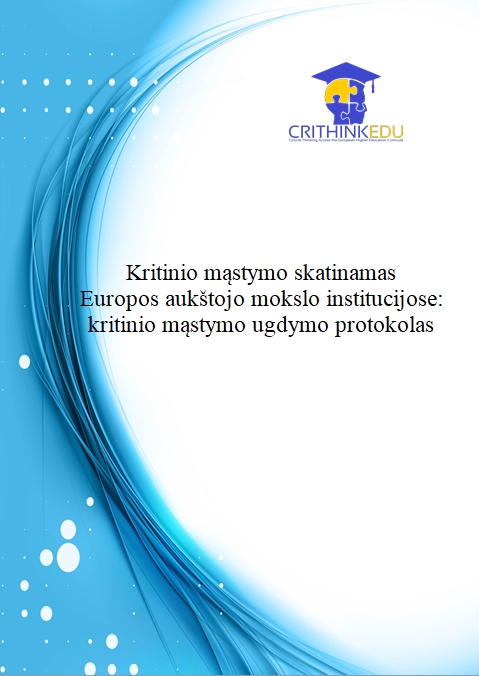
Promoting Critical Thinking in European Higher Education Institutions: Towards an Educational Protocol (2019)
Critical thinking is a vital objective of higher education institutions. To contribute to the achievement of this goal, the project partners have developed this protocol. The protocol is designed to support the development of critical thinking within higher education institutions, highlighting essential elements related to the cultivation and promotion of critical thinking in higher education.
The protocol is based on two fundamental premises: 1) students will develop and refine their critical thinking by engaging in appropriate and purposefully organized critical thinking activities; 2) the strength and quality of critical thinking lie in its continuous practice and improvement.
The target group for this protocol is higher education staff responsible for designing study programs and educating students. Naturally, this document may also be of interest to others involved in or interested in higher education and critical thinking. The protocol consists of five parts. The first part introduces the problem, while the second presents theoretical perspectives and assumptions. The third part is dedicated to presenting possibilities for modeling critical thinking. The fourth part describes the expression of critical thinking across different fields of study and disciplines. The fifth part focuses on the protocol itself – explaining the concept behind its creation and the expectations for its future application.
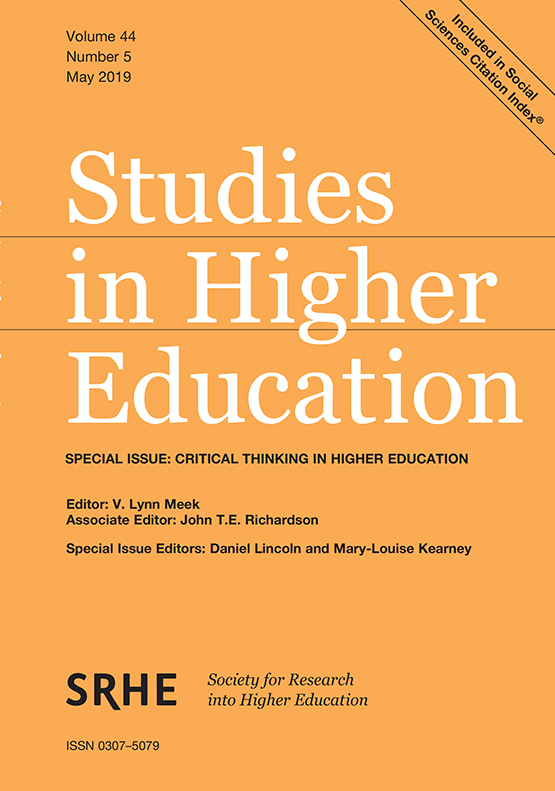
Studies in Higher Education, Volume 44, Issue 5 (2019)
A special issue of the journal Studies in Higher Education, based on the outcomes of the CRITHINKEDU project. The focus is on students’ critical thinking competence, particularly in relation to their employability prospects.
This special issue presents the results of empirical research concerning current pedagogical practices in higher education institutions that promote critical thinking. These findings build upon the work already conducted in developing the final output of the CRITHINKEDU project – a protocol for fostering critical thinking in European higher education, which aims to encourage institutions to take a definitive stance on this issue.
Given the importance of critical thinking in higher education and its specific characteristics across various fields and contexts, this special issue comprises eight articles. These include not only the perspectives of specialists from different fields on critical thinking but also literature reviews of critical thinking development practices across various disciplines.
Download EN
MANIFESTO ON CRITIAL THINKING EDUCATION
Critical thinking is essential for society. Therefore, the development of critical thinking is a vital goal of higher education. Fostering critical thinking requires focused attention and specific educational interventions. This Manifesto is based on an educational protocol, which serves as a guide for promoting the development of critical thinking in higher education institutions.
PROJECT RESULTS
- A study on critical thinking skills in today’s labor market has been conducted.
- A review of scientific literature and higher education teachers’ practices in fostering critical thinking has been prepared.
- A critical thinking development training program for educators has been developed.
- A protocol for the development of critical thinking has been established.
- A special issue of the journal Studies in Higher Education, dedicated to critical thinking competence, has been published.
- Dissemination of project ideas reached 38 countries worldwide.
- The project involved 2,637 participants (including 113 higher education teachers, 2,283 students, 189 professionals, and 52 other education staff).
- 65 project events were held, attended by 1,095 participants (comprising 19 seminars, 10 mini-courses, 11 camps, 24 meetings, and 1 conference).
- On June 3, 2019, the 1st European Summit on Critical Thinking Education was organized in Leuven in collaboration with the Foundation for Critical Thinking (USA). The summit brought together higher education researchers, lecturers, deans, student support agencies, policymakers, and employers interested in investing in critical thinking development. During the summit, the key results of the CRITHINKEDU project were presented, and participants were encouraged to take a stance on the future of critical thinking in European higher education by signing the Manifesto on Critical Thinking Education.
Impact on Higher Education:
- Increased awareness of the need for critical thinking development.
- Improvement of curriculum design and teaching practices.
- Expansion of the network of scientists and researchers.
- Engagement across all institutional levels in supporting critical thinking development.
- Closer collaboration between universities and businesses in fostering critical thinking.
- Enhancement of educators’ professional development and students’ critical thinking skills.
- Implementation of operational and teaching strategies that promote and sustain critical thinking.
- Creation of critical thinking development scenarios across various fields of higher education.
PROJECT DISSEMINATION

- Ahern, A., Dominguez, C., McNally, C., O’Sullivan, J., & Pedrosa, D. (2019). A literature review of critical thinking in engineering education. Studies in Higher Education, 44(5), 816–828. DOI: https://doi.org/10.1080/03075079.2019.1586325
- Bargiela, I., Puig, B., Blanco Anaya, B., & Crujeras, B. (2017). Pensamiento crítico en educación superior: análisis de un grupo de discusión. Enseñanza de las Ciencias, N.º extraordinario, 2799-2804. ISSN: 2174–6486
- Carvalho, M., Dominguez, C., & Morais, T. (2019). Desenvolver o Pensamento Crítico através da Pesquisa Guiada e Jigsaw: um estudo exploratório num curso de engenharia. Revista Lusófona de Educação, 40(44), 211–230.
- Cruz, G., Nascimento, M., Payan-Carreira, R., Dominguez, C., Silva, H., & Morais, F. (2017, September 3–6). CRITHINKEDU: from labor market needs to Critical Thinking across the European Higher Education Curricula. Paper presented at the 39th EAIR Forum Porto 2017 – “Under Pressure? Higher Education Institutions Coping With Multiple Challenges”, Porto, Portugal.
- Cruz, G., Payan-Carreira, R., & Dominguez, C. (2017). Critical thinking education in the portuguese higher education institutions: a systematic review of educational practices. Revista Lusófona de Educação, 38, 43–61.
- Cruz, G., Nascimento, M., & Dominguez, C. (2019). With a little help from my peers: professional development of higher education teachers to teach critical thinking. Revista Lusófona de Educação, 44(44), 141–157.
- Dimitriadou, C., Vrantsi, A., Lithoxoidou, A., & Seira, E. (2018, June 20-22). Teachers’ critical thinking dispositions through their engagement in action research projects: An example of best practice. Paper presented at the 1st International Conference on Technology and Innovation in Learning, Teaching and Education (TECH-EDU 2018), Thessaloniki, Greece.
- Dumitru, D. (2017, May 18). What employers think about critical thinking? Preliminary research report . Paper presented at the 6th Annual Edition of the International Conference EdProf 2017 – “Professionalism in Education”, Bucharest, Romania.Dumitru, D. (2018, June 20–22). University teachers’ thoughts about how critical thinking is a part of their classes. Paper presented at the 1st International Conference on Technology and Innovation in Learning, Teaching and Education (TECH-EDU 2018), Thessaloniki, Greece.
- Dumitru, D. (2019, February 4–6). Arts and Humanities as a source of Critical Thinking Development. Paper presented at the 6th International Conference on Education and Social Sciences (INTCESS 2019), Dubai, United Arab Emirates.
- Dumitru, D. (2019). Creating meaning. The importance of Arts, Humanities and Culture for critical thinking development . Studies in Higher Education, 44(5), 870–879. DOI: https://doi.org/10.1080/03075079.2019.1586345
- Lopes, J., Silva, H., & Morais, E. (2019). Teste do Pensamento Crítico e Criativo para estudantes do ensino superior. Revista Lusófona de Educação, 44(44), 173–189.
- Lorencová, H., Jarošová, E., Avgitidou, S., & Dimitriadou, C. (2019). Critical thinking practices in teacher education programmes: a systematic review. Studies in Higher Education, 44(5), 844–859. DOI: https://doi.org/10.1080/03075079.2019.1586331
- Mártires, A., Monteiro, M. J., Rainho, M. C., & Branco, M. Z. C. (2019). Promoção de competências de pensamento crítico em estudantes de enfermagem. Revista Lusófona de Educação, 44(44), 173–189.
- Morais, F., Silva, H., Cruz, G., Pedrosa, D., Payan-Carreira, R., Dominguez, C., & Nascimento, M. M. (2018, June 20–22). Perceptions of Portuguese university teachers about critical thinking educational practices. Paper presented at the 1st International Conference on Technology and Innovation in Learning, Teaching and Education (TECH-EDU 2018), Thessaloniki, Greece.
- Nascimento, M., Silva, H., Morais, F., Pedrosa, D., Cruz, G., Dominguez, C., & Payan-Carreira, R. (2018, June 20–22). Stairway to the Stars: Comparing health and tourism professionals views about critical thinking. Paper presented at the 1st International Conference on Technology and Innovation in Learning, Teaching and Education (TECH-EDU 2018), Thessaloniki, Greece.
- Nascimento, M., Catarino, P., Morais, E., & Vasco, P. (2019). Com Um Brilhozinho nos Olhos: Três experiências promotoras de ensino do pensamento crítico na área da Matemática. Revista Lusófona de Educação, 44(44), 191–209.
- Payan-Carreira, R., & Cruz, G. (2018, June 20–22). Students’ study routines, learning preferences and self-regulation: are they related?. Paper presented at the 1st International Conference on Technology and Innovation in Learning, Teaching and Education (TECH-EDU 2018), Thessaloniki, Greece.
- Payan-Carreira, R., Cruz, G., Papathanasiou, I., Fradelos, E., & Jiang, L. (2019). The effectiveness of critical thinking instructional strategies in health professions education: a systematic review. Studies in Higher Education, 44(5), 829–843. DOI: https://doi.org/10.1080/03075079.2019.1586330
- Penkauskienė, D. (2017). Kritinio ir kūrybinio mąstymo sąsaja. Socialinė teorija, empirija, politika ir praktika, 13, 90–104. DOI: 10.15388/STEPP.2016.13.10045
- Penkauskienė, D., Railienė, A., & Cruz, G. (2019). How is critical thinking valued by the labour market? Employer perspectives from different European countries . Studies in Higher Education, 44(5), 804–815. DOI: https://doi.org/10.1080/03075079.2019.1586323
- Poce, A., Agrusti, F., & Re, M. R. (2017, June 21–23). Use of webcasting and development of critical thinking skills. Paper presented at the 3rd International Conference on Higher Education Advances, HEAd’17. doi: 10.4995/HEAd17.2017.5452
- Pnevmatikos, D., Christodoulou, P., & Fachantidis, N. (2018, June 20–22). Promoting critical thinking dispositions in children and adolescents through Human-Robot Interaction with Socially Assistive Robots. Paper presented at the 1st International Conference on Technology and Innovation in Learning, Teaching and Education (TECH-EDU 2018), Thessaloniki, Greece.
- Pnevmatikos, D., Christodoulou, P., & Georgiadou, T. (2019). Promoting critical thinking in higher education through the values and knowledge education (VaKE) method. Studies in Higher Education, 44(5), 892–901. DOI: https://doi.org/10.1080/03075079.2019.1586340
- Puig, B., Blanco-Anaya, P., Bargiela, I., & Crujeiras-Pérez, B. (2019). A systematic review on critical thinking intervention studies in higher education across professional fields. Studies in Higher Education, 44(5), 860–869. DOI: https://doi.org/10.1080/03075079.2019.1586333
- Silva, H., Lopes, J., & Dominguez, C. (2018, June 20–22). Enhancing college students’ critical thinking skills in cooperative groups. Paper presented at the 1st International Conference on Technology and Innovation in Learning, Teaching and Education (TECH-EDU 2018), Thessaloniki, Greece.
- Spyrtou, A., Manou, L., Peikos, G., & Zachou, P. (2018, June 20–22). Facilitating Primary Student Teachers’ Development of Critical Thinking Through a Nanotechnology Module. Paper presented at the 1st International Conference on Technology and Innovation in Learning, Teaching and Education (TECH-EDU 2018), Thessaloniki, Greece.
- Tiruneh, D., Cock, M., & Elen, J. (2018). Designing Learning Environments for Critical Thinking: Examining Effective Instructional Approaches. International Journal of Science and Mathematics Education, 16(6), 1065–1089. DOI: https://doi.org/10.1007/s10763-017-9829-z
- Verburgh, A. (2019). Effectiveness of approaches to stimulate critical thinking in social work curricula. Studies in Higher Education, 44(5), 880–891. DOI: https://doi.org/10.1080/03075079.2019.1586336
- Agrusti, F. (2017, June). Use of webcasting and development of Critical Thinking skills. Presented at the 3rd International Conference on Higher Education Advances (HEad’17), València, Spain.
- Aleixandre, M. P. J., Puig, B. & Blanco, P. (2019, June). Using socio-scientific issues contexts for promoting Critical Thinking. Presented at the 1st European Summit for Critical Thinking Education, Leuven, Belgium.
- Bîgu, D. (2019, June). An Outline of a Critical Thinking Course for Public Policy and Business Students. Presented at the 1st European Summit for Critical Thinking Education, Leuven, Belgium.
- Carvalho, M., Morais, T. & Dominguez, C. (2019, July). O uso das técnicas de pesquisa guiada e Jigsaw como alavancas do pensamento crítico. Presented at the 6º Congresso Nacional de Práticas Pedagógicas no Ensino Superior (CNaPPES.19), Santarém, Portugal. Note: this presentation is only available in Portuguese.
- Cruz, G. (2017, July). Critical Thinking in Portuguese Higher Education: a systematic literature review on pedagogical practices and interventions. Presented at the 4th National Congress of Pedagogical Practices in Higher Education (CNaPPES.17), Setúbal, Portugal. Note: this presentation is only available in Portuguese.
- Cruz, G. (2017, September). CRITHINKEDU: from labor market needs to Critical Thinking across the European Higher Education Curricula. Presented at the 39th EAIR Forum 2017, Porto, Portugal.
- Cruz, G., Dominguez, C., Payan-Carreira, R., Nascimento, M., Silva, H. & Morais, F. (2019, July). ODesafiar alunos, professores e empresas a pensar criticamente os problemas do século 21: o ‘Dia do Pensamento Crítico’ na UTAD. Presented at the 6º Congresso Nacional de Práticas Pedagógicas no Ensino Superior (CNaPPES.19), Santarém, Portugal. Note: this presentation is only available in Portuguese.
- Cruz, G., Dominguez, C., Payan-Carreira, R., Nascimento, M., Silva, H. & Morais, F. (2019, July). Implementar práticas pedagógicas promotoras do pensamento crítico nos curricula do ensino superior europeu: o protocolo CRITHINKEDU. Presented at the 6º Congresso Nacional de Práticas Pedagógicas no Ensino Superior (CNaPPES.19), Santarém, Portugal. Note: this presentation is only available in Portuguese.
- Cruz, G., Silva, H., Lopes, J. & Dominguez, C. (2019, June). Enhance students’ critical thinking skills and dispositions through cooperative learning. Presented at the 1st European Summit for Critical Thinking Education, Leuven, Belgium.
- De Keyzer, J. & Jiang, L. (2019, June). Critical thinking in STEM: problem solving by modeling and practice. Presented at the 1st European Summit for Critical Thinking Education, Leuven, Belgium.
- Dimitriadou, C. (2017, April). Aspects of Action Research in European ERASMUS+ Projects: The case of CRITHINKEDU. Presented at the “Educational Action Research: Challenges, Conflicts and Perspectives” Symposium, Florina, Greece. Note: this presentation is only available in Greek.
- Dimitriadou, C., Vrantsi, A., Lithoxoidou, A., & Seira, E. (2018, June). Teachers’ critical thinking dispositions through their engagement in action research projects: An example of best practice. Presented at the 1st International Conference on Technology and Innovation in Learning, Teaching and Education (TECH-EDU 2018), Thessaloniki, Greece.
- Dominguez, C. (2017, May). Human Capital, Higher Education and Regional Development in Southern Europe: Should we invest in Critical Thinking across the Higher Education Curricula?. Presented at the EDULOG 2017 International Conference – Economic Development in Southern European Regions: Policies and Higher Education, Porto, Portugal.
- Dominguez, C. (2018, September). Critical Thinking across the European Higher Education Curricula: lessons learnt. Presented at the OECD Meeting, Paris, France.
- Dumitru, D. (2017, May). What employers think about critical thinking? Preliminary research report . Presented at the 6th Annual Edition of the International Conference EdProf 2017 – Professionalism in Education, Bucharest, Romania.
- Dumitru, D. (2018, June). University teachers’ thoughts about how critical thinking is a part of their classes. Presented at the 1st International Conference on Technology and Innovation in Learning, Teaching and Education (TECH-EDU 2018), Thessaloniki, Greece.
- Dumitru, D. (2018, August). The transfer and transferability of critical thinking skills. Presented at the XXIV World Congress of Philosophy, Beijing, China.Dumitru, D. (2018, September). Critical thinking and teaching critical thinking. Presented at the OECD Meeting, Paris, France.
- Elen, J. (2019, May). Stimulating critical thinking in higher education: practical insights from educational research. Presented at the Universidad Nacional Agraria La Molina (UNALM), Lima, Peru.
- Elen, J. (2019, March). Design d’enseignement pour le développement de la pensée critique chez les étudiants. Presented at University of Kinshasa, Kinshasa, Congo. Note: this presentation is only available in French.
- Fradelos, E. (2017, March). The development of Critical Thinking in Nursing Education. Presented at the “Public Institute of Vocational Training of State Mental Hospital of Attica ‘Daphne’” Conference, Athens, Greece. Note: this presentation is only available in Greek.
- Fradelos, E. (2017, April). Skills and Dispositions of Critical Thinking: A Qualitative Research Study. Presented at the 10th Pan-Hellenic & 9th Pan-European Scientific & Professional Nursing Conference, Heraklion, Crete, Greece. Note: this presentation is only available in Greek.
- Fradelos, E. (2017, October). Critical Thinking in Nursing Higher Education: Perception and Development. A Qualitative Approach . Presented at the International Conference on Mental Health Care – “Mental Health: Global challenges of XXI century”, Kiev, Ukraine.
- Lorencová, H., Králová, T., & Jarošová, E. (2019, June). Case studies as a vehicle for developing students’ Critical Thinking at the Faculty of Business Administration. Presented at the 1st European Summit for Critical Thinking Education, Leuven, Belgium.
- Morais, F., Silva, H., Cruz, G., Pedrosa, D., Payan-Carreira, R., Dominguez, C., & Nascimento, M. M. (2018, June). Perceptions of Portuguese university teachers about critical thinking educational practices. Presented at the 1st International Conference on Technology and Innovation in Learning, Teaching and Education (TECH-EDU 2018), Thessaloniki, Greece.
- Nascimento, M., Silva, H., Morais, F., Pedrosa, D., Cruz, G., Dominguez, C., & Payan-Carreira, R. (2018, June). Stairway to the Stars: Comparing health and tourism professionals views about critical thinking. Presented at the 1st International Conference on Technology and Innovation in Learning, Teaching and Education (TECH-EDU 2018), Thessaloniki, Greece.
- Nascimento, M., Dominguez, C., Catarino, P. & Morais, E. (2019, June). Nobody said it was easy: Promoting Critical Thinking in STEM. Presented at the 1st European Summit for Critical Thinking Education, Leuven, Belgium.
- Papathanasiou, I. V. (2017, May). Critical Thinking Skills and Dispositions in Health Sector: A Qualitative Research Study. Presented at the 44th Panhellenic Nursing Conference, Naxos, Greece. Note: this presentation is only available in Greek.
- Payan-Carreira, R. (2018, June). Students’ study routines, learning preferences and self-regulation: are they related?. Presented at the 1st International Conference on Technology and Innovation in Learning, Teaching and Education (TECH-EDU 2018), Thessaloniki, Greece.
- Payan-Carreira, R., Papathanasiou, I. V., Fradelos, E. C. & Jiang, L. (2019, June). A win-win deal: Critical thinking in Health Sciences education. Presented at the 1st European Summit for Critical Thinking Education, Leuven, Belgium.
- Penkauskiene, D. & Railiene, A. (2019, June). Framework for teaching critical thinking: Experience of teaching students at a Social Science university. Presented at the 1st European Summit for Critical Thinking Education, Leuven, Belgium.
- Pnevmatikos, D. (2018, June). Promoting critical thinking dispositions in children and adolescents through Human-Robot Interaction with Socially Assistive Robots. Presented at the 1st International Conference on Technology and Innovation in Learning, Teaching and Education (TECH-EDU 2018), Thessaloniki, Greece.
- Poce, A., Re, M. R., Agrusti, F., Cruz, G. & Dominguez, C. (2019, June). Critical Thinking in Information Literacy: what teachers can do in digital era?. Presented at the 1st European Summit for Critical Thinking Education, Leuven, Belgium.
- Poce, A., Re, M. R. & Amenduni, F. (2019, June). How to assess Critical Thinking Through Writing?. Presented at the 1st European Summit for Critical Thinking Education, Leuven, Belgium.
- Railiene, A. (2017, January). Critical Thinking skills in the labor market. Presented at the “Critical Thinking in Education and Job Market” Seminar, Vilnius, Lithuania. Note: this presentation is only available in Lithuanian.
- Silva, H., Lopes, J., & Dominguez, C. (2018, June). Enhancing college students’ critical thinking skills in cooperative groups. Presented at the 1st International Conference on Technology and Innovation in Learning, Teaching and Education (TECH-EDU 2018), Thessaloniki, Greece.
- Spyrtou, A., Manou, L., Peikos, G., & Zachou, P. (2018, June). Facilitating Primary Student Teachers’ Development of Critical Thinking Through a Nanotechnology Module. Presented at the 1st International Conference on Technology and Innovation in Learning, Teaching and Education (TECH-EDU 2018), Thessaloniki, Greece.

Funded by the European Union. Views and opinions expressed are however those of the author(s) only and do not necessarily reflect those of the European Union or the National Agency. Neither the European Union nor National Agency can be held responsible for them.