


Project No. 118435-CP-1-2004-1-LT-COMENIUS-C21
Project duration: 18 November 2004–1 October 2005
Project co-funder: EU Socrates programme
Project coordinator: Šiuolaikinių didaktikų centras
Project partners:
8th Rhodes Primary School (Greece)
West Pirkanmaa District Municipal Federation of Education, Adult Education Unit (Finland)
Vocational College and Practical School, Nový Jičín (Czech Republic)
University of Malta, Faculty of Education (Malta)
Youth Career and Advising Centre (Lithuania)
Kaunas Jonas Jablonskis Gymnasium (Lithuania)
Project experts:
Dr. Kurt Meredith and Dr. Jeannie Steele, Northern Iova University (USA)
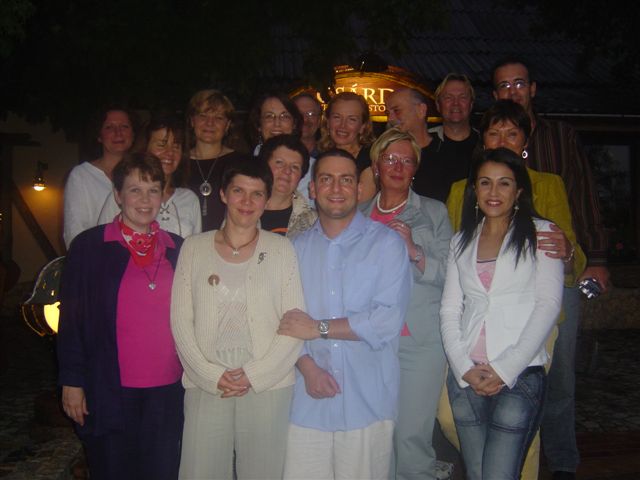
Project team
PROJECT RELEVANCE
In this age of information, everything changes faster than we can think. Technology changes, information changes, and new interpretations of one phenomenon or another emerge. What seemed unshakeable collapses, what seemed obsolete is rediscovered and reevaluated. The process of active learning and discovery is endless. In order to function successfully in a changing world, we must constantly rethink all the information we have and receive and select what is important and what is not.
Educators around the world, from politicians and administrators to curriculum developers and teachers, have been searching for some time for an answer to a fundamental question: how can we prepare students to succeed in the future if we cannot predict what that future will look like even ten years from now? Many countries are implementing educational reforms in an effort to answer this question. Depending on the traditions and needs of a particular country, there may be different answers and solutions to the problem. However, they all have one thing in common: the need to educate critically thinking and responsible citizens, because “everyone is responsible for making important decisions, so it seems obvious that we, as a society, should care about how those decisions are made” (Halpern D. F., Thought and Knowledge, 1996, p. 3).
There is no single definition of critical thinking. Many scholars and educators have debated the key characteristics of this concept. It is agreed that critical thinking is purposeful thinking that uses cognitive strategies and skills to achieve a desired outcome. Critical thinking involves searching for information, exploring ideas, expressing different points of view, solving problems, arguing, making decisions, and forming independent opinions. Many educational documents emphasize that each person’s success and well-being depends on their ability to learn and reflect on the ever-increasing and changing information.
It is estimated that approximately twenty-five percent of jobs will change in the near future: some will change significantly, others will disappear altogether, and new ones will emerge that will be needed due to changes in the social and economic situation. This changing situation forces us to take a fresh look at the concept of a career. Nowadays, people change their profession or job three, four, or more times during their lifetime. Therefore, the conclusion is very clear: it is impossible to teach and learn everything, but it is possible to educate people who are able to learn throughout their lives, think critically, and make successful personal and professional decisions. This is where critical thinking as a skill and tool meets career as a goal and object. Critical thinking skills allow you to navigate information, help you understand your strengths and weaknesses, set goals and pursue them purposefully, make wise choices, and reconsider everything when circumstances change. Critical thinking encourages different opinions and perspectives, especially those based on sound arguments.
All these ideas became our philosophical foundation for implementing the international projects “MIND – Critical Thinking for a Successful Future Career in EU” (2001–2003) and “MIND2 – Critical Thinking for a Successful Future Career in EU: A Practical Approach” (2004–2005). The project partners were the Czech Republic, Greece, Finland, Lithuania, and Malta came together to create a joint product – a professional development program and guide for teachers designed to prepare them to work with an integrated and specialized career education program and guide developed within the framework of the MIND project.
PROJECT AIM
Promote equal opportunities for learning and successful careers in EU.
PROJECT OBJECTIVES
Develop a teacher and teacher trainer professional development program designed to train teachers to work with an integrated and specialized career education program and guide.
Specific objectives:
to develop general framework of the in-servise training programme;
to develop strategies for elaboration of separate in-servise training programme parts;
to arrange mini-seminars and test separate parts of in-servise training programme in partner countries;
to arrange one pilot seminar for multicultural team of teachers and teacher trainers;
to maintain equal partnership and cooperation between project partners in the process.
Long term objectives:
to strengthen international dialogue and relations between country teams for the further successful co-operation;
to promote equal opportunities for quality in education;
to promote equal opportunities – for boys and girls, socially wealthy and socially poor, healthy and disable people – to choose way of life.
PROJECT TARGET GROUPS
School teachers (including young teachers, teachers-experts, teacher trainers, teachers working with special need children, initial training teachers) who have already tested the project materials, and are willing to disseminate the project ideas and methodology as trainers in their communities. The course is planed as in-service training for different levels and types of schools, including the lowest (pre-primary) and highest one (gymnasium/high school).
PROJECT INTELLECTUAL OUTPUTS
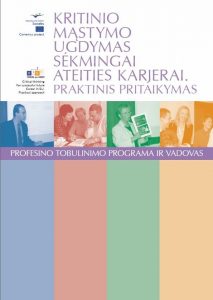
Developing Critical Thinking for a Successful Future Career. Practical Approach: Professional Development Program and Guide (2005)
The publication is intended for teachers, lecturers, and career advisors working with adults, with the aim of preparing teachers to work with integrated and specialized career education programs developed in 2001–2003 as part of the project “MIND – Developing Critical Thinking Skills for Successful Future Careers in the EU.” The guide provides ideas on the stages of planning and preparing to teach courses to teachers, how to deliver the course, and how to encourage reflective activities. The guide presents the competencies, knowledge, skills, and attitudes necessary for the successful implementation of the program. It combines theory and practical examples that will help to model a professional development program and prepare qualification improvement courses for those who want to purposefully implement the presented provisions for critical thinking education for a successful future career. The guide for lecturers is authentic, tried-and-tested material based on the experience of the project.
PROJECT RESULTS
- The project brought together seven partner institutions (NGOs, general education, higher education, and special education schools) from five countries (Lithuania, the Czech Republic, Greece, Malta, and Finland).
- A professional development program and guide for working with integrated and specialized career education programs have been prepared.
- Professional development program tested in partner countries (112 participants).
- Teams of lecturers have been set up in each country to train other teachers to work with integrated and specialized career education programs.
- Accredited 40-hour program “Critical Thinking for a Successful Future Career.”
- On July 18–22, 2004, and June 10–16, 2005, together with the Youth Career Center, organized international Socrates Grundtvig seminars “Critical Thinking Development for Successful Future Career” (16 participants).
[masterslider_pb alias=”ms-8-1-1-1-2-1″]

Funded by the European Union. Views and opinions expressed are however those of the author(s) only and do not necessarily reflect those of the European Union or the National Agency. Neither the European Union nor National Agency can be held responsible for them.