

Project duration: 2008–2010
Project funder: Nordic Council of Ministers, The Nordplus Framework Programme
Project coordinator: Pirkanmaa Westcome, Adult Education Unit (Finland)
Project partners:
Modern Didactics Centre (Lithuania)
Secretary General Folkeuniversitetet, Adult Education Association (Norway)
Norwegian Association for Distance and Flexible Education (Norway)
Centre for Lifelong Learning in the Westfjords (Iceland)
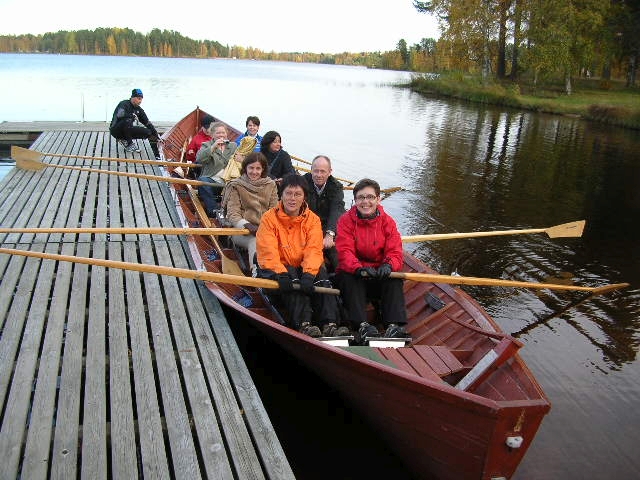
Project team
PROJECT RELEVANCE
In the manifestation of UNESCO’s fifth world conference of adult education held in Hamburg it is said: ”There are more elderly people in the world in relation to the whole population than ever before, and their proportion is getting bigger all the time. These elderly people have a lot to give to the social development. Because of that it is important that for them there is an equal opportunity to learn in ways which are suitable for them. We have to recognize their skills and abilities and we have to be able to exploit these”. The theme of lifelong learning touches both working age and retired population. The implementation of new technology requires continual learning of new skills to keep up professional know-how. On the one hand, new methods of learning and teaching are needed, on the other hand, developing new technology so that it is suitable for use by seniors.
The methods used in adult education today do not give adequate support to the participation of seniors. Therefore one of the biggest challenges of adult education is the training of seniors. For this purpose it is important to develop the methods and contents of training. Today there is too much concentration on ”hard” knowledge and the significance of social skills is underestimated. Underlining these skills would strengthen the meaning of experience, which would benefit senior employees and help their training. The resources of adult education must be increased, and more attention must be paid to the development of practical learning situations and training material as well as to diversifying training course contents. Seniors do not often have the capacity to manage modern methods of learning. Senior learning depends on the organization of the learning event: there is a need for own learning strategies, conditions, methods and pace suitable for seniors. In addition, the learning has to be realized according to their aptitude, learning skills and terms. How are the needs of seniors taken into account when planning the contents of training, choosing the methods of teaching and organizing the events of learning?
The purpose of the project is to collect existing knowledge of the methods and contents of teaching that the successful senior learning demands. How can you pay attention to the needs of seniors in today’s supply of learning opportunities? How can you make sure that seniors are in a position to participate in training and learn and benefit from it when they desire? How can you reach those who usually do not participate? How can you bring the idea of lifelong learning into practice level?
The methods of education for the aging population have been pondered over on a relatively large scale nationally and there are statistics available. The purpose of this project is to get a larger angle of vision on this subject, covering the Nordic and even the Baltic countries. The purpose is to collect different practices, compare them and analyze their strong and weak points, and to disseminate the best of them to other countries and to the use of other organisations.
This project conforms to the priority of Nordplus Adult programme to develop the quality of adult education.
PROJECT AIM
To map out the good practices of training of seniors used in different partner countries and to disseminate this information to organisations of adult education, authorities and for use in working life.
PROJECT OBJECTIVES
- Gather information on best practices in lifelong learning for older adults in partner countries.
- Develop a guide to best practices.
- Disseminate the gathered information to adult education organizations and other relevant institutions.
PROJECT TARGET GROUPS
- seniors (over 55 years old);
- trainers of seniors;
- employment offices, trade unions or associations working with seniors.
PROJECT ACTIVITIES
The aim of the project is to map out available statistics on training of seniors (over 55 years old) in the partner countries, including e.g. participation in training, staying at work, retirement age, what kind of training they participate in, what are the topics of training, which kinds of adult education organisations exist in different countries, policies for the training of seniors. The partners wrote a report on the basis of this information, where the results are analysed and divided by countries and by ages.
Besides the existing statistics, the project concentrated on collecting information on the methods used in the training of seniors, their positive and negative aspects, and the learning methods seniors prefer to use. For this purpose, the partners together planned and created a questionnaire, which examines such questions as gender, age, still working or retired, needs and interests regarding training, barriers of participation in training, learning styles, reasons of participation in training, which kind of information of training best reaches the seniors, best places and times for training, spare time activities.
On the basis of the survey results, partners prepared advices and recommendations for the training of seniors – best methods and contents, ways to exclude the barriers of participation, and ways of motivation for training and lifelong learning.
Then each partner organisation planned, marketed and arranged a pilot course: Basic Word for Seniors (Norway), The Legacy of the Generations (Iceland), Get Familiar with the Utilization of Internet (Finland), Let‘s Read & Share Joy of Reading (Lithuania).
All project materials were compiled into a publication “NORDIC+ Senior Golden Examples. Findings About Senior Learning from Finland, Iceland, Lithuania and Norway” for dissemination to other organisations and authorities working with adult education and to those who are interested in adult education.
PROJECT INTELLECTUAL OUTPUTS
Research „Motivating the Aged to Participate in Lifelong Learning“ (2009)
A study was conducted on the learning of seniors (over 55 years of age) in partner countries, focusing on teaching methods and content that ensure successful learning in older age—information was collected on seniors’ participation in training, learning needs and interests, motivation for learning, barriers to learning, learning methods, leisure activities, the nature and content of training, teaching methods, their positive and negative aspects, which learning methods seniors prefer, and more. In each country, 45–55 seniors from various target groups were surveyed—including those who are employed and unemployed, those actively engaged in learning, and those who, for various reasons, are not currently learning.
The study revealed that older adults in the project partner countries are interested in adult education and intend to learn so they can participate equally in society. A successful future depends on physical and mental health, as well as the ability to use new technologies. A very important motivation for participating in training is the opportunity to meet others who share the same interests. By learning, people feel healthier and become active citizens who contribute to the country’s economic growth. People with diverse skills are a major asset to the labor market. Unfortunately, some older people are forced to retire even though they want to and are able to work. Although employers often prefer to hire young people, this does not mean they will perform better than older workers. Young people lack the experience and wisdom that are often invaluable in professional life. The challenge today is to pass on to the younger generation what the older generation has accumulated.
The results of the study of all countries are presented in the methodological publication.
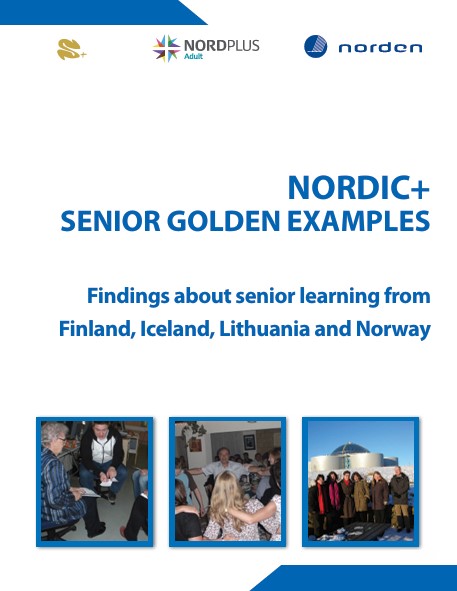
NORDIC+ Senior Glden Examples. Findings About Senior Learning from Finland, Iceland, Lithuania and Norway (2010)
This publication reviews the results of a project aimed at improving the quality of education for older adults. The document compares senior education policies in Finland, Iceland, Lithuania, and Norway, emphasizing that lifelong learning is an essential tool for reducing social exclusion. It presents data from the 2009 study “Motivating the Aged to participate in Lifelong Learning”, based on which the authors emphasize that traditional teaching methods are often unsuitable for seniors, so it is necessary to focus on practical training, the development of social skills, and personal experience. At the end of the publication, specific recommendations and examples of best practices are provided, such as computer literacy or reading promotion activities tailored to the older generation. This material is intended for adult educators who wish to apply the experience of the Nordic and Baltic countries to their work.
PROJECT RESULTS
- The result of the project is to find out new methods to increase the knowledge and skills of seniors, to find out ways for motivating to training and reasons for non-participation in training.
- Different kinds and types of organisations working with adult education have an opportunity to work together to achieve the common aims.
The report on the statistics concerning the training of seniors was performed in partner counties. - The project publication, where recommendations, good practices and examples of the training of seniors (needs, aims, barriers etc. concerning participation) are collected.
- As a result of the dissemination of the report and the publication, organisations in different countries have an opportunity to become familiar with the practices in other countries, utilize them and learn from them.