




Project No. 118340-CP-1-2004-1-BE-COMENIUS-C21
Project duration: 3 February 2005–11 March 2007
Project co-funders:
European Commission
EU Socrates Programme Coordination Support Foundation in Lithuania
Project coordinator: University College Arteveldehogeschool (Belgium)
Project partners:
Modern Didactics Center (Lithuania)
Vilnius Pedagogical University (Lithuania)
University of Malta (Malta)
Stavanger University (Norway)
Ramon Llull University (Spain)
University of Gävle (Sweden)

Project team
PROJECT RELEVANCE
The aim of MOST is to contribute to the development of a European standard for the starting teacher. This standard will be based on action research composed by the mobility of teacher trainees for the purpose of teaching practices and a joint evaluation strategy for the recognition of these activities. At this moment there is no European standard for teachers, nor a national standard in the countries participating in the project. This is an obstacle for European mobility.
MOST focuses especially upon the standard for the starting teacher. At the end of his studies the teacher trainee must have reached the basic competencies to start his professional life. During his studies he will evolve towards obtaining the competencies and this evolution will continue during his professional life. Therefore the standard for the starting teacher must keep all elements of the standard itself. The teacher trainee will be involved as evaluator and will be evaluated so that he is able to continue his self-reflection and self-evaluation to grow as a good teacher. This idea will be used inside MOST by the teacher educators through action research. The teacher educators start with comparative analyses of the final goals and methods of assessment. They test their methods upon the training inside this exchange programme and develop techniques to permanently upgrade the proposed standard for the starting teacher. This new European standard for the starting teacher is developed within teacher training institutions and can inspire the decision makers in the field of education and teacher training. It is the ultimate aim of the project to raise the quality of teacher training in Europe. This will be done through target-oriented training, using the standard as a qualitative tool for the starting teacher to reach qualitative basic competences and for the teacher educator to guide his/her students in this process.
The current situation in the countries involved:
Belgium (Flanders – Arteveldehogeschool): the government has put the basic competencies for teachers in a decree. Teacher training institutions are free to determine how their students should acquire those competencies at the end of their training programme. Arteveldehogeschool has made its own translation to evaluate their teacher trainees. (see supporting document 2)
Lithuania: a new concept of teacher training is to be prepared to reflect the priorities of the recent reform on higher education.
Malta: is doing research upon the teacher standards in function of a reform
Norway (Stavanger) has a national plan for the practical training, which is also transformed to a local plan by Stavanger University College.
Sweden (Gävle): has a new organization for the practice with criteria for evaluating the teaching performance of teacher trainees during their teaching practice period.
During the preliminary meeting in Gent (January 2004) it became very clear that all partners work to optimize the practical training to prepare their teacher trainees for the future challenges in schools. All recognize that the problems of assessment are connected with the need of a clear standard for the starting teacher. To realize the evaluation and the academic recognition of the training period abroad becomes a driving force to reach a consensus about a European standard for the teacher trainee at the end of his studies. “European standard for the starting teacher” means a standard made by six teacher training institutions of six European countries.
PROJECT AIM
The overall aim of MOST is to contribute to the mobility of teachers in Europe. The specific objectives are:
A good framework for mobility of teacher trainees, including practice and recognition of those activities. Within the Socrates / Erasmus programme, mobility of teacher trainees is a difficult issue as teaching practice has different approaches in the different European countries.
PROJECT OBJECTIVES
- To develop a framework for mobility of teacher trainees and organise teaching internships for students in partner countries.
- Perform an activity study based on students’ experiences during their internships.
- To develop common European standard for the beginning teacher (including both a common European part and a specific part per partner), giving all partners involved a workable tool to evaluate their teacher trainees.
- To create a dynamic evaluation system for the European standard for the beginning teacher, so that the European standard stays in tune with the changing society and the role of teacher training institutions in society.
PROJECT TARGET GROUPS
- Teacher trainees trained to work in schools with children aged 10 to 18.
- Teacher educators and teacher training institutions.
- The mentors in the schools.
- Decision makers in the field of education / teacher training.
PROJECT ACTIVITIES
STUDENT MOBILITY
During the project, in February and March 2005–2007, student mobility was organized for 5-week teaching internships at the project partners’ higher education institutions in Belgium, Norway, Sweden, Malta, Spain, and Lithuania. A total of 154 students participated in the exchange program. The students completed their teaching internship at universities and general education schools, where they were supervised by teacher-mentors. During the internship, students observed classes, taught them independently, carried out projects, and led extracurricular activities.
The chosen internship structure –1+3+1 – allocated the first week to familiarizing students with the host institution, the country’s education system, culture, and traditions; discussing internship evaluation criteria and meeting with mentors. Three weeks are dedicated to practical work at the school (observing lessons, preparing for lessons, organizing lessons and after-school activities). The final week involves student self-assessment, reflection, discussion, and the evaluation and assessment of the entire internship.
ACTION RESEARCH
During the internships, students, teacher-mentors, and faculty members conducted an action research study – continuously observing and evaluating the progress of the internships. The data from the action research was used to develop a standard for teacher trainees.
The internship was evaluated based on changes in professional, learning, and social competencies. Evaluation was conducted in various ways, with some of the main methods being: a two-way journal, the portfolio method, and reflection. For the internship evaluation, students were required to submit a prepared practicum portfolio, in which they had the opportunity to reflect systematically on the entire internship, starting with an introduction, presenting their first impressions of the country and the school, and concluding with a detailed analysis of a lesson, emphasizing its different stages – preparation, classroom management skills, student motivation, and assessment. At the end of their internship, students were asked to analyze their experience in three aspects: professional (I as a teacher), social (I as a community member), and learner (I as a student). All students who participated in the program acknowledged that they had improved their skills in all these aspects, but believe that they improved the most in terms of “me as a teacher” and “me as a student.”
Competence assessment criteria (EN)
STANDARD FOR TEACHER TRAINEES
University lecturers participating in the project conducted a comparative analysis of students evaluation methods and tested these methods during students internship. Based on data from the study of students and teacher-mentors activities, the faculty members developed a model of the teacher trainees standard. The standard defines the core competencies of a teacher trainees necessary to begin teaching, as well as methods for assessing these competencies.
For teacher trainees this standard will serve as a guide for improving professional competence, while for lecturers and mentor teachers, it will assist in evaluating students’ performance during their internship.
PROJECT INTELLECTUAL OUTPUTS

MOST Project Handbook (2007)
The Handbook intended for students and mentors. It presents the theoretical framework of the project, covering the modeling of the learning process, the setting of learning objectives, content, formats, activities, and methods. It includes tasks for the teacher to complete, questions to help them assess themselves as educators, and lesson models designed to help students not only acquire general knowledge but also develop the ability to listen, communicate, and evaluate their own and others’ activities. Observation forms are also provided for the mentor, the student, and the university students participating in the project and observing the teachers’ work. The “Assessment” section presents the “European Standard for Teacher Trainees” developed during the project, which discusses the core competencies a teacher must acquire at various levels: the classroom, the school community, and society. It also includes evaluation documents for mentors and students regarding project activities, as well as specific tasks for project participants to help them monitor, evaluate, and improve their own competencies as teachers.
Download EN
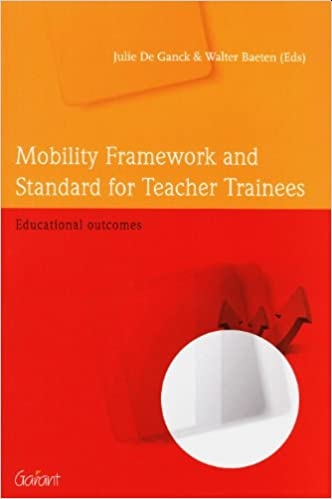
Mobility Framework and Standard for Teacher Trainees. Educational Outcomes (2012)
This publication provides an overview of the implementation of student internship in the project partner countries and discusses methodological aspects of the standard for teacher trainees. The development of this standard was based on research into student internship. Intensive efforts were made to create a system that would facilitate the mobility of student teachers and trainee teachers in Europe in the future. Consequently, the European Credit Transfer System (ECTS) and academic recognition were introduced.
The organization of exchange programs between different partner institutions is an important incentive for developing a shared understanding of the similarities and differences among school systems in various European countries and for identifying the core competencies that a teacher trainees should possess in order to work within a European context.
Download EN

Mobility Framework and Standard for Teacher Trainees. The Theoretical Framework (2012)
The European Standard for Teacher Trainees defines the competencies that a new teacher should possess. These competencies are organized into three equally important areas: a) at the classroom level, b) at the school community level, and c) at the societal level. The principles of classroom management for novice teachers, the specifics of communication with students, the necessity of professional competencies, and the role of the teacher as a member of the community and society are discussed.
Download EN
PROJECT RESULTS
The direct outcome is a structured framework for the organization of mobility activities of teacher trainees including the practical training and the recognition of these activities. It is the ultimate aim of the project to raise the quality of teacher training in Europe. This was done through target-oriented training, using the standard as a qualitative tool for the starting teacher to reach qualitative basic competences and for the teacher educator to guide his/her students in this process. In this respect, the enhancement of the professionalization of all actors involved in the project (teacher trainees, teacher educators, mentors) was significant and had impact on the future generations of teacher educators, trainees and mentors.

Funded by the European Union. Views and opinions expressed are however those of the author(s) only and do not necessarily reflect those of the European Union or the National Agency. Neither the European Union nor National Agency can be held responsible for them.