Project duration: 19 September–31 December 2003
Project co-funders:
Open Society Fund-Lithuania
Danish Embassy in Lithuania
Project coordinator: Modern Didactics Center
Project partners:
Special Investigation Service of the Republic of Lithuania
Ministry of Education and Science of the Republic of Lithuania
Transparency International-Lithuanian Chapter
Project consultants:
Evaldas BAKONIS – head of Textbooks Research and Information Center at the Center for Education Development, teacher of Vilnius S.Daukantas secondary school
dr.Vaiva VAICEKAUSKIENE – senior specialist of the Center for Education Development
Arturas PALIUSIS – head of Public Education and Support unit, Special Investigation Service
Aida MARTINKENIENE – senior specialist of Special Investigation Service
Ramune PAUKSTIENE – specialist of Special Investigation Service
Arne NIELSEN – expert of PLS Rambøll Management, Denmark
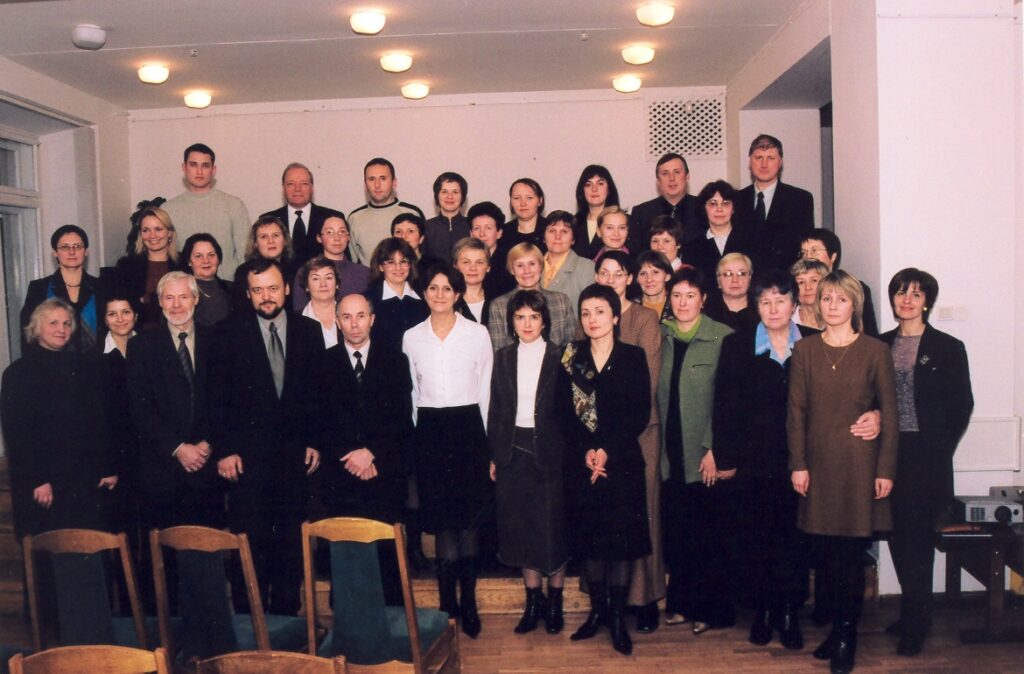
Project participants at the final confeence
PROJECT RELEVANCE
Corruption is believed to be a more pressing issue in post-communist states than in other Western countries. Communist systems relied on corruption as a consolidating force, where kleptocracy and clientelism had become the norm. These behavioral habits and mental stereotypes become obstacles to the establishment of democratic states and a private economy based on free competition. Due to the complexity and specificity of corruption-related crimes in Lithuania, a special anti-corruption institution—the Special Investigation Service (STT)—was established in the autumn of 1997.
The measures of the National Anti-Corruption Program, approved by the Seimas of the Republic of Lithuania, aim not only to detect crimes; significant attention is also devoted to corruption prevention and public education. The program declares one of its most important tasks as follows: “To promote intolerance towards manifestations of corruption in every possible way, to collaborate closely with non-governmental organizations and the media for this purpose, and to create and implement educational programs within the education and science system.”
The implementation plan for the program’s measures included the preparation of a draft of methodological recommendations for anti-corruption education and the subsequent implementation of these recommendations. The participation of general education schools in anti-corruption education is also mandated by Article 10 of the Law on the Prevention of Corruption of the Republic of Lithuania [2002], adopted by the Seimas:
- Anti-corruption public education shall be carried out as an integral part of public education in order to foster personal morality, cultivate citizenship and the understanding of an individual’s rights and duties to society and the State of Lithuania, and to ensure the implementation of corruption prevention objectives.
- Anti-corruption public education shall be carried out in educational institutions of all types and levels according to prepared educational programs, through the media, and by other means.
The relevance of the project is based on the aim to integrate anti-corruption education into the general school curriculum as a component of civic awareness. Since the educational reform in Lithuania is oriented toward the creation of a free, democratic state, corruption prevention has become a necessary value-based counterweight to the legacy of the Soviet mentality. The project seeks not only to provide theoretical knowledge but also to change the attitudes of students and educators by promoting transparency and personal responsibility. Such an initiative is relevant in addressing the issue of public distrust in institutions and in raising a younger generation capable of recognizing and resisting dishonest behavior.
PROJECT AIM
To form pupils’ active civil position and to raise intolerance towards corruption by implementing anti-corruption education in a school of general education curriculum.
PROJECT OBJECTIVE
To prepare a programme and methodical recommendations of anti-corruption education for teachers of a school of general education.
PROJECT PARTICIPANTS
Project was devoted to teachers and pupils of a school of general education, school and local communities.
32 teachers of Ethics, Psychology, Religion, History, Political Science, Civic Education from following schools participated in the project:
Anykščiai Antanas Baranauskas Secondary School
Elektrėnai „Ąžuolynas“ Secondary School
Gargždai „Vaivorykštė“ Gymnasium
Kėdainiai „Atžalynas“ Secondary School
Marijampolė 6th Secondary School
Mažeikiai „Venta“ Secondary School
Panevėžys 9th Secondary School
Pasvalys Petras Vileišis Gymnasium
Radviliškis Vaižgantas Gymnasium
Raseiniai „Šaltinis“ Secondary School
Šiauliai Stasys Šalkauskis Secondary School
PROJECT ACTIVITIES
Project team was actively involved in trainings, development of an integrated anti-corruption programme and testing of anti-corruption education strategies and methods at schools. Group of teachers attended various training courses, broadened their knowledge about corruption, discussed how to convey the information and experience they had to pupils in the most interesting and understandable way.
31 October 2002
Seminar “International Experience in the Field of Anti-Corruption Education”. The Meaning of Corruption”
9–10 December 2002
Seminar “Meaning of Anti-Corruption Education”
6–7 February 2003
Seminar “Development of Integrated Anti-Corruption Programme”
28–29 April 2003
Seminar “Anti-Corruption Education at School”
6–10 October 2003
Anti-corruption week at schools
23–24 October 2003
Seminar “Examples of Crime Prevention Education: Ideas, Materials, Implementation”
28 November 2003
Final conference
PROJECT INTELECTUAL OUTPUT

Anti-corruption education at school: Methodical material for general and higher education schools (2006)
This methodological tool is intended for educators seeking to integrate the values of integrity and citizenship into the educational process. The publication consistently analyzes the concept of corruption, the harm it causes to society, and emphasizes the importance of preventive work starting from the school bench. Teachers from general education schools and project participants actively took part in the preparation of this methodological material. The authors provide specific didactic recommendations and practical methods on how to discuss complex ethical issues with students of various ages.
Practical examples of lessons and extracurricular activities will help to better understand the content of anti-corruption education and the possibilities for applying these methods. For those seeking more information, additional materials and references to literary sources are provided. The developers of this tool hope that this publication will assist teachers wishing to carry out educational corruption prevention activities, help them gain more knowledge about the concept of corruption, and explore possibilities for integrating anti-corruption education into academic subjects and after-school activities. Furthermore, it aims to encourage a more active interest in the public life of the country and foster an active, well-reasoned civic stance on issues important to us all. This publication is a valuable tool for creating a transparent school community culture and forming a zero-tolerance attitude toward corruption among young people.
Download LT, EN
PROJECT RESULTS
- Project participants gained knowledge and techniques to apply anti-corruption education strategies during their own lessons and other educational activities.
- Integrated programme of anti-corruption education and methodical recommendations for a school of general education were developed.
- It is expected to expand project at regions: schools, participated in the project, will be responsible for project ideas dissemination and further development.
- It is expected to find funds for project continuation and to train teachers-consultancies of the project, who will be further responsible for the dissemination activities.
- Ministry of Education and Science approved anti-corruption education programme for general education in 2005, therefore project could be developed at broader extend.
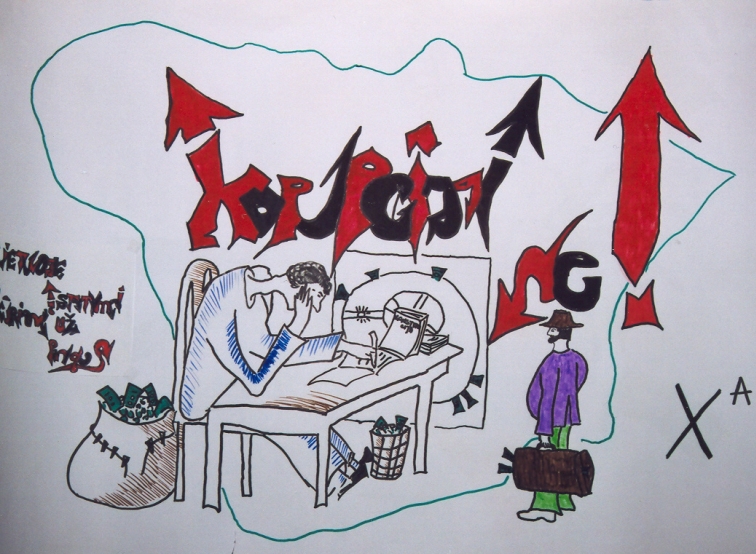
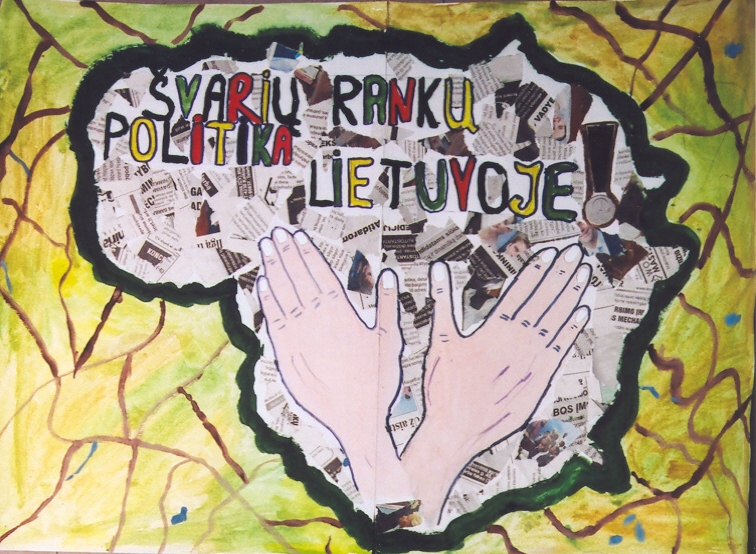
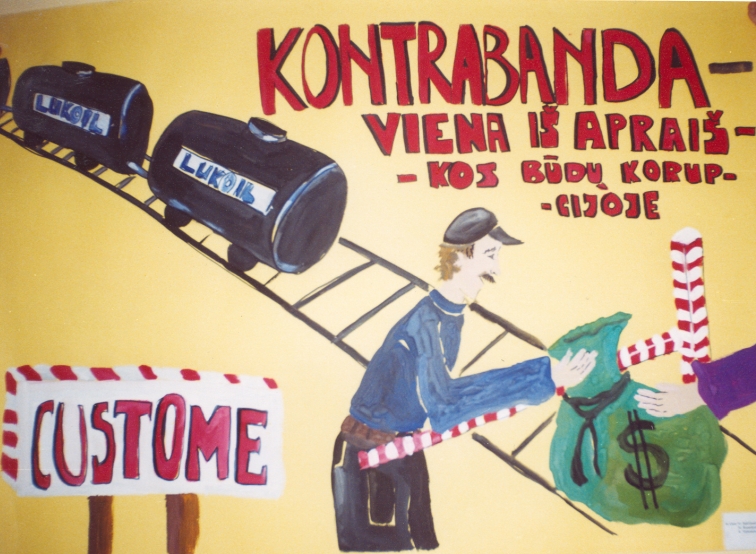
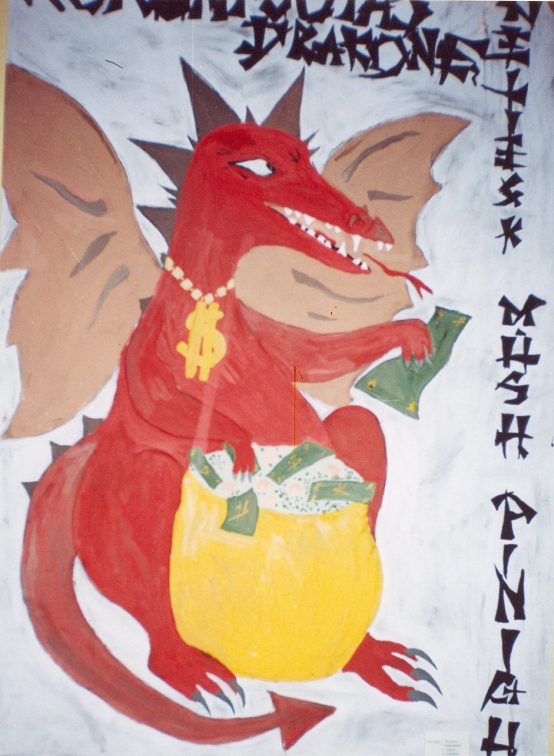
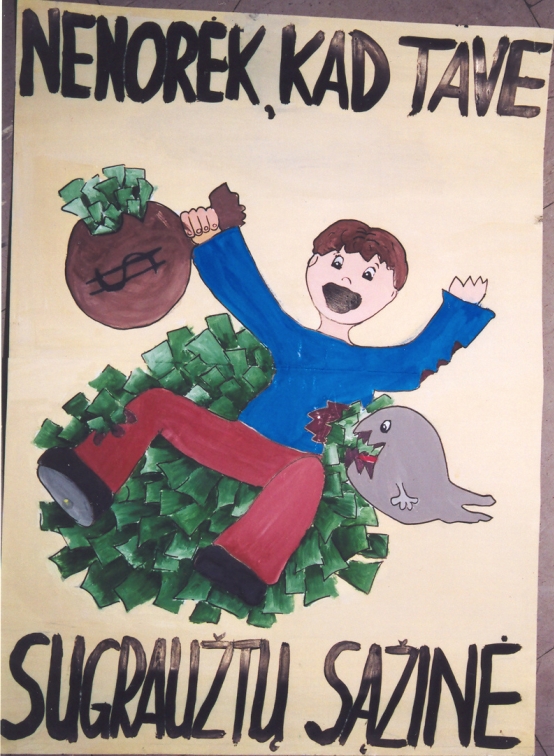
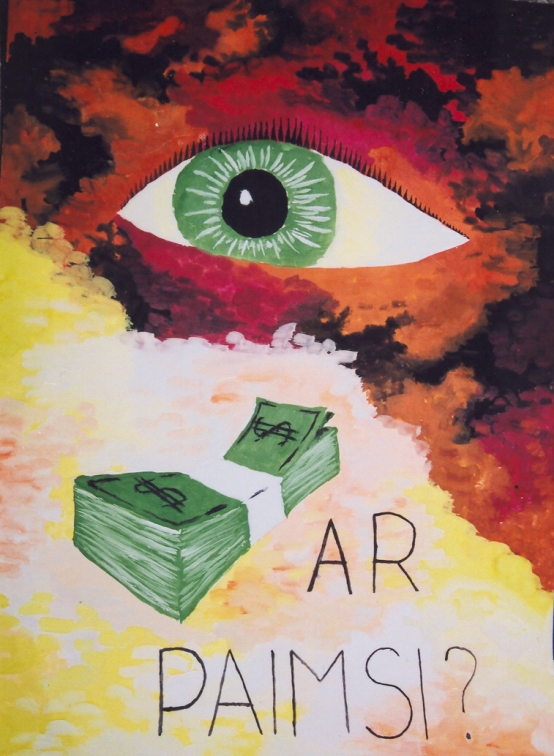
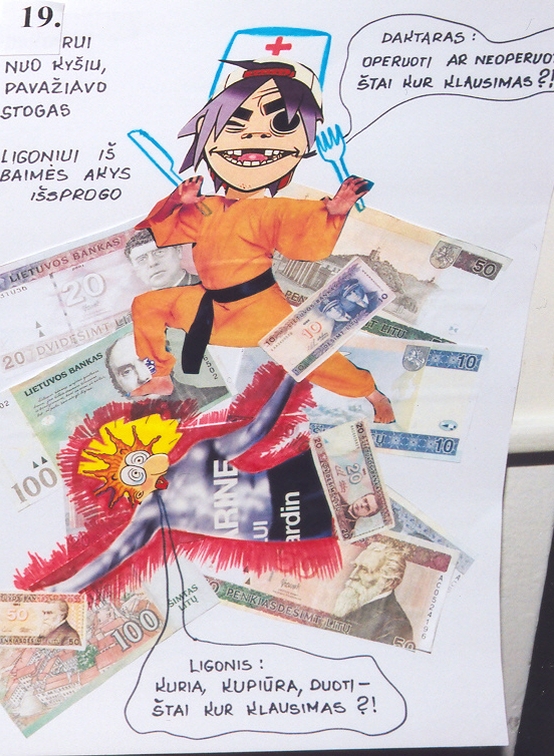
Students’ posters and paintings