



What is critical thinking
Critical thinking does not have a single definition. Its concept depends on the field and branch of science, academic traditions and schools of thought, as well as the historical and cultural context. Psychologists, philosophers, and educators continue to debate the definition and core characteristics of critical thinking, while its development remains a pressing issue in many countries.
The Modern Didactics Centre defines critical thinking as:
- The ability to raise well-founded questions, investigate, and seek answers to them;
- The courage to question “correct” answers, norms imposed by authorities, and universally pushed opinions;
- The courage to admit mistakes and accept being wrong;
- The ability to refrain from unfounded judgment;
- Honest, fair, and non-conformist individual thinking;
- The reconsideration of underlying assumptions to improve thinking and adjust actions;
- Socially responsible thinking, taking accountability for the consequences of one’s own thoughts;
- A contextual phenomenon that is not automatically transferable;
- An individual’s attitudes and ability to think freely and responsibly, regardless of their background, social status, culture, age, or education.
What critical thinking is NOT:
- Criticizing with the intent to mock, hurt, or disparage;
- Routine problem-solving of everyday questions or issues;
- Thinking based solely on logical, decontextualized reasoning.
1
CRITICAL THINKING IS INDEPENDENT THINKING
In critical thinking lessons, each individual creates their own ideas and values, and forms their own beliefs. No one can think critically for you. Critical thinking is a task you must do for yourself. Therefore, the personal right to independent thought during lessons is a prerequisite for critical thinking. Students must experience the freedom to think for themselves and to ask themselves challenging questions. Independent thinking is the first and, arguably, the most important characteristic of critical thinking.
2
INFORMATION IS THE STARTING POINT, NOT THE END POINT, OF CRITICAL THINKING
Students need to know a fair amount of things to feel motivated and capable of thinking for themselves. To develop complex thoughts, one needs plenty of raw material – facts, ideas, texts, theories, data, and concepts. Students of all ages, from primary school pupils to university students, are capable of thinking critically because they all already possess a wealth of life experience and rich sources of prior knowledge. And the more they learn, the wiser thinkers they become. Critical thinking is the work that students and teachers, writers and scientists, actually do when processing the knowledge they have acquired. Critical thinking turns traditional learning into something personal, meaningful, useful, and continuous.
3
CRITICAL THINKING BEGINS WITH QUESTIONS AND WITH PROBLEMS THAT NEED TO BE SOLVED
Students achieve better learning outcomes when their own lived experiences allow them to recognize general problems – whether economic, social, or political – and solve them by drawing upon classroom and school resources. When students actively engage in intellectual work by formulating solutions to real-life problems, the development of critical thinking becomes a purposeful and fruitful process, rather than just a simple instructional activity.
4
CRITICAL THINKING REQUIRES REASONED ARGUMENTS
Critical thinkers develop their own solutions to problems, backing them up with strong arguments and convincing reasoning. They recognize that more than one solution exists and strive to prove why their proposed solution is logical and practical.
5
CRITICAL THINKING IS SOCIAL THINKING
Ideas shared with others are tested and refined. By reading, discussing, debating, and engaging with the ideas presented and understood, we enter a process of clarifying and sharpening our own positions. Furthermore, critical thinking educators employ a wide range of teaching methods that encourage thinking in the presence of others—such as group work, discussions, debates, and the publication of various student writings. Ultimately, while the importance of independent thought is highlighted, the social aspect of critical thinking is heavily emphasized, because a critical thinker ultimately functions within society, working alongside others to solve broader challenges that go far beyond self-creation.
9
projects
4
international courses
498
workshops
13047
participants
13
publications
5
critical thinking centres
International critical thinking development program
The authors of the Reading and Writing for Critical Thinking (RWCT) program are Dr. Kurt Meredith, Dr. Jeannie Steele (University of Northern Iowa), Dr. Charles Temple (Hobart and William Smith Colleges), and Scott Walter (International Reading Association).
The program is designed for educators across all educational levels and subject areas, as well as staff at professional development institutions, school leaders, and administrators seeking ways to develop democratic education ideas and processes at the school and classroom levels. Working with teacher trainers, general education teachers, and higher education faculty, the program aims to transform the instructional process by implementing teaching and learning methods that encourage students’ critical thinking and independent learning, as well as to establish professional development models and techniques.
The RWCT (Reading and Writing for Critical Thinking) program is directly linked to the educational process. It not only provides coherent, theoretically grounded teaching methods that encourage students to actively learn, think critically, and work collaboratively, but it also encompasses the entire organization of the educational process – from planning to assessment. The program is built on a unified system of thinking and learning, developed based on educational research and the works of prominent educators (such as J. Dewey, N. Noddings, L. Vygotsky, C. B. Smith, P. D. Pearson, L. Fielding, L. Rosenblatt, J. L. Vaughan, T. Estes, among others). Its philosophical foundation rests on the ideas of pragmatism and social constructivism. The methodological cornerstone of the RWCT program is a scientifically validated teaching and learning framework that ensures a natural connection of prior knowledge, experience, and culture with new educational content, leading to its internalization, reflection, and the formation of authentic learning experiences and concepts.
In 1996–1997, the Open Society Institute (now the Open Society Foundations) and the International Reading Association (now the International Literacy Association) initiated the program in 9 countries across Central Europe, the Caucasus, and Central Asia. In total, the program has been implemented in 46 countries throughout Central and Eastern Europe, the Balkans, Central and South Asia, and Latin America. Since 2000, the program has evolved into an international structure – the International Consortium for Reading and Writing for Critical Thinking. This is an international network of teachers and developers of literacy and critical thinking materials. Currently, the consortium unites over 20 organizations from Europe, Asia, North and South America, and Africa, brought together by shared values, educational and development goals, a commitment to expanding the ideas of the RWCT program, and advocating for critical thought even where it is not yet welcome.
Developing Students’ Skills
-
To think critically – to be curious, to question, to reflect, to debate, and to ask questions; to seek alternatives to expressed ideas, to have one’s own opinion and defend it rationally, to know how to evaluate and carefully weigh information, and to use it creatively.
-
To take responsibility for one’s own learning – not passively absorbing the knowledge provided by the teacher, but using an inquiry-based strategy – learning independently through reading, writing, and discussion.
-
To work collaboratively with others – exchanging ideas with peers, listening carefully to others, respecting different viewpoints, speaking confidently and politely, knowing how to identify a problem, and contributing to shared solutions as a responsible group member.
-
To become a lifelong learner – to have a constant thirst for knowledge, mastering inquiry and study strategies that can be used many years after graduating from school.
Developing Teachers’ Skills
- To create a classroom environment that promotes open and responsible communication, fosters dialogue between student and teacher, tolerates a diversity of opinions, encourages students to actively engage in the learning process, and guides them to communicate responsibly with their peers in the pursuit of knowledge.
- To use an instructional framework that encourages critical thinking and independent learning – relying on a model where teaching and learning are structured into phases, enabling the teacher to systematically organize instruction, set teaching goals and objectives, plan supplementary activities, engage students in purposeful learning, and establish connections between curriculum subjects.
- To use a system of effective methods – relying on a variety of critical thinking strategies throughout the curriculum, such as reading and comprehension, text interpretation, learning through writing, collaborative learning, discussions, and debates.
- To become reflective practitioners – continuing to learn how to teach, evaluating and monitoring the learning process, anticipating obstacles, and developing new strategies to overcome them.
- To become resources for other teachers – sharing one’s skills and knowledge of teaching methodologies with colleagues.
Critical thinking development program in Lithuania
Since its establishment in 1999, the Modern Didactics Centre took over the coordination in Lithuania of the international RWCT project, which had been implemented since 1997 under the Open Lithuania Fund’s program “Education for Lithuania’s Future”.
During the implementation of the project between 1997 and 2000, RWCT trainers were prepared in Lithuania to disseminate the program across Lithuanian schools. In 1997–2000, 48 schools and education centers participated in the project, and over 600 teachers from various schools across the country attended RWCT seminars. In 1998–1999 at Vilnius University and in 1998–2008 at Vilnius Pedagogical University, an elective credit course titled “Developing Critical Thinking in Subject-Specific Lessons” was offered to students, with over 700 students completing the course. In 1999, a sociological study of the RWCT project was conducted, which revealed the successful progress of the project in Lithuania and positive changes in the activities of both teachers and students. To ensure the quality of the program, a certification process for critical thinking education teachers and trainers was launched in Lithuania in 2001, and certification standards were published. In Lithuania, 30 RWCT teachers, 14 trainers, and 5 evaluators have been certified. In 2000, the Modern Didactics Center developed a continuous professional development program for “Developing Critical Thinking,” aimed at fostering citizenship and instilling democratic skills in the classroom, cultivating thoughtful and reflective readers, expanding the modern concept of literacy, training educators capable of applying critical thinking methods in their lessons, creating modern study programs, developing and mobilizing schools as methodological centers, and implementing the international teacher certification program.
Having started as an international project, RWCT has evolved into a coherent, systematically implemented, and expanding core activity of the Modern Didactics Centre.
Critical thinking centers
Five schools have become methodological centers for critical thinking education. The majority of teachers in these schools have completed the full cycle of RWCT seminars and are certified teachers and trainers of the program. They apply the critical thinking instructional framework and methods in their lessons, conduct seminars for other teachers, and host open lessons.





Critical thinking development program initiatives


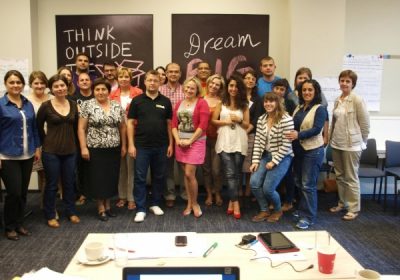


While discussing with my colleagues, I had to support their ideas that our students do not think, do not analyze and do not reflect critically upon many things. They are not capable even to ask or to comment on what is interesting or important to them. I was sure for 100%, that it is their problem. RWCT change my approach not only to learning process itself, but also to learning process participants. Now I am curious how to engage all students to critical thinking process. Ability to express ideas in their own words, capacity to apply theoretical knowledge into practice, to sort information critically – those are key indicators that help me to find out, if students think critically. Direct communication during lectures, reading their works, essays, diaries helps me to see, if they are critical thinkers. It is great reward to see how students’ thinking and attitude towards learning change across the time. More and more often you can find their own thoughts and reflections in written works, in open and alive discussions during lectures