


Project duration: 2004
Project funder: Foundation for Education Change, Lithuania
Project coordinator: Modern Didactics Centre
Project partners:
Special Investigation Service of the Republic of Lithuania
Transparency International-Lithuanian Chapter
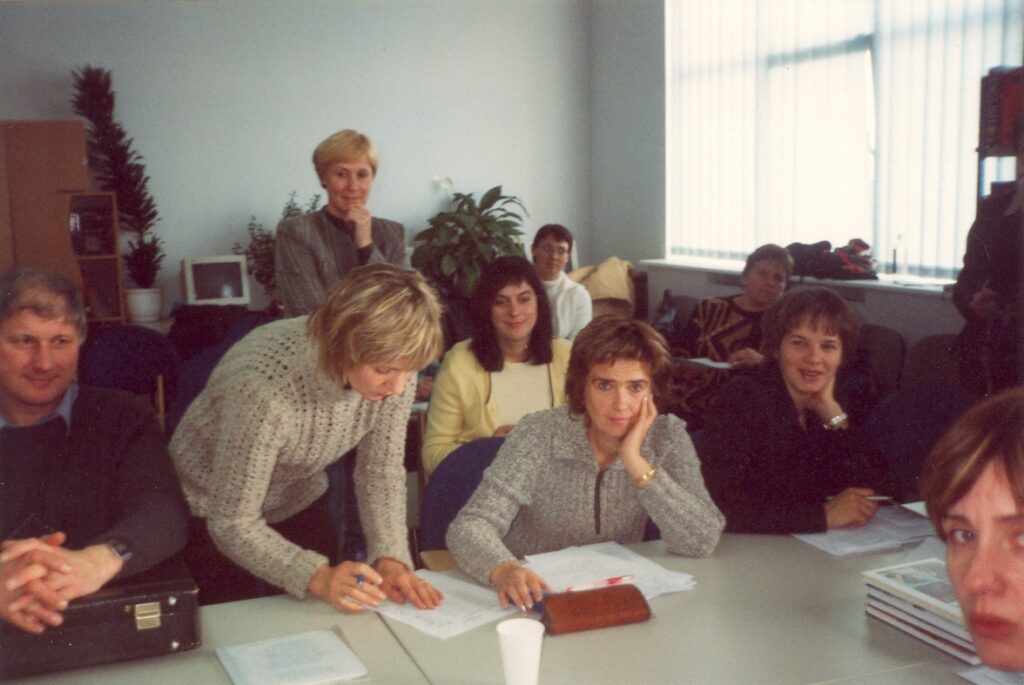
Project participants
PROJECT RELEVANCE
This project prolongs activities started with the project “Education against Corruption” (2002–2003). During that project integrated programme of anti-corruption education for a school of general education was created and tested at eleven project schools, various anti-corruption extra-curricular activities were organized at schools.
This project was initiated to contribute Lithuania National Anti-Corruption Programme (adopted by the Seimas on 17 January 2002, No. IX-711) by implementing following directions:
„8.2.3. to organize anti-corruption training seminars for various public groups and provide them with knowledge and skills to fight with corruption, to share opinions and latest information about anti-corruption activities stride in the country;
8.2.4. to create and implement anti-corruption education programmes for schools of general and higher education“.
The fight against corruption is one of the priority areas of activity for the Government and the Seimas of the Republic of Lithuania. The effectiveness of anti-corruption activities largely depends on civic awareness and the public’s determination to cooperate with law enforcement institutions. However, the fight against corruption is not solely about the detection of crimes; significant attention is also devoted to corruption prevention and public education.
Anti-corruption public education should be carried out as an integral part of public education, aiming to foster personal morality, cultivate citizenship, and develop an understanding of an individual’s rights and duties to society and the State of Lithuania, while ensuring the implementation of corruption prevention goals.
Anti-corruption education in schools can be both formal and informal. Formal education involves integrating elements of anti-corruption education into general education curricula, while informal education encourages various extracurricular initiatives, such as civic campaigns, student conferences, and other events. Since the primary target of anti-corruption education is the maturation of civic consciousness, the most favorable environment for its integration is within social disciplines: civic education, history, political science, and ethics.
PROJECT AIM
To form values and develop skills, that form young people and their educators’ civic attitudes towards corruption.
PROJECT OBJECTIVES
- To prepare in-service training programme of anticorruption education.
- To prepare team of trainers able to consult and train other teachers.
- To set up centers of anticorruption education in participating schools.
To develop strategic plans of anticorruption activities in the regions working in close cooperation with schools, municipalities and local communities. - To improve and complement the integrated programme of anti-corruption education for a school of general education.
PROJECT PARTICIPANTS
Project was devoted to teaches and pupils of a school of general education, school and local communities. Teachers, participated in the project “Education against Corruption”, were invited to join this project.
22 teachers from following schools participated in the project:
Anykščiai Antanas Baranauskas Secondary School
Elektrėnai „Ąžuolynas“ Secondary School
Gargždai „Vaivorykštė“ Gymnasium
Kėdainiai „Atžalynas“ Secondary School
Mažeikiai „Venta“ Secondary School
Panevėžys 9th Secondary School
Pasvalys Petras Vileišis Gymnasium
Radviliškis Vaižgantas Gymnasium
Šiauliai Stasys Šalkauskis Secondary School
PROJECT ACTIVITIES
February 2004
- Preparing of training course/module for teachers
- Improvement of the integrated programme of anti-corruption education for a school of general education
- Development of in-service training programme for teachers
29-30 March 2004
- Seminar for trainers “Critical Thinking Methodology for Anti-Corruption Education”
April 2004
- 28 April 2004 – seminar for trainers “Foundations of Adult Education”
- 29 April 2004 – seminar for trainers, school principals and representatives of municipalities “Principles of Strategic Planning”
June 2004
- Development of strategic plans of anti-corruption activities in regions
26-27 August 2004
- Seminar for trainers “Development of In-service Training Programme of Anti-Corruption Education”
September-December 2004
- Final preparation and publication of integrated and in-service training programme
- Pilot in-service training seminars in regions
- Observation of project participants’ lessons and seminars
- 17 December – Presentation of project results and regional strategic plans of anticorruption education in final conference
PROJECT INTELLECTUAL OUTPUTS

Anti-corruption education at school: Methodical material for general and higher education schools (2006)
This methodological tool is intended for educators seeking to integrate the values of integrity and citizenship into the educational process. The publication consistently analyzes the concept of corruption, the harm it causes to society, and emphasizes the importance of preventive work starting from the school bench. Teachers from general education schools and project participants actively took part in the preparation of this methodological material. The authors provide specific didactic recommendations and practical methods on how to discuss complex ethical issues with students of various ages.
Practical examples of lessons and extracurricular activities will help to better understand the content of anti-corruption education and the possibilities for applying these methods. For those seeking more information, additional materials and references to literary sources are provided. The developers of this tool hope that this publication will assist teachers wishing to carry out educational corruption prevention activities, help them gain more knowledge about the concept of corruption, and explore possibilities for integrating anti-corruption education into academic subjects and after-school activities. Furthermore, it aims to encourage a more active interest in the public life of the country and foster an active, well-reasoned civic stance on issues important to us all. This publication is a valuable tool for creating a transparent school community culture and forming a zero-tolerance attitude toward corruption among young people.
Download LT
In-service training programme “Possibilities of Anti-corruption Education at a School of General Education”
The program is intended for teachers of history, civic education, political science, ethics, and psychology working with students in grades 5–12, as well as for class tutors and organizers of extracurricular activities. The program will assist teachers who wish to carry out educational corruption prevention activities by helping them gain more knowledge about the concept of “corruption” itself and the possibilities for integrating anti-corruption education into academic subjects and after-school activities. Practical examples of lessons and extracurricular events will help to better understand the content of anti-corruption education and the possibilities for applying various methods.
The programme became one of the permanent Modern Didactics Center’s in-service training programmes.
PROJECT RESULTS
- Training workshops for project participants delivered.
- Additional teaching materials for teachers prepared.
- In-service training programme “Possibilities of Anti-corruption Education at a School of General Education” developed and tested in pilot seminars.
- Project trainers from nine Lithuanian schools prepared.
- The integrated programme of anti-corruption education for a school of general education improved.
- Strategic plans of corruption prevention prepared in nine municipalities.