


Projekto Nr. 134648–2007–IT–COMENIUS–CMP
Project duration: 18 February 2008–30 November 2009
Project co-funder: EU program Erasmus+
Projekto coordinator: Associazione SEND (Italy)
Project partners:
VšĮ Šiuolaikinių didaktikų centras (Lietuva)
Università di Palermo, Scuola Interuniversitaria Siciliana di Specializzazione per l’Insegnamento Secondario (Italy)
Univerzita Komenského, Fakulta matematiky, fyziky a informatiky v Bratislave (Slovakia)
Ruhr-Universität Bochum – Fakultät für Physik und Astronomie – Lehrstuhl für Fachdidaktik der Physik (Germany)
Andrei Saguna University (Romania)
Arteveldehogeschool (Belgium)

Project team
PROJECT RELEVANCE
In recent years, numerous studies have indicated a significant decline in the number of students studying mathematics and the sciences. The way in which the sciences are taught in schools has been the primary contributing factor. Schools are encouraged to adopt more effective, research-based teaching methods and to actively promote the improvement of teacher qualifications and the creation of teacher networks. A better culture of teaching natural and exact sciences would help create a true knowledge society and a knowledge-based economy in the EU.
National teacher training systems in European countries, both for initial training and professional development, are based on traditional, standardized models, often without taking into account the latest scientific advances and research, particularly in the teaching of natural and exact sciences. As a result, an opportunity is lost to respond to the challenges of the 21st century and to foster young people’s interest in scientific ideas.
The project aims to update teaching methods in the Science and Technology areas, with an emphasis on developing pedagogical competencies and enhancing students’ motivation to learn. Numerous studies reveal that students are not adequately prepared to work in schools and present the subject matter to students in an accessible manner. The level of academic learning required of students in higher education is subsequently transferred to students in general education schools once they begin working there, without considering the need to rethink didactic methodology and instructional content. This contradiction highlights the need to develop prospective teachers’ ability to link subject-specific competencies with pedagogical competencies and to teach students not only the subject matter but also the didactics of the subject.
This project is build on the need to develop competences and knowledge in the educational field of the initial teacher education of secondary school teachers of science and technology areas with specific reference to the Pedagogical Content Knowledge (PCK) methodology.
PROJECT AIM
To strengthen the teaching of scientific and technological areas in higher education institutions and general education schools, as well as to increase students’ motivation and interest in natural and exact sciences, in the teaching of these subjects, and in scientific careers, and train future teachers in the application of these methods in schools.
PROJECT OBJECTIVES
- To create a working group at European level composed by trainers of prospective teachers, teachers of science and technology areas, which will develop an educational approach based on PCK development diffused to institutions dealing with initial teacher education (secondary school level).
- To test training models for prospective teachers in working groups.
- Elaborating the Handbook including pedagogical materials for the PCK development.
- To ralise experimentation and exchange paths of the PCK development among prospective teachers of science and technology areas through mobility actions abroad.
PROJECT TARGET GROUPS
- Students – future teachers of Science and Technology subjects.
- University teachers – trainers of future teachers.
- Students – indirect target group.
PROJECT ACTIVITIES
DIDACTIC MODULES
The partner institutions developed teaching modules for physics, mathematics, and computer science programs. These modules were tested and evaluated during the student exchange (mobility) program in the spring semester of 2009.
The following modules have been developed:
Mechanical waves: from observation to descriptive and interpretive models (SISSIS, University of Palermo, Italy)
Mathematical mazes and card games as teaching tools (Comenius University in Bratislava, Slovakia)
Introduction to the “fourth” state of matter: plasma (Ruhr University Bochum, Germany)
Atomic theory: from theory to conceptual experiments (Vilnius Pedagogical University)
Alternative teaching methods using conceptual illustrations and experiments with inexpensive materials (Artevelde University College, Belgium)
MOBILITY PROGRAM
A four-week mobility program was organized, bringing together 60 future European teachers from the project’s partner institutions. During the program, after an initial week of joint activities, participants were divided into subject groups and, under the guidance of a mentor, began classroom internships that involved testing the models developed locally. The overall aim of the mobility program is to incorporate a European dimension into teacher training. More specifically, the four weeks abroad will provide an opportunity to engage in discussions within an international working group – comprising “colleagues” from six European countries – on science teaching methods and to test the European applicability of the PCK models developed with local groups.
AN ASSESSMENT OF MOBILITY PROGRAM
Under the guidance of the coordinating organization, which specializes in mobility projects in Europe, a quality model was developed to identify the key factors contributing to the success of the mobility experience and establish quality standards for it. The purpose of the quality modl – to establish standards that all partners must adhere to when organizing both incoming and outgoing mobility. This helped ensure that mobility experiences are as consistent as possible in terms of educational offerings, logistical services, and cultural aspects. The definition of standards were essential for evaluating the various experiences.
During the mobility program, students’ reflections were recorded and analyzed. Students assessed their satisfaction with the program, their involvement in activities, opportunities to demonstrate their competencies as future teachers, their lesson preparation and delivery, and the experience they gained in schools by observing lessons and participating in scientific trials and experiments. Group cohesion, the activities of the host institution, and the organization of mobility were also evaluated.
PROJECT INTELECTUAL OUTPUT
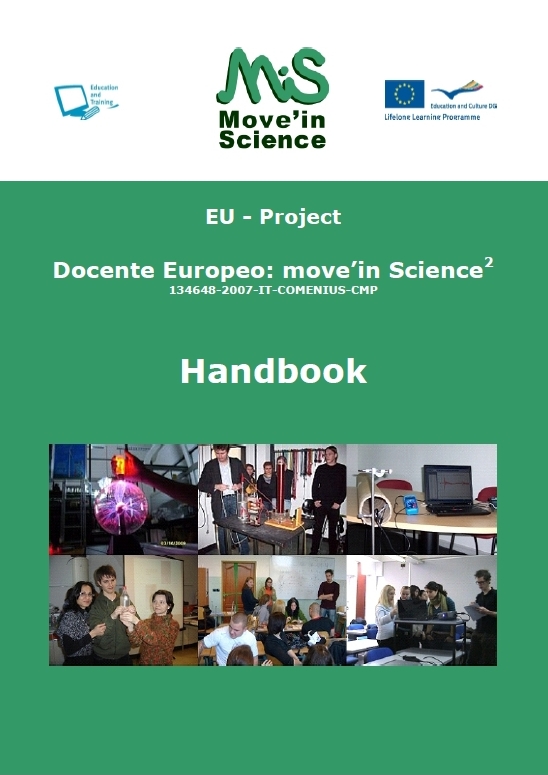
EU project Docente Europeo: Move’in Science Handbook (2009)
PROJECT RESULTS
- The project strengthened international cooperation among educational institutions in the field of science and promoted the mobility of students in the exact sciences.
- The project contributed to improving the training of future teachers and motivating students to choose fields of study in the natural and technological sciences.

The European Commission’s support for the production of this publication does not constitute an endorsement of the contents, which reflect the views only of the authors, and the Commission cannot be held responsible for any use which may be made of the information contained therein.