
Project duration: 1997–2000
Project funders:
Open Society Institute (USA)
International Reading Association (USA)
Open Society Fund Lithuania
Project coordinator: Šiuolaikinių didaktikų centras
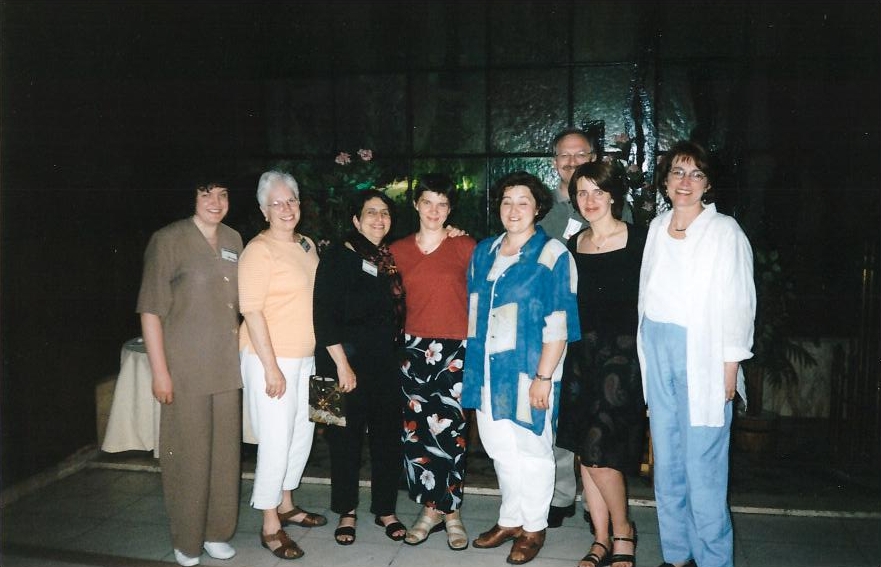
Project coordinators with volunteers Wendy Saul, Jeanne Reardon and project authors Kurt Meredith, Jeannie Steele
PROJECT RELEVANCE
Critical Thinking for Reading and Writing (RWCT) is an international project initiated in 1997 by the Open Society Institute (OSI) and the International Reading Association (IRA). The authors of the project are Kurt Meredith, Jeannie Steele (Northern Iowa University), Charles Temple (Hobart and William Smith College), and Scott Walter (International Reading Association).
Critical thinking is one of the most important skills in an open and democratic society. More than ever, young people need to be able to solve complex problems, critically assess circumstances, weigh alternative opinions, and make thoughtful, consistent decisions. Lithuanian general education standards and general education programs also emphasize the ability to think critically, use information creatively, and apply it in practice.
Before starting to implement the international RWCT project in Lithuania, studies on the state of science in Lithuania and assessments of the quality of educational content were analyzed, which showed that:
- Lithuanian schools focus on teaching knowledge and aim to reinforce encyclopedic knowledge.
- Students are unable to make independent decisions and justify them, draw conclusions from their experience, or plan for the future.
- Students lack the skills to search for, select, and evaluate information.
- The knowledge acquired at school is not linked to practice.
- The knowledge assessment system is imperfect.
- Teachers’ creativity is limited.
- There is a shortage of specialists with new ideas.
- There are few advanced teaching tools.
- There are no signs of the development of an information-based and democratic society.
Advantages of the RWCT project:
- It can be effectively applied at all levels of the education system – primary, secondary, higher, and higher education institutions teaching various subjects.
- The project is designed to develop critical thinking in children of different ages.
- Teachers and students do not need any prior preparation.
- Teachers can rely on their own experience, existing programs, and teaching materials.
- Theory is closely linked to practice – after attending seminars, teachers can immediately apply new teaching methods in their lessons.
- The Critical Thinking Education (CTE) program is based on a unified system of thinking and learning, which is developed based on the latest educational research and the works of prominent educators (J. Piaget, J. Dewey, N. Noddings, L. Vygotsky, C. B. Smith, P. D. Pearson, L. Fielding, L. Rosenblatt, J. L. Vaughan, T. Estes, and others).
PROJECT AIM
To foster critical thinking and civic engagement, and to develop democratic education ideas and processes at the school and classroom levels.
PROJECT OBJECTIVES
- Train RWCT teachers and lecturers.
- Help teachers restructure the teaching process by introducing teaching methods that encourage critical thinking and independent learning among students.
- Establish teacher training models and methods that can be used after the project ends.
PROJECT TARGET GOUP
The program is addressed to teachers of all levels of education and all subjects, as well as employees of professional development institutions, heads of educational institutions, and administrators.

For me, critical thinking is a process of considering information that is applied in all areas of life; it is the ability to justify one's thoughts, consider, make decisions, and implement them. It is analytical, non-authoritarian reasoning, constantly asking causal questions, seeking the most correct (best) solutions, without emphasizing or imposing a single absolute truth. As an educator, critical thinking for me is dialogue (with students, colleagues, pupils, etc.), searching for the most favorable solutions, solving emerging problems, forming beliefs, and fostering independence and responsibility.

What RWCT means for me? Several things – term of pedagogical reality; constant self-questioning: Am I in a right track? Are my students in a right track? Do I provide opportunities to them to look at problems differently?; community of close to me people, where we understand each other from half of a word.
What critical thinking means for me? I began to understand a man and his/her „revolutionary attempts to struggle with biological, moral, intellectual reality” I found this thought while reading book „Promise of Daybreak“ by Romain Gary. It sounded to me as not found, but as recognized and experienced idea. RWCT helped me to understand that those attempts can be fruitful. <...> To learn means to change and to expand personal boundaries. To learn means to help to do the same for others. Learning is sharing. For me, an introvert person, RWCT was intensive social training. I was rewarded for my attempts by numerous free, inspiring, meaningful professional conversations. When I reflect upon got experience, I can say honestly, that becoming member of RWCT community means to be fortunes gift.

RWCT for me is what I was looking for long time in books, conversations, methodical literature. What I have learned in the programme, proved my assumptions, guesses, helped to look again at the already known things differently and from the new perspective. RWCT provided, scientifically and pedagogically proved methodology, like comprehensive system for teaching and learning, which can be applied in all subjects and for all age pupils. I can openly acknowledge that RWCT changed my work style. What was like separate attempts, methods, „tries“, became systematical daily practice. I cannot imagine working in other way now.
PROJECT ACTIVITIES
Since its establishment in 1999, the Modern Didactics Centre has taken over the coordination of the international RWCT project in Lithuania, which has been implemented since 1997 by the Open Lithuania Foundation’s program “Education for Lithuania’s Future.”
- In the first year, future lecturers were trained: volunteers Wendy Saul (University of Maryland), Jeanne Reardon (Montgomery County Public Schools), Janice Dole (University of Utah), Bonnie Morgan (Utah State Department of Education) led seminars for teachers from Lithuanian primary, secondary, and high schools, as well as university lecturers, teaching various methods and strategies that encourage critical thinking.
- In 1998, the RWCT program began to be disseminated in Lithuanian schools.
- Between 1997 and 2000, 48 schools from educational centers participated in the project, and over 600 teachers from various schools across the country attended KMUSR seminars.
- In 1998–1999, Vilnius University and in 1998–2008, Vilnius Pedagogical University offered an elective credit course for students entitled “Critical Thinking in Various Subjects,” which was attended by over 700 students.
- In 1999, a sociological study of the KMUSR project was conducted, which revealed the successful implementation of the project in Lithuania and positive changes in the activities of teachers and students.
- In order to ensure the quality of the program, a certification process for teachers and lecturers of critical thinking education programs was launched in Lithuania in 2001, and certification standards were published. Three teachers have been certified in Lithuania.
- RWCT programme, starting from 1997 till now has faced many challenges. Any way it still remains to serve as background for many RWCT-Lithuania team works. It had tremendous impact on personal and professional growth on project participants.
Critical thinking education centers
Five schools have become methodological centers for critical thinking education. Most teachers at these schools have completed the full cycle of KMUSR seminars and are certified program teachers and lecturers. They apply critical thinking education schemes and methods in their lessons, conduct seminars for other teachers, and hold open lessons.




PROJECT INTELLECTUAL OUTPUTS
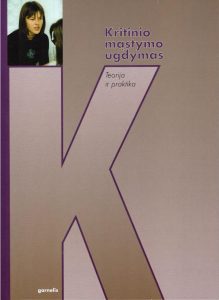
Critical Thinking Education: Theory and Practice (2001)
The aim of the book is to introduce the main ideas and theoretical principles of the project and to share practical experience. The first chapter of the book presents a consistent thinking and learning scheme and shows how to apply it, as well as the advantages and significance of each stage of the scheme in developing critical thinking. It also discusses lesson planning and assessment options. In the second chapter of the book, teachers working with children of various ages, from primary school pupils to university students, share their experiences; teachers who teach various subjects, from the humanities to the exact sciences. Teachers from general education schools and higher education institutions participated in the project. By listening to theoretical lectures, experimenting, and trying to apply critical thinking methods in their work, teachers sought to discover their own model of critical thinking and to figure out for themselves what critical thinking is.
Download LT

RWCT Teacher’s and Lecturer’s Certification Standards and Procedures (2004)
Lithuania, like other countries participating in the project, has joined the international project participant certification process. Readers are presented with international critical thinking education standards for professional development and qualification improvement. The focus is on the personal and professional competencies of teachers/lecturers, which are expressed through the creation of the learning environment, the educational process itself, lesson planning, and assessment.
Educators who aspire to become excellent teachers can use the standards and assessment procedures as guidelines. Certified critical thinking teachers/instructors and lecturers play an important role in developing their personal and professional growth as well as that of their pupils or students.
Download LT
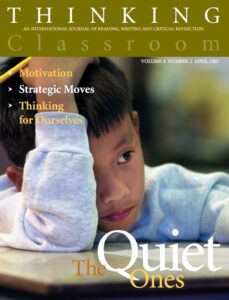
Thinking Classroom, 2000–2008 m.
This is an international journal on critical thinking education, published in Lithuanian, Russian, and English from 2000 to 2008. It is intended for teachers and all educators interested in the dissemination of democratic education, promoting professional cooperation among educators and the sharing of experience and research. Permainos publishes theoretical reflections, relevant research material, and lesson examples to help readers better understand teaching practices, education policy and methodology that encourages critical and creative thinking, active learning, and student-centered teaching and assessment.
From 2000 to 2005, the journal was published by the Modern Didactics Center, and from 2006 to 2008 by the International Critical Thinking Consortium.