


Project duration: 1 July 2004–30 June 2005
Project funder: World Bank
Project coordinator: Šiuolaikinių didaktikų centras
Projecr partner: Paramos vaikams centras (Lithuania)
PROJECT RELEVANCE
The most important activity for students at school is learning. It determines how students evaluate themselves and perceive others, and essentially determines how successful they will be in adulthood. Therefore, it is very important to give children opportunities at school to take a closer look at their own learning process and that of their friends, and to create an environment where they can safely analyze and overcome learning difficulties. This will help them to better understand themselves and others, learn to tolerate diversity, focus on meaningful activities, and help and accept help.
There is a lot of research data proving that mutual assistance among students has a positive effect on school life: there are fewer late arrivals, fewer missed classes, and fewer dropouts. Students’ social and self-control skills and learning outcomes improve.
For Lithuanian schools, this is a new form of learning that requires new skills in organizing educational activities, reflecting on the learning process, and collaborating.
Mutual assistance among students in learning is organized with the understanding that learning failure is one of the factors contributing to school absenteeism, and efforts are made to overcome the causes of this phenomenon rather than the consequences of school avoidance. This activity brings the school community together, as it involves cooperation between students from different classes, their parents, and teachers. It also promotes the consolidation of democratic attitudes, as the results of this learning are publicly visible and discussed. Undoubtedly, this method of learning promotes the achievement of strategic educational goals: fostering a supportive civil society and reducing social exclusion. What is new is that it seeks to mobilize the internal resources of the school community to overcome learning gaps, and the most active participants in these processes are the students themselves. However, they need methodological guidance from teachers and the support and assistance of parents and peers.
An active student position is a desirable goal for Lithuanian schools, which is pursued by introducing collaborative learning, active teaching methods, fostering critical thinking, and implementing a concept of student progress and achievement assessment that focuses on improving students’ ability to self-assess and set learning goals. It would be great if students, by helping each other, could understand the benefits of these methods and learn how to use them in practice.
New methods and ideas usually reach schools in the form of shorter or longer projects. This project is one of many. It is new in that it draws attention to a pressing problem: learning gaps and how to overcome them by pooling the internal resources of the school community. It also draws attention to the organization of the educational process, where overcoming learning gaps has not been given the necessary attention until now.
PROJECT AIM
The project aimed to involve school communities in peer and cross-age tutoring activities, promoting the idea of learning to learn as the main accelerator towards the goal of inclusive education.
PROJECT OBJECTIVES
- To provide teachers and tutors with teaching instructions for partner-learning.
- To achieve multiple increase of help-giving recourses.
- To enhance learning results of tutees and tutors and their contentment with the learning activities.
- To increase the collaboration skills between the teachers, students and their parents.
- To make learning processes a part of democratization of school community life.
PROJECT PARTICIPANTS
Target groups of the project – teachers, students and their parents, school communities.
15 teachers and 42 students of 7–10 grades from these schools participated in the project:
Vilnius J. Basanavicius secondary school
Grigiskes secondary school of Vilnius municipality
Vilnius A. Kulvietis secondary school
Vilnius A. Mickiewich gymnasium
Vilnius M. Mazvydas secondary school
Vilnius P. Vileisis basic school
Project lecturers:
Romualda RAGUOTIENĖ, psychologist of Vilnius A.Mickievich gymnasium
Erna PETKUTĖ, Director of Children Support Center
PROJECT ACTIVITIES
September 2004–May 2005
Workshops for the teachers and students-tutors
September–October 2004
Organization of peer and cross-age tutoring clubs
September 2004–June 2005
Ongoing assessment of peer tutoring activities
September 2004–June 2005
Discussions on peer and cross-age tutoring activities at the students’ councils
September–October 2004
Preparation of the tools to evaluate students learning progress and contentment with the learning activities
September 2004–June 2005
Monitoring of learning progress of tutors and tutees during the project time
September 2004, May 2005
Survey on contentment with the learning activities of tutors and tutees in the beginning and in the end of the project
October 2004–May 2005
Consultations for tutors regarding teaching contents, methods, communication problems
October 2004–May 2005
Publications in the schools newsletters about the project activities and problematic issues
March–May 2005
Preparation and publishing the methodical recommendations on peer and cross-age tutoring
October 2004–May 2005
Discussions of the project activities with students teachers and parents
PROJECT INTELLECTUAL OUTPUT
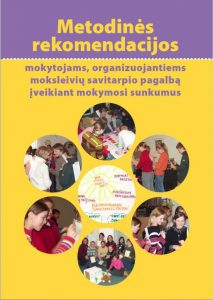
Methodical Recommendations for Teachers Organizing Peer and Cross-age Tutoring Activities (2005)
Publication introduces a peer and cross-age tutoring model, elaborated during the project, that could be applied at other Lithuania schools. The methodical and practical guidelines of peer and cross-age tutoring programme implementation as well as individual cases of peer tutoring are presented in the publication.
Download LT
PROJECT RESULTS
- The project activities improved child-oriented teaching skills, provided the opportunities to discuss openly the teaching and learning issues, to look for and mobilize inner school resources for learning improvement.
- The methodic recommendations for the teachers who want to organize peer tutoring in their schools were prepared.
- A group of teachers and tutors prepared for teaching new groups after the end of the project.
Learning to learn is one of the goals of contemporary school. Our project like a small laboratory enabled to notice, how this goal is possible to achieve and what stands on the way to it.
The teachers involved in the project were interested and trying to keep the timetable of the project. This project stressed the reflection skills and the ability to go deep in to the learning specifics of the particular child, which is more and more demanded at the contemporary school because of the ongoing process of integration children with the special educational needs. Our project gave the opportunity for the teachers to develop these necessary skills.
Students involved in the project seemed also interested, because they have the possibility to learn communication skills and to discuss the difficulties in very concrete activities, which is not common in usual class setting. Giving voice for children in the process of solving problems of their learning is the part of democratization of school community life.
Communication with the school communities was not always easy, but useful, because the process of the discussion showed, that participants became more and more involved in the topic and developed the attitude of the necessity to organize support for those in need.
Some teachers experienced significant difficulties in monitoring the learning process of the peer they coach, because this is a quite new skill they have to learn.
Some cases showed, that teachers are reluctant to negotiate with parents difficult topics, such as, why the parents do not allow their children either to help other children or to receive the help from other children after the lessons, why the work in peers do no show results at class and how to solve this inadequacy.
Some pupils think that life at school is so intense and out of their control, that the best thing they can do is to help themselves. This is the attitude worth constant teachers and parents attention. This is an obstacle for the sustainability of our project ideas.