


Project No. VP1-2.2-ŠMM-05-K-02-029
Project dutarion: 4 August 2011–4 August 2013
Funded by the European Social Fund and the budget of the Republic of Lithuania
Project coordinator: Kaunas District Education Centre (Lituania)
Project partners:
Šiuolaikinių didaktikų centras
Kaunas District Domeikava Gymnasium
Klaipėda Vydūnas Secondary School
Trakai District Onuškis Secondary School
Ukmergė District Siesikai Secondary School
Vilnius Gerosios Vilties Secondary School

PROJECT RELEVANCE
A complex and rapidly changing environment increases the need to solve problems creatively. Lithuania’s progress strategy, Lithuania 2030, focuses on education, which must create all the conditions for the formation of creative, responsible, and open personalities, and at the conference “Education for Lithuania’s Success” on August 24, 2011, unleashed creativity was identified as one of the main priorities.
However, many foreign and Lithuanian scientists note that today’s schools are oriented towards non-creative, reproductive education. The very concept of creativity in Lithuania is mostly associated with artistic and extracurricular activities. The cultivation of creativity is limited by the prevailing culture of assessing quantifiable achievements. Today, teachers are not trained or encouraged to work creatively, and they often lack the knowledge and skills needed for universal creativity education and critical thinking strategies. Although teachers theoretically recognize the importance of creativity, they do not always succeed in applying it in practice in the educational process. They often associate it with well-expressed thoughts in speech and writing. Other manifestations of creativity are difficult to recognize, and if they are recognized, they are difficult to fit into the framework of traditional assessment. In Lithuania, the culture of creativity education as it is understood today is only just emerging. We have few original publications and studies. The latter are often limited to a specific research task, examining a particular area of creativity, or are content with stating the general situation.
We do not have a broad, deep, and comprehensive study across several levels of education in Lithuanian language and literature classes. Nor do we have an exclusively original methodology for creativity in Lithuania. The only serious work in this area is L. V. Sruoginis’ book “Rašyti gali kiekvienas” (Anyone Can Write), which is dedicated to teaching creative writing to children. Of course, individual tasks can be found in textbooks or exercise books, but this is not consistent teaching.
PROJECT AIM
This project aims to contribute to the implementation of a systematic approach to creativity education in schools, starting with Lithuanian language and literature lessons. The essence of the project is to promote the development of creative thinking, which allows for the improvement of thinking in a positive direction and should become a universal goal.
PROJECT OBJECTIVES
Based on the analysis of the results of the study on the state of creative thinking education in grades 4, 8, and 11 in the Lithuanian language, develop and test creativity development methodology, methodological and teaching tools for various types of schools.
PROJECT TARGET GROUPS
Primary and secondary school teachers who teach Lithuanian and school administrators.
PROJECT INTELLECTUAL OUTPUTS
RESEARCH ON THE CURRENT STATE OF STUDENTS CREATIVITY DEVELOPMENT IN LITHUANIAN (NATIVE) LANGUAGE CLASSES
When developing a methodology for creativity development and creative thinking in native language lessons, a comprehensive situation analysis was conducted to identify shortcomings in creativity education and opportunities for improvement. Six studies were conducted in the five schools participating in the project:
1. Research on environments fostering creative thinking in schools (2011)
Research into a supportive environment is one of the most important components of creativity education. The research report discusses the characteristics of the immediate environment conducive to creativity related to the problem under investigation, with particular attention paid to the school as an environment for the expression and development of creativity and creative thinking among teachers and students. In order to create a suitable research instrument, the experience of similar studies conducted abroad and in Lithuania was first analyzed. The results of the literature analysis became the basis for empirical research, i.e., they helped to create and scientifically substantiate the methodology for researching environments conducive to the development of creativity and creative thinking. A survey of teachers and school administrators revealed the overall panorama of creativity education in Lithuania and showed the extent and nature of the opportunities available to Lithuanian language teachers. The survey was conducted using a virtual electronic environment (written survey). Respondents included primary school teachers who teach the Lithuanian language, secondary school and gymnasium teachers who teach Lithuanian, and school administrators (101 respondents).
2. Analysis of native language education programs and teaching resources (2012)
After developing a unified analysis methodology, educational programs and teaching tools were analyzed in terms of creativity and creative thinking development. Taking into account the analysis of theoretical literature and empirical research data, the aim was to answer the question: whether and to what extent the conditions for fostering creativity are created in educational programs and teaching tools. This analysis provided a basis for more focused and targeted planning and development of creativity education methodology. It also helped teachers to critically evaluate the available tools and provided some insights for the developers of new programs and teaching tools. The main sets of teaching tools analyzed—textbooks, teacher’s books, and exercise books—are used in all schools participating in the project when teaching the native language in grades 4, 8, and 11. The latest editions of teaching tools were evaluated. A total of 40 items were analyzed.
3. A study on the development of creativity and creative thinking in native language lessons (2012)
Class observation is one of the methods used in the project to find out how creativity is fostered in Lithuanian language and literature classes in grades 4, 8, and 11. The lessons were observed to see how teachers create a learning environment conducive to creativity, how they plan and conduct lessons, how they evaluate and reflect on their own work and that of their students in Lithuanian language lessons, how students engage in lessons, and how and which teaching (and learning) strategies used by teachers are most or least effective in fostering students’ creativity and active participation in lessons. 67 lessons in 34 classes were observed.
Qualitatice Research (2012):
4. Research on teachers’ attitudes towards fostering creativity in native language lessons
5. Research on students’ attitudes toward creativity education in native language lessons
6. Analysis of students’ creative tasks
The study aimed to find out the attitudes of teachers and students towards the situation, conditions, prerequisites, and opportunities for creativity education in native language classes. Thirty teachers from five schools participating in the project, who teach Lithuanian in grades 4, 8, and 11, took part in the study. Three hundred eighty-five students in grades 8 and 11 responded to the questionnaire, and 513 students (in grades 4, 8, and 11) were analyzed, which allowed us to find out how students think and how their thinking is revealed when performing tasks, what the similarities and differences are, and what the general trends are. The research methodologies were based on the results of a study of environments conducive to creative thinking, an analysis of educational programs and teaching tools, and observations of native language lessons conducted during this project. The analysis of these research results became a valuable source of information for the developers of creativity education methodologies, teaching and methodological materials.
Summary of studies, conclusions, and recommendations (2012)
The results of six studies conducted in five schools participating in the project are presented in summary conclusions, on the basis of which recommendations are formulated. The conclusions on the state of creativity education in Lithuania were presented to the project participants and the education community on June 18, 2012, during an event in Vilnius.
METHODOLOGY AND TEACHING MATERIALS FOR CREATIVITY EDUCATION
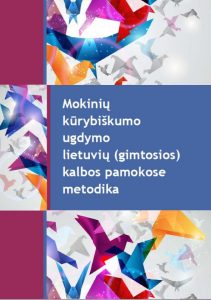
Methodology for Developing Students’ Creativity in Lithuanian (Native) Language Lessons (2013)
The methodology for developing creativity is common to all grades and covers all possible means of expression in primary, middle, and secondary schools. It is a tool for the successful application of creativity education strategies and methods in reading, writing, discussing, storytelling, and improvisation in Lithuanian language and literature lessons. The structure and objectives of the methodology are in line with the goals of active teaching (and learning), it presents the factors that determine creativity, analyzes and evaluates creative processes, reveals stereotypes about creativity that prevent both students and teachers from being more insightful, flexible, and courageous, and provides a number of valuable tips.
Download LT
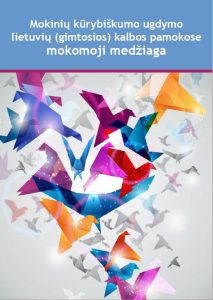
Teaching Material for Developing Students’ Creativity in Lithuanian (Native) Language Lessons (2013)
The teaching material is designed to foster creativity in students during Lithuanian language and literature lessons. The material is prepared in such a way that it is convenient to print out one or more pages and prepare teaching material for students. With this and the methodological materials, teachers will be able to explain to students the purpose of the tasks and the expected results. The authors of these materials have deliberately not assigned the tasks to a specific class or age group. Many of the tasks described here can be adapted to different classes – if not exactly as described, then at least by adapting certain aspects (for example, by choosing a different text or working methods). The authors of the resource view the development of students’ creativity in the context of the challenges facing modern schools, so they have made an effort to ensure that the selected material provokes students’ thinking, encourages motivation, develops creative abilities, and emphasizes the importance of non-stereotypical, original thinking and activity.
Download LT
Creation and Creativity, 2013
An Enviroment Promoting Creativity, 2013
Creative writing workshop, 2013
Reading with intention and creation of stories, 2013
Evaluation of creative works, 2013
PROJECT RESULTS
The study on the state of creativity education became the basis for an original creative education methodology for Lithuanian language lessons. The methodology covers various areas of expression and provides teaching materials that can be used at all levels of education. It was tested during seminars and lessons in schools participating in the project and, at the end of the project, was presented to the educational community in 10 Lithuanian municipalities. The creativity education methodology will continue to be implemented in the schools that participated in the project. It is hoped that the research and methodology tools developed will serve as a model for the analysis, implementation, and development of creativity education in other educational programs/