

Project No. 10.1.2-ESFA-K-917-02-0021
Project duration: 20 February 2018–15 May 2020
Funded by the European Social Fund and the budget of the Republic of Lithuania
Project coordinator: Jaunimo karjeros centras
Project partners:
Modern Didactics Centre
Vytautas Magnum University
Kaišiadorys St. Faustina School
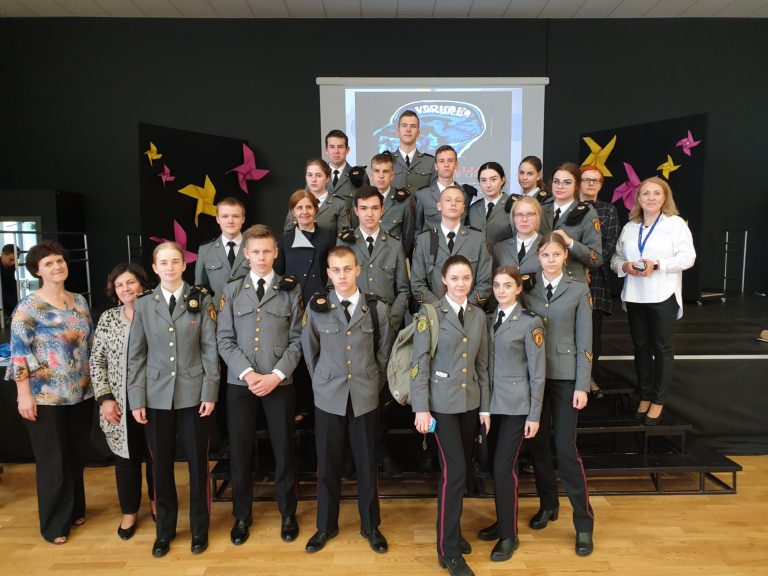
Trainings at General P. Plechavičius Cadet Lyceum
PROJECT RELEVANCE
Data from the 2015 European Social Survey shows that more than 90% of Lithuanian youth (aged 14–20) are completely uninterested in politics, placing the country among the lowest in Europe for this indicator. A survey conducted by Flash Eurobarometer revealed that only 49% of Lithuanians participated in political elections over the past three years, representing one of the lowest rates in the EU. According to the Interinstitutional Action Plan for Civic and National Education (2016–2020), “the perception of civic influence in Lithuanian society changes little (or only temporarily)—the influence of ordinary citizens on decision-making is rated very poorly, there is little interest in politics, and the readiness to act is extremely weak.” It confirms that Lithuanians show the least interest in politics, have the lowest voter turnout, and are the least satisfied with the functioning of democracy compared to all other European countries.
These studies note that while Lithuanian youth believe more than other age groups in their power to influence political decisions and are ready to participate more actively in social activities, they are distinguished in the European context by a lower interest in public affairs. Furthermore, Lithuania has the highest percentage of youth in Europe citing the conviction that “their vote will not change anything” as a reason for not voting. A 2016 European Parliament study showed that most Lithuanian youth believe the best ways to participate effectively in public life are individual aid to the poor and voting in EU elections. This indicates that while most young people are not active in political elections, they do perceive their importance. Additionally, in a 2017 TAMO survey of 1,243 students in grades 9–12, 82% answered “yes” to the question “Are you thinking about emigration?” The majority (31.9%) indicated they want to leave Lithuania permanently, while 29.7% of respondents do not see future opportunities in Lithuania.
This suggests that youth lack confidence in their ability to influence positive change in their country, highlighting a deficit in active citizenship attitudes.
In 2011, a youth integrity survey commissioned by Transparency International Lithuania—the first of its kind in the country—showed that youth most often associate corruption as a crime only with bribes, while the majority justify the abuse of office, withholding the truth, or using personal connections. According to this study, young people identify education as one of the most effective tools for fostering integrity. Therefore, this project aims to utilize innovative, high-quality educational methods and tools to develop the necessary skills to promote active citizenship, engagement in state governance processes, and intolerance toward corruption.
PROJECT AIM
To increase the intolerance of youth in five Lithuanian municipalities towards manifestations of corruption in the sectors of political activity, legislation, and public management through the active development of young people’s citizenship, awareness, and engagement in public governance processes.
PROJECT OBJECTIVES
- To investigate youth attitudes and existing knowledge regarding active citizenship and corruption in political elections and public management.
- To promote active citizenship, awareness, intolerance towards corruption, and engagement in public governance processes among young people.
- To encourage youth volunteering as a means of mobilizing and selflessly addressing various community issues.
PROJECT TARGET GROUPS
- Youth (aged 18–25). Young individuals who have just reached adulthood are already expected to express their civic stance. However, due to poor preparation for this step, as well as ambiguous and often unfounded information in the media, they frequently lack the criteria to form an informed opinion. Consequently, they are highly vulnerable during political elections; especially in the periphery, youth decisions are influenced by potential manifestations of corruption (bribery, vote buying or tampering, accepting inappropriate gifts, entertainment, or outings, and the presentation of declarative but unfeasible political party strategies, promises of legislative changes, etc.). Changing the knowledge and attitudes of this target group regarding corruption is essential, as our future belongs to them.
- Youth from socially vulnerable groups. The civic education of these young people has been inconsistent due to their withdrawal from formal education. Most of these individuals distrust government institutions and therefore do not utilize opportunities for socialization and civic participation. Their values are often based on the pursuit of personal gain; manifestations of corruption go unnoticed due to a lack of information or are justified by an existing distrust of the public sector.
- Indirect target group: youth workers, teachers, psychologists, and social workers.
The project is being implemented in the municipalities of Kaunas, Vilnius, Raseiniai, Šiauliai, and Kaišiadorys.
These municipalities were selected for the project to balance the resolution of problematic areas with existing successful experience and a broad network of partners. Vilnius, Šiauliai, and Kaišiadorys were included due to the need to increase youth activity in specific groups with low electoral or civic engagement, and to work with national minorities and youth with special needs. Raseiniai district was chosen to reduce isolation in remote areas, while Kaunas serves as an example of best practice, where high civic activity will facilitate the exchange of experience between different regions.
PROJECT ACTIVITIES
During this project, youth and the professionals working with them—including teachers, psychologists, and social workers—had the opportunity to actively engage in activities related to civic participation, intolerance towards corruption, and cooperation with government representatives.
In 2018, a study on youth knowledge and attitudes toward active citizenship and corruption was conducted. Using surveys, interviews, and focus group methods, over 500 youth representatives were interviewed to identify key problematic areas.
Based on the research data, a program was developed to organize five 4-day practical workshops on active citizenship and anti-corruption in the participating municipalities of Kaunas, Vilnius, Raseiniai, Šiauliai, and Kaišiadorys. Additionally, regional Active Citizenship Forums were held in the five participating municipalities, along with a national Forum dedicated to discussing the contribution of this project and other measures in shifting youth attitudes toward corruption and shaping the concept of a responsible citizen among young people. These regional forums, held in youth centers and schools and led by experienced moderators, brought together youth representatives, political science students, local government officials, and representatives of youth political wings. During the forums, participants had the opportunity to discuss pressing issues in their regions related to political elections, active citizenship, and opportunities for youth to become more actively involved in public governance processes.
PROJECT INTELLECTUAL OUTPUTS
Study on Youth Knowledge and Attitudes Toward Active Citizenship (2018)
The primary goal of the study was to assess the attitudes of youth aged 15–29 toward corruption and their readiness to actively participate in anti-corruption activities across five selected Lithuanian municipalities. The study sought not only to determine the current level of tolerance for corruption but also to identify which areas of public life youth consider the most corrupt, their level of trust in local government institutions, and the barriers preventing youth from engaging in transparency-building initiatives within their communities.
A total of 518 respondents were surveyed in the municipalities of Anykščiai, Druskininkai, Jonava, Šalčininkai, and Tauragė.
The study revealed that although the majority of young people view corruption negatively, their practical understanding of the phenomenon and their ability to recognize it in everyday situations remain limited. The results show a significant gap between declared values and real actions: a considerable portion of respondents still tolerate petty corruption or do not know how to act when encountering it. It was determined that the main reasons for passivity are a lack of trust in government institutions, fear of consequences, and the belief that individual citizens cannot change the system. A comparison of the municipalities showed that in areas with more active civic education, youth intolerance toward corruption is higher, and the connection with local authorities is stronger.
The final conclusions emphasize that the most effective tool for changing this situation is not dry theoretical teaching, but the practical involvement of young people in public governance monitoring and simulation processes. The study justifies the need for consistent development of critical thinking, which would enable youth to become active transparency controllers in their communities.
Download LT
Anti-corruption Education and Civic Awareness Program: Guidelines for Non-formal Youth Education Activities (2018)
PROJECT RESULTS
- Factors shaping civic attitudes were strengthened, and the active social participation of nearly 1,500 youth representatives from schools in the Kaunas, Vilnius, Raseiniai, Šiauliai, and Kaišiadorys municipalities was encouraged in the political life and governance of the state.
- Throughout the project, interest in the activities of national government and legislative institutions, as well as political parties, was fostered using innovative and engaging methods tailored to young people.
- Young people were introduced to potential manifestations of corruption in political elections, such as votes collected through illegal means, unlawful lobbying, document forgery, vote-buying, and non-transparent or hidden political advertising.
- Participants were encouraged to react correctly and effectively to prevent corruption, emphasizing the contribution and importance of the younger generation in participating in public governance processes and contributing to social well-being.
- The project activities contributed to reducing the prevalence of corruption in the political activity and legislative sectors as outlined in the National Anti-Corruption Program for 2015–2025. This was achieved by expanding and increasing young people’s perception of corruption, which directly contributes to the program’s goal of increasing Lithuania’s Corruption Perceptions Index and reducing the likelihood of bribery among youth.