European Lessons

Project No. K2015-VB-BY-051
Project duration: 29 June 2015–25 November 2016
Project financed by the Ministry of Foreign Affairs of the Republic of Lithuania under the Development cooperation and democracy promotion programme
Project coordinator: Modern Didactics Centre
Project partners:
Association “School-Family-Society” (Georgia)
Educational centre “Pro Didactica” (Moldova)
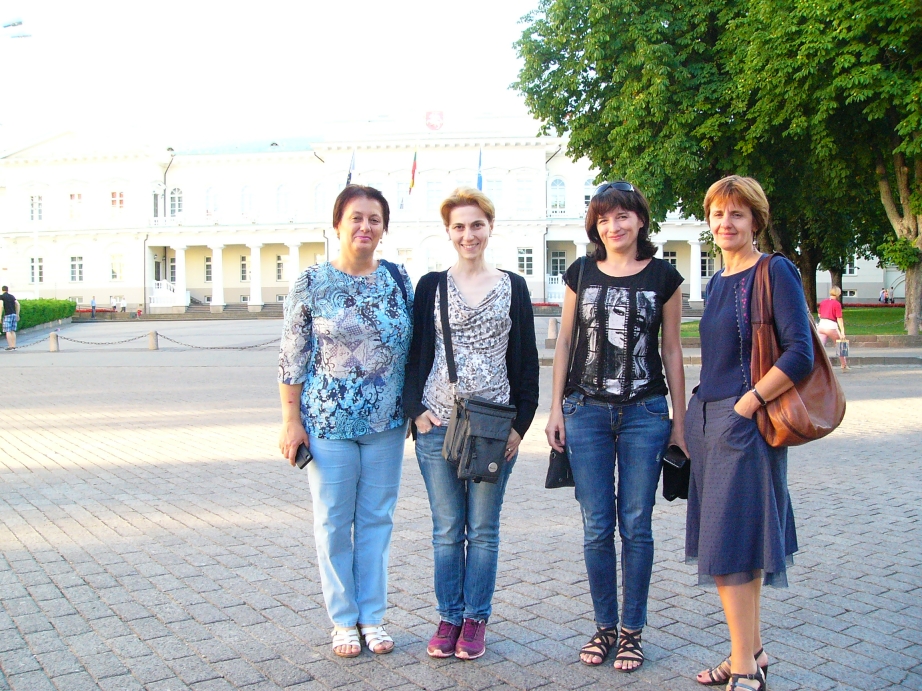
Project team
PROJECT RELEVANCE
Georgia and the Republic of Moldova are countries seeking EU membership (having initialed Association and Free Trade Agreements with the EU in 2013) and are active partners in the foreign policy of the Republic of Lithuania.
European integration processes in the Republic of Moldova span various areas of public life, including education. With the adoption of a new Law on Education (2014) and the Education Strategy 2014–2020, general and higher education curricula are being reviewed, textbooks are being updated, and new tools are being developed. Non-governmental organizations are also actively participating in these reform efforts. The project partner, NGO “Pro Didactica,” developed a 34-hour elective program for schools titled “Education for EU Integration” in 2008–2009, which was approved by the Ministry of Education in 2010. It was adopted by over 100 general education schools across various regions. However, a need has arisen to update the program by including new relevant topics (e.g., the Association Agreement), with a particular focus on transparent governance and corruption prevention. Furthermore, there is a need to train both current and new teachers. Currently, significant emphasis is placed on non-formal youth education; therefore, a program is required for use by various youth organizations to spread the ideas and values of democratic life among their members and to cultivate future leaders. As the provisions and principles of new educational documents require existing programs to be aligned with EU requirements, this project is both timely and highly necessary for Moldova.
Although European integration processes in Georgia are currently less prominent than in Moldova, Georgia began restructuring its education system much earlier, involving broad sectors of society and various organizations in the reform process. The Education Development Center (ŠDC) has been collaborating with the “School-Family-Society” association for ten years, jointly implementing projects on parent education, representation, and anti-corruption education. While Georgia does not yet have a school curriculum focused on European integration processes, there is both a demand and an opportunity to implement such programs within the formal and non-formal education systems, given the association’s long-standing cooperation with the Ministry of Education and other educational institutions. Similar to “Pro Didactica,” the association maintains an extensive network of partner schools where the products developed during the project will be tested.
Throughout the project, best practices are exchanged: Moldovan colleagues share their experience in implementing the “Education for EU Integration” program, while their Georgian counterparts share expertise in implementing anti-corruption education initiatives.
PROJECT AIM
Strengthening of civil society institutions for inducing their more active involvement in the Eastern Partnership policy-making and implementation and for dissemination of the information about European integration benefits.
PROJECT OBJECTIVES
- To renew and create optional educational program “Education for European Integration” for secondary schoos of Moldova and Georgia for development of European values and knowledge about euro-integration processes.
- To develop non-formal education program „European Lessons“ and supplementary materials for youth organizations in Georgia and Moldova.
- To develope in-service program for teachers working with the program “Education for European Integration”.
PROJECT TARGET GROUPS
- Secondary school pupils (16–18 years old). This group was chosen because at that age students are actively interested in the world, other cultures, are able to explain and understand some of political, social and economic issues.
- Young people (18–29 years old), representing a variety of formal and informal youth organizations. They have been chosen due to the availability to embrace active and civic-minded young people, which aim to educate members of their organization as well as to improve themselves strengthening their organizations.
- Subject teachers and class teachers, educated to work with created programs and materials while working with the students.
PROJECT ACTIVITIES
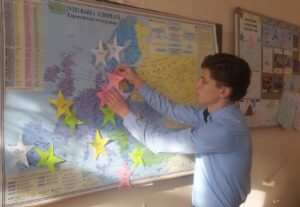
The project targets secondary school pupils and young people by encouraging them to know more about EU values, history, politics; helping to understand and recognize value of democratic countries community for each separate country. Project aim will be reached by following measures: developed and tested optional program “The Education for European Integration” for secondary schools of Moldova and Georgia; developed and tested program and supplementary materials for youth organizations; developed in-service training program for teachers implementing “The Education for European Integration” optional program.
Optional program “Education for European Integration” for secondary schools
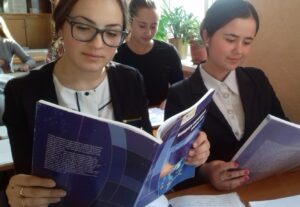
During September–October 2015 Georgian experts developed the optional 24 hours program “Education for European Integration” for secondary schools. The program covers such themes as European Union, EU system of common European bodies and institutions, and their meaning/destination/purpose, EU development policy; Georgia and the EU. During October 2015 topic “European Union” was tested in three schools: public school of Tbilisi No. 5, public school of Tbilisi No. 130 and private school “Eruditi”. 28 students of upper grades participated in pilot lessons.
Teachers have filled program pilot reports, where indicated positive aspects also obstacles, weaknesses of the program/topic and presented recommendations for improvement. Teachers noted high expectations and interest of the students. During lessons students were high involved, they independently developed the text, categorized information, raised questions, and expressed their thoughts and emotions. Students were excited and ready to attend more lessons.
The main obstacle – lack of time. Topics are broad, requiring discussions, reflections, therefore it would be better to provide double lesson. Other weaknesses teachers addressed to their own preparation for the lesson.
To understand the sense of European Union, teachers recommending to include the program “Education for European Integration” into national curricular. Teachers also think it would make sense to start lessons in lower grades and make this subject not optional but compulsory.
During September–October 2015 experts of Moldova renewed the existing 34 hours program “European Integration for you”. This program was developed during 2008-2009 and approved by the Ministry of Education in 2010. Renewed topics cover such themes as Europe, European civilization, idea of European unity; establishment of the European Union; EU institutions; free movement in Europe; single European currency – fundamental element of economic cohesion of the EU; school and education in the EU; young people in the EU; Moldova before and after the signing of the Agreement for European Association; new export markets for Moldovan products; EU and the challenges of contemporary world; EU and Arab migration crisis; what future for Europe?
During September–December 2015 the program was piloted in theoretical lyceum ,,Emil Nicula” Mereni, high school TEORETIC Rćspopeni, theoretical lyceum „Mihai Eminescu” or. Hînceşti. There were piloted topics “Europe and European Civilization”, “Unity in Diversity of Europe”, “Republic of Moldova and the Council of Europe”, “Council of Europe – ,,the Biggest” European Organization”. 58 students of upper grades participated in pilot lessons.
Teachers have filled program pilot reports, where indicated positive aspects also obstacles, weaknesses of the program/topic and presented recommendations for improvement. Evaluating the program teachers noticed that topics are with broad aspects of approach, not politicized, actual and interesting for pupils. During the lessons all pupils were involved in various activities, having freedom to express their opinion – that increased their motivation on learning process. Pupils possess discipline’s specific language and operate with it easily and appropriately. The informational support was visually diverse and theoretically accessible. The information’s structuring in diagrams or tables allowed pupils to access information in more easy way. The educational framework benefited to the qualitative empathetic teacher-pupils relationship.
Teachers in Moldova also faced a lack of time – it was stated that lessons need more time because of the broad themes, a large volume of information. Teachers do not always manage properly time for lesson – seeking to discuss one topic were lack of time to another. For some tasks there was given too much time, some tasks did not involved all students, sometimes too much factual information was presented. The political aspect involved students were less until not been challenged in a discussion.
Teachers pointed out, that the program is actual and believe it is necessary to follow and realize as much as possible tasks / activities / techniques proposed in the handbook. It was suggested to establish working techniques that would allow flexibility and adaptation to the pupils needs; to encourage pupils to express personal opinions as well as to identify situations where they might apply the accumulated knowledge; to review some texts, sources, suggested documents from the manual; too include more images, tables, charts for better students understanding. Teachers are looking for recommendations for various techniques to guide learning in which the teacher would be able to select and less to initiate one. For teachers it might be necessary to create a website for exchanging experience and improving educational process.
Optional program “European Integration for you” is implemented in more that 60 secondary schools and about 1500 pupils completing the course each year (according 2015 data). The renewed program and teaching materials are available on Educational Centre “Pro Didactica” website.
Integrated programme RO
Training meterials RO
In-service training program for teachers
During January–June 2016 Moldova and Georgia experts, leading by recommendations of Modern Didactics Centre, developed in-service training program for social sciences teachers, preparing them to implement “The Education for European Integration” optional program and to use training materials in their classes. Trained teachers also will be able to plan integrated lessons and to integrate program topics into their subject lessons.
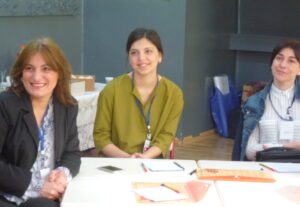
In Moldova teachers in-service program was tested on 27–28 April, 2016. 16 teachers from different secondary schools attended 2-days workshop. There were introduced the renewed optional program for secondary schools “European Integration for you” and demonstrated concrete examples of teaching of European integration, approaching the topic by modern techniques involving motivation, suspense and interest. Teachers noticed, that teaching materials provided during the seminar will be helpful not only for the optional subject “European Integration for you”, but also for other subjects such as: Civic Education, Human Rights Education, History etc. Topics selected for the program are current and interesting, the support materials are relevant and useful. Participants have an opportunity to share experiences and practices with colleagues from other institutions and they acquired not only of knowledge and experience, but also a strong motivation to share the gained knowledge to students.
The teachers in-service training course is included in Educational Centre PRO DIDACTICA list of topics of professional development program and teachers/schools can choose it.
In Georgia teachers in-service program was tested on 7–8 May, 2016. 17 teachers from 8 different secondary schools attended 2-days workshop. There were presented model lessons using different critical thinking strategies. Policy and values of European Union and its reflection in the social sciences standards as well as connection between thematic units of “Education for European Integration” and the outcomes of state subject standards were analysed. Teachers also were taught to plan integrated lessons.
Participants noticed that the program for secondary schools is informative, interesting and very necessary; training environment was very positive, training materials and methods that were introduced were very considerable and important.
Non-formal education program “European Lessons” and supplementary materials for youth organizations
During June-November 2016 project experts in Moldova and Georgia are working under development of non-formal education program and teaching materials of European integration for youth organizations.
PROJECT RESULTS
Following the successful implementation of the project, a new curriculum was developed in Georgia and an existing one was updated in Moldova, both dedicated to fostering European values and deepening the understanding of European integration processes.
This program was pilot-tested in general education schools and teacher training events in both countries, ensuring the methodological material’s relevance and direct applicability in the classroom. Furthermore, a non-formal education program designed for youth organizations helped strengthen civic engagement and critical thinking, encouraging young people to engage more confidently in discussions about democratic processes.
Key outcomes of the project include:
- Expert collaboration: The close cooperation established between educational experts from Lithuania, Georgia, and Moldova laid the foundation for long-term knowledge sharing and future joint educational initiatives.
- Teacher empowerment: The professional development program enabled teachers to more effectively integrate European Union themes into various subjects, providing students with a comprehensive understanding of the benefits of EU membership.
- Strategic impact: These results have significantly contributed to strengthening civil society and supporting the European trajectory in the partner countries.
PROJECT MOMENTS