
Project duration: 1 February 2002–30 May 2003
Project funder: Baltic American Partnership Programme
Project coordinator: Youth Career Advising Centre
Project partners:
Ateitininkai Federation
Lithuanian Club of Initiative Schools
Non-formal Education Debate Centre
Children Support Centre
Modern Didactics Centre
School Development Centre
Skuodas District Municipal Association of Parents of Children and Students
Education Change Foundation
Education Innovation Centre
Vilnius Pedagogical University
Vytautas Magnus University
Project consultants:
Wessex Partnerships Ltd (Jungtinė Karalystė) – a consulting organization working in the field of economic development.
The Scotish Further Education Unit, SFEU – an organization providing assistance to continuing education institutions in the field of curriculum and training development
William Robert SEARY, independant NGO expert
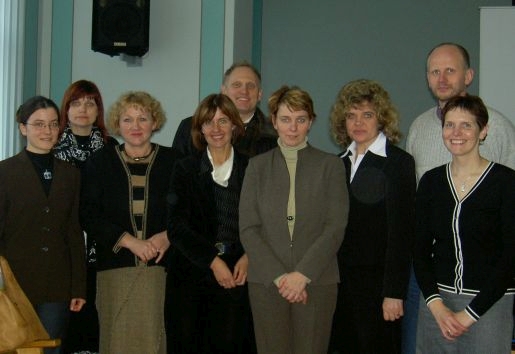
Founders of the Coalition “Jungtys”
PROJECT RELEVANCE
For a decade, a rapid education reform has been underway in Lithuania, affecting every family raising children in one way or another. It is no secret that the reform is being implemented ‘top-down,’ with insufficient consideration for the views and interests of key stakeholder groups such as children, parents, teachers, and school leaders. Furthermore, the absence of a clear long-term education strategy means that many individual educational innovations remain misunderstood by the public and cause anxiety about the future. The core problem is the lack of civilized mechanisms and methods for interest representation in Lithuanian education; consequently, decisions made at state and municipal levels often spark dissatisfaction within the educational community. Groups representing diverse educational interests lack the necessary cooperation skills to express these interests collectively, while government structures also lack experience in working with such groups.
A coalition of young non-governmental educational organizations has formed to influence the course of the education reform in Lithuania through various means. The initiators of this project – NGOs established by the Open Society Fund Lithuania between 1999 and 2000 – represent the interests of pupils, students, educators, and the broader educational community by implementing modern educational ideas. These NGOs aim to deepen their expertise and skills in interest representation within the field of education. During the project, they will analyze, develop proposals, and present a key issue: the transformation of curriculum content within the process of social integration. This initiative aims to exert a concrete influence on education policy regarding youth social integration at both regional and national levels.
PROJECT AIMS
- To strengthen the role of NGOs in shaping education policy and decision-making at national and regional levels.
- To create opportunities for representatives of educational NGOs to acquire new skills by participating in a training program on interest representation in education and methods through which the public can influence education policy.
- To facilitate the establishment of active regional groups to advocate for the interests of parents, pupils, students, educators, and various educational institutions in developing regional education policy drafts and preparing education budgets.
- To develop long-term mechanisms for NGO interest representation in education and a system for influencing education policy.
- To empower educational communities to express their interests and ensure they are taken into account during key decision-making processes and the implementation of education reform in Lithuania.
PROJECT PARTICIPANS
Zina BALTRĖNIENĖ, director of the Youth Career Advising Centre
Jūratė MURINIENĖ, consultant of the Youth Career Advising Centre
Vaclovas LABYS, president of the Skuodas District Municipal Association of Parents of Children and Students
Eglė PRANCKŪNIENĖ, director of the School Development Centre
Daiva PENKAUSKIENĖ, director of the Modern Didactics Centre
Regina SABALIAUSKIENĖ, director of the Education Innovation Centre
Virginija PAKŠIENĖ, director of the Non-formal Education Debates Centre
PROJECT ACTIVITIES
Phase I
- Discussion of the focal issue: Curriculum transformation within the process of social integration;
- Organization of a 3-day training seminar for NGO representatives with the involvement of international consultants.
Phase II
- Situation analysis of national and regional education policies regarding youth social integration;
- Review of the situation and discussions within working groups, and the development of strategic outlines for specific proposals.
Phase III
- Consultations between project developers and both international and Lithuanian experts;
- Review and detailing of the project proposal.
Phase IV
- Internships/Study visits for NGO representatives at partner organizations; experience sharing;
- Synthesis and presentation of the gained experience to all coalition partners.
Phase V
- Preparation of a joint coalition project;
- Discussion and public presentation of the project to the educational community, the general public, education strategists, and policymakers;
- Dissemination of project ideas;
- Summary of mechanisms for influencing education policy, discussion of a pilot model for influencing public policy, and system development.
PROJECT RESULTS
- The most significant outcome of the project is the establishment of the NGO Coalition “Jungtys”/Connections (since 2004 – Association “Naujos Jungtys”/New Connections, since 2010 reoganized into Association LITDEA).
- NGO representatives who have participated in the training program and gained experience in advocacy will be prepared to disseminate their expertise to other NGOs and informal interest groups.
- Educational NGOs will become active partners in the formation of education policy.
- An interest representation mechanism will be established, and a system for influencing public policy will be implemented.