




Projecto No. 502374-LLP-1-2009-1-RO-GRUNDTVIG-GMP
Project duration: 2009–2011
Project co-funder: European Commision Grundtvig programme
Project coordinator: Reading and Writing for Critical Thinking International Consortium (Rumania)
Project partners:
Šiuolaikinių didaktikų centras (Lithuania)
Berufsforderungsinstitut Steiermark (Austria)
Iberika Sprachschule (Germany)
Thüringer Volkshochschulverband e.V. (Germany)
Instituto de Formacion Integral S.L.U. (Spain)
Centro Studi et Initiative Europeo (Italy)
Education Development Center (Latvia)
Orava Association for Democratic Education (Slovakia)
Non-formal partner:
ARIADNE Hess (Switzerland)
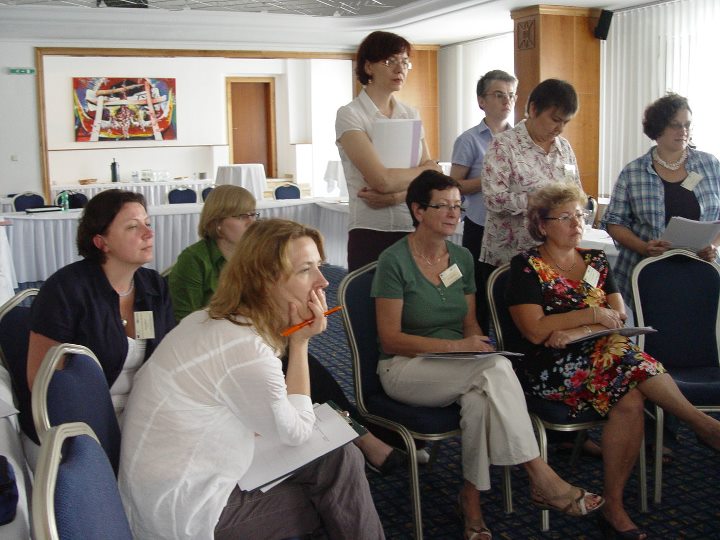
Project trainings in Bratislava
PROJECT RELEVANCE
In the 21st century, individuals should be able to cope with constant changes. Our rapidly changing world causes a large share of its population to be forced into new and challenging working environments, which call for new skills and attitudes. In many European countries, teaching has been geared towards preparing individuals to become lifelong learners by helping them develop learning skills as early as in primary school. Some EU member states’ educational systems are more advanced in implementing an engaging style of teaching and in supporting the development of learning skills, including in the case of adult education, while other systems lag far behind. The proponents of the present project, a wide partnership of Eastern, Central and Western European adult education organizations, aim to identify key factors related to motivating participation and persistence in LLL processes of a wide range of adult learners.
We plan to carry out a survey of adult educators and learners, and collect a set of best practices in adult education to widely share with adult educators. Building on the existing good practices, we will develop innovative approaches to teaching adults, relying on a constructivist framework for learning, and pilot them in our countries; a guidebook including the innovative approaches will be published, and a Grundtvig training course will be developed.
In sum, educators will be provided with creative and critical thinking strategies to use in a variety of adult learning contexts; learning will be made more accessible for adults, and their motivation for lifelong learning will be enhanced. The workshops will provide adult educators direct experience of the innovative practices. We expect to make an important contribution to the more successful learning of European adults, and to the overall improvement of their learning skills. The collection of best practices and the guidebook sharing innovative teaching strategies will be produced in five languages.
PROJEKTO TIKSLAI
- Contribute to the development of high-quality lifelong education.
- Develop innovative strategies for the professional development of adult educators, with the aim of strengthening adults’ motivation to learn and their active participation in the lifelong learning process.
- Promote self-actualization, competitiveness, employment, and entrepreneurship through innovative teaching strategies.
- To foster closer and more effective cooperation among organizations active in the field of adult education.
- To promote the inclusion of low-motivated individuals and those from socially vulnerable groups in the lifelong learning process..
PROJECT OBJECTIVES
- To motivate adults’ participation and persistence in LLL processes.
- To compile a set of creative and critical thinking strategies to be used by adult educators to more successfully motivate adults to participate in LLL processes.
- To improve teaching competences of adult-teachers/tutors.
- To improve the content and delivery of adult education.
- To improve the accessibility of learning opportunities for adults.
- To enhance the adults’ motivation for lifelong learning.
- To provide trainers/ tutors the opportunity to share experiences and practices from the participating countries.
- to work together with European colleagues to improve participation in Lifelong learning.
PROJECT TARGET GROUPS
Adult educators from 9 EU countries (Romania, Lithuania, Latvia, Austria, Germany, Italy, Spain, Slovakia, Switzerland).
PROJECT INTELLECTUAL OUTPUTS
Best Practices of Training Methodologies and Learning Techniques in Adult Education. Survey Report
The project partners shared their accumulated experience working with various groups of adults, examined adult education practices, and analyzed best practices in adult education from European Union countries. A survey of adult education providers and learners in the project countries was conducted to collect best practices in adult education related to teaching methodologies and learning strategies. Twenty examples of good practice were selected and presented in a separate publication; the selection methodology was discussed, and a comparison of the examples of good practice was provided.
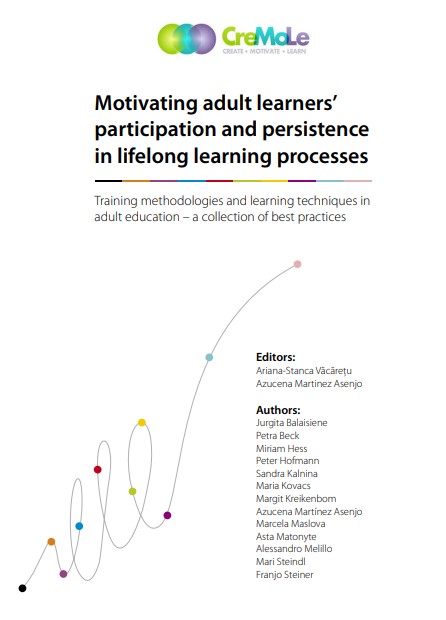
Motivating Adult Learners’ Participation and Persistence in Lifelong Learning Processes. Training Methodologies and Learning Techniques in Adult Education – a Collection of Best Practices (2010).
The best practice examples presented in this publication are based on the experience of the project partners and a systematic review of nine European countries: Austria, Germany, Italy, Latvia, Lithuania, Romania, Slovakia, Spain, and Switzerland. Project partners from these countries examined various adult education programs and courses developed and organized by different adult education providers for various adult groups. Forty examples of training programs were reviewed, analyzed, and evaluated. From these, 16 of the most innovative and motivating programs were selected, suitable for adaptation in other countries. This publication is intended for adult education providers, adult educators, and instructors seeking to motivate learners in the lifelong learning process.
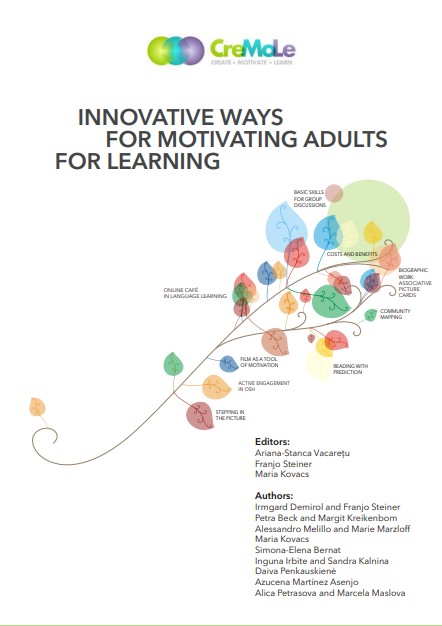
Innovative Ways for Motivating Adults for Learning. Guidebook (2011)
The guide consists of two parts. The first, introductory part describes the project itself and its partnership, and provides basic information about the project. The second part provides a definition of “innovative strategies”—as understood by the project partners and the guide’s authors—and offers a systematic and detailed description of the innovative strategies that, in the project partners’ view, foster adult motivation to learn; it includes key information, specific examples, feedback received from training participants, and recommendations for those wishing to apply or adapt specific strategies. The appendices contain additional references and resources (texts, questions, etc.). The methods, strategies, and activities described here can be used in both formal and non-formal education settings. Some strategies may be adapted for use with children, adolescents, school teachers, or parents. The guide offers tried-and-true ideas designed to motivate learning. The guide may also be useful for organizations that develop vocational training programs and activities for adult educators seeking to improve and enhance the quality of their services.
PROJECT RESULTS
- A collection of best learning practices and a guide presenting innovative teaching strategies were developed.
- A Grundtvig training course was developed.
- Experiences were shared using creative and critical thinking strategies and by motivating adults to participate in the lifelong learning process.
- It is expected that this project has contributed to more successful adult learning in Europe. The proposed strategies for fostering creative and critical thinking can be applied in various adult learning contexts, situations, geographical areas, and cultures.
PROJECT DISSEMINATION

Funded by the European Union. Views and opinions expressed are however those of the author(s) only and do not necessarily reflect those of the European Union or the National Agency. Neither the European Union nor National Agency can be held responsible for them.