



Project duration: 2000–2001
Project funded by Open Society Fund-Lithuania
Project coordinator: Šiuolaikinių didaktikų centras
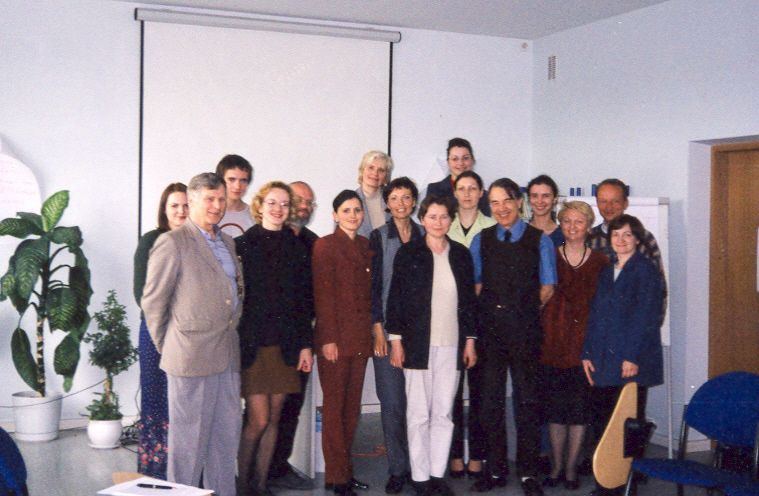
Project participants with prof. T. Kozma
PROJECT RELEVANCE
In today’s professional field, a creative methodology that integrates artistic and philosophical concepts to enhance problem-solving and communication is highly relevant:
- The job market demands professionals with innovative problem-solving skills.
- Trainers in the arts, philosophy and communication need structured Visual Thinking resources.
- The project provides new methodologies for effective and engaging education.
PROJECT AIM
To improve the quality of teaching at the universities, organizing dissemination of modern teaching methods, encouraging doctoral students and beginners lecturers to share information and experience of working with students.
PROJECT OBJECTIVES
- To help doctoral students and beginners lecturers to prepare for work with the students.
- To come to agreement with the administrations of the organizations of the participants on introducing the “University Didactic” course as an obligatory course for doctoral students.
- To help project participants to collect methodical materials and prepare notes for the lesson “Introduction into University Didactic”.
PROJEKTO DALYVIAI
70 representatives of Lithuania universities took part in the project.
Doctoral students and lecturers from these universities participated in the project:
Vilnius University
Vilnius Pedagogical University
Vilnius Gediminas Technical University
Vilnius college
Kaunas Vytautas Magnum University
Lithuanian Music Academy
Siauliai University
Klaipeda University
Lithuanian University of Law
Lithuanian Military Academy.
PROJECT ACTIVITIES
11 January 2001
Lecture “Theories, Research and Practice of Education” / Lecturer – Prof. David Bridges (East Anglia University, UK).
12 January 2001
Presentation of the publication “University Didactic” and discussions with the authors / Moderator – Nijole Lomaniene (Vilnius University, Lithuania).
26 February–1 March 2001
Seminar “Problem Based Learning” / lecturer – Prof. Tamas Kozma (Debrecen University, Hungary).
30 April–3 May 2001
Seminar “Researching and Monitoring Student satisfaction” / Lecturer – Prof. Tamas Kozma (Debrecen University, Hungary).
9–12 June 2001
Seminar “High Education as Adult Learning” / Lecturer – Prof. Tamas Kozma (Debrecen University, Hungary).
10–11 October 2001
Seminar “Active Learning Methods at University” / lecturers: Daiva Penkauskiene, dr. Valdone Indrasiene (Modern Didactic Center, Lithuania)
10–11 December 2001
Seminar “Evaluation Portfolio and Evaluation Criteria: Tool of Self Assessment and Evaluation” / Lecturer – Katerina Kubesova (Charles University, Czech Republic).
PROJECT RESULTS
The project has been modified in the process of implementation taking into account needs and expectations of the participants, so just part of the objectives had been achieved.
While forming the group of the participants, representatives delegated by the universities had been invited and they committed to keep contacts with the administration of their institutions in the process of preparing the “University didactic” course. However, the delegated people either did not participate at all, or they participated only in solitary seminars, so communication with administration of the universities was not successful.
The most active participants were those who learned about the project from their colleagues and expressed their willingness to participate. The main need of the participants was not representing their institutions, not preparing the course for their universities, but new knowledge and skills, i.e. their own professional development. The participants of the seminars not only made their notes, but they also received written in shorthand materials and directions of the sources which might help prepare plan of the introductory course.
Since the motivation of the participants has changed, the project had no direct influence on the universities. That’s why it is not clear if administration of the universities will be willing to include the course into curriculum, despite of the fact that a few of them (Lithuanian Academy of Law, Klaipeda University, Siauliai University) confirmed their intentions in written form.
The organizers of the project consider the project to be a success, because it met the needs of the participants and showed that seminars of such mind are necessary for the lecturers of the universities. Modern Didactics Center managed to unite doctoral students and lecturers of the universities interested in the problems of university didactic and are open for further communication and cooperation.